


Page 893 - Textbook of Pathology, 6th Edition
P. 893
ENCEPHALITIS                                                                                             877
           Parenchymal infection of brain is termed encephalitis.
           Encephalitis may be the result of bacterial, viral, fungal and
           protozoal infections.

           Bacterial Encephalitis

           Bacterial infection of the brain substance is usually secondary
           to involvement of the meninges rather than a primary
           bacterial parenchymal infection. This results in bacterial
           cerebritis that progresses to form  brain abscess. However,
           tuberculosis and neurosyphilis are the two primary bacterial
           involvements of the brain parenchyma.
           BRAIN ABSCESS. Brain abscesses may arise by one of the
           following routes:
           1. By direct implantation of organisms e.g. following
           compound fractures of the skull.
           2. By local extension of infection e.g. chronic suppurative
           otitis media, mastoiditis and sinusitis.
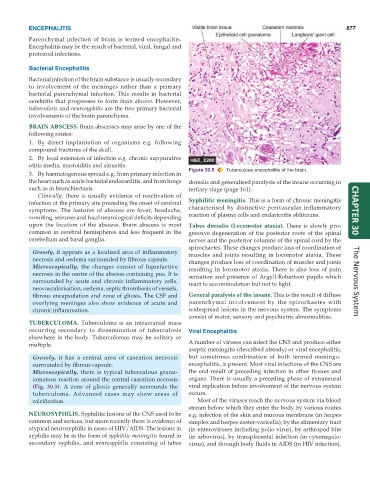
                                                               Figure 30.5  Tuberculous encephalitis of the brain.
           3. By haematogenous spread e.g. from primary infection in
           the heart such as acute bacterial endocarditis, and from lungs  dorsalis and generalised paralysis of the insane occurring in
           such as in bronchiectasis.                          tertiary stage (page 161).
              Clinically, there is usually evidence of reactivation of
           infection at the primary site preceding the onset of cerebral  Syphilitic meningitis. This is a form of chronic meningitis
           symptoms. The features of abscess are fever, headache,  characterised by distinctive perivascular inflammatory  CHAPTER 30
           vomiting, seizures and focal neurological deficits depending  reaction of plasma cells and endarteritis obliterans.
           upon the location of the abscess. Brain abscess is most  Tabes dorsalis (Locomotor ataxia).  There is slowly pro-
           common in cerebral hemispheres and less frequent in the  gressive degeneration of the posterior roots of the spinal
           cerebellum and basal ganglia.                       nerves and the posterior columns of the spinal cord by the
                                                               spirochaetes. These changes produce loss of coordination of
            Grossly, it appears as a localised area of inflammatory  muscles and joints resulting in locomotor ataxia. These
            necrosis and oedema surrounded by fibrous capsule.  changes produce loss of coordination of muscles and joints
            Microscopically, the changes consist of liquefactive  resulting in locomotor ataxia. There is also loss of pain
            necrosis in the centre of the abscess containing pus. It is  sensation and presence of Argyll-Robertson pupils which
            surrounded by acute and chronic inflammatory cells,  react to accommodation but not to light.             The Nervous System
            neovascularisation, oedema, septic thrombosis of vessels,
            fibrous encapsulation and zone of gliosis. The CSF and  General paralysis of the insane. This is the result of diffuse
            overlying meninges also show evidence of acute and  parenchymal involvement by the spirochaetes with
            chronic inflammation.                              widespread lesions in the nervous system. The symptoms
                                                               consist of motor, sensory and psychiatric abnormalities.
           TUBERCULOMA.  Tuberculoma is an intracranial mass
           occurring secondary to dissemination of tuberculosis  Viral Encephalitis
           elsewhere in the body. Tuberculomas may be solitary or
           multiple.                                           A number of viruses can infect the CNS and produce either
                                                               aseptic meningitis (described already) or viral encephalitis,
            Grossly, it has a central area of caseation necrosis  but sometimes combination of both termed meningo-
            surrounded by fibrous capsule.                     encephalitis, is present. Most viral infections of the CNS are
            Microscopically, there is typical tuberculous granu-  the end-result of preceding infection in other tissues and
            lomatous reaction around the central caseation necrosis  organs. There is usually a preceding phase of extraneural
            (Fig. 30.5). A zone of gliosis generally surrounds the  viral replication before involvement of the nervous system
            tuberculoma. Advanced cases may show areas of      occurs.
            calcification.                                        Most of the viruses reach the nervous system via blood
                                                               stream before which they enter the body by various routes
           NEUROSYPHILIS. Syphilitic lesions of the CNS used to be  e.g. infection of the skin and mucous membrane (in herpes
           common and serious, but more recently there is evidence of  simplex and herpes zoster-varicella), by the alimentary tract
           atypical neurosyphilis in cases of HIV/AIDS. The lesions in  (in enteroviruses including polio virus), by arthropod bite
           syphilis may be in the form of syphilitic meningitis found in  (in arbovirus), by transplacental infection (in cytomegalo-
           secondary syphilis, and neurosyphilis consisting of tabes  virus), and through body fluids in AIDS (in HIV infection).

