


Page 890 - Textbook of Pathology, 6th Edition
P. 890
874                                                      SECONDARY HYDROCEPHALUS.  Secondary hydro-
                                                               cephalus is much less common and is defined as compen-
                                                               satory increase of CSF due to loss of neural tissue without
                                                               associated rise in intracranial pressure (normal pressure
                                                               hydrocephalus) e.g. from cerebral atrophy and infarction.

                                                                 MORPHOLOGIC FEATURES. Grossly, there is dilatation
                                                                 of the ventricles depending upon the site of obstruction.
                                                                 There is thinning and stretching of the brain. The scalp
                                                                 veins overlying the enlarged head are engorged and the
                                                                 fontanelle remain open.
                                                                 Histologically, severe hydrocephalus may be associated
                                                                 with damage to ependymal lining of the ventricles and
                                                                 periventricular interstitial oedema.

                                                               INFECTIONS
                                                               A large number of pathogens comprising various kinds of
                                                               bacteria, fungi, viruses, rickettsiae and parasites can cause
                                                               infections of the nervous system. The micro-organisms may
                                                               gain entry into the nervous system by one of the following
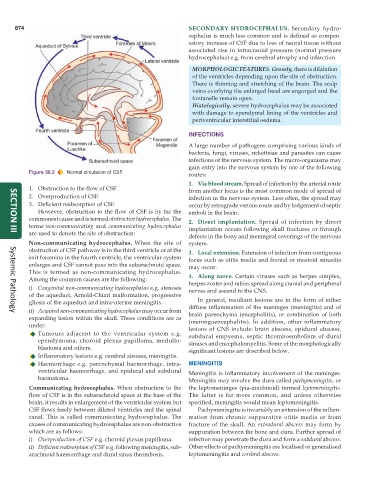
           Figure 30.2  Normal circulation of CSF.             routes:
                                                               1. Via blood stream. Spread of infection by the arterial route
           1. Obstruction to the flow of CSF.                  from another focus is the most common mode of spread of
           2. Overproduction of CSF.                           infection in the nervous system. Less often, the spread may
           3. Deficient reabsorption of CSF.                   occur by retrograde venous route and by lodgement of septic
              However, obstruction to the flow of CSF is by far the  emboli in the brain.
           commonest cause and is termed obstructive hydrocephalus. The  2. Direct implantation.  Spread of infection by direct
           terms non-communicating  and  communicating hydrocephalus  implantation occurs following skull fractures or through
           are used to denote the site of obstruction:
                                                               defects in the bony and meningeal coverings of the nervous
     SECTION III
           Non-communicating hydrocephalus. When the site of   system.
           obstruction of CSF pathway is in the third ventricle or at the  3. Local extension. Extension of infection from contiguous
           exit foramina in the fourth ventricle, the ventricular system  focus such as otitis media and frontal or mastoid sinusitis
           enlarges and CSF cannot pass into the subarachnoid space.  may occur.
           This is termed as non-communicating hydrocephalus.
           Among the common causes are the following:          4. Along nerve. Certain viruses such as herpes simplex,
                                                               herpes zoster and rabies spread along cranial and peripheral
           i) Congenital non-communicating hydrocephalus e.g. stenosis  nerves and ascend to the CNS.
           of the aqueduct, Arnold-Chiari malformation, progressive
           gliosis of the aqueduct and intra-uterine meningitis.  In general, resultant lesions are in the form of either
           ii) Acquired non-communicating hydrocephalus may occur from  diffuse inflammation of the meninges (meningitis) and of
                                                               brain parenchyma (encephalitis), or combination of both
     Systemic Pathology
           expanding lesion within the skull. These conditions are as  (meningoencephalitis). In addition, other inflammatory
           under:                                              lesions of CNS include: brain abscess, epidural abscess,
              Tumours adjacent to the ventricular system e.g.  subdural empyema, septic thromboembolism of dural
              ependymoma, choroid plexus papilloma, medullo-   sinuses and encephalomyelitis. Some of the morphologically
              blastoma and others.                             significant lesions are described below.
              Inflammatory lesions e.g. cerebral abscess, meningitis.
              Haemorrhage e.g. parenchymal haemorrhage, intra-  MENINGITIS
              ventricular haemorrhage, and epidural and subdural  Meningitis is inflammatory involvement of the meninges.
              haematoma.                                       Meningitis may involve the dura called pachymeningitis, or
           Communicating hydrocephalus. When obstruction to the  the leptomeninges (pia-arachnoid) termed leptomeningitis.
           flow of CSF is in the subarachnoid space at the base of the  The latter is far more common, and unless otherwise
           brain, it results in enlargement of the ventricular system but  specified, meningitis would mean leptomeningitis.
           CSF flows freely between dilated ventricles and the spinal  Pachymeningitis is invariably an extension of the inflam-
           canal. This is called communicating hydrocephalus. The  mation from chronic suppurative otitis media or from
           causes of communicating hydrocephalus are non-obstructive  fracture of the skull. An  extradural abscess may form by
           which are as follows:                               suppuration between the bone and dura. Further spread of
           i) Overproduction of CSF e.g. choroid plexus papilloma.  infection may penetrate the dura and form a subdural abscess.
           ii) Deficient reabsorption of CSF e.g. following meningitis, sub-  Other effects of pachymeningitis are localised or generalised
           arachnoid haemorrhage and dural sinus thrombosis.   leptomeningitis and cerebral abscess.

