


Page 887 - Textbook of Pathology, 6th Edition
P. 887
871


            Chapter 30                            The Nervous System
            Chapter 30


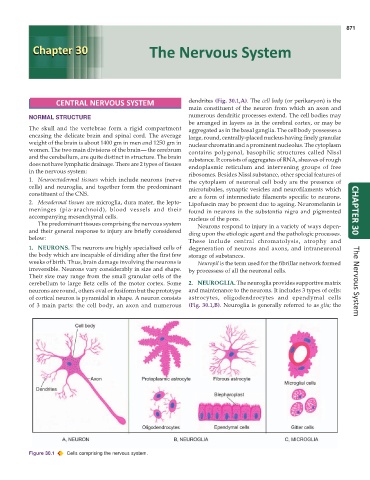
                    CENTRAL NERVOUS SYSTEM                     dendrites (Fig. 30.1,A). The cell body (or perikaryon) is the
                                                               main constituent of the neuron from which an axon and
           NORMAL STRUCTURE                                    numerous dendritic processes extend. The cell bodies may
                                                               be arranged in layers as in the cerebral cortex, or may be
           The skull and the vertebrae form a rigid compartment  aggregated as in the basal ganglia. The cell body possesses a
           encasing the delicate brain and spinal cord. The average  large, round, centrally-placed nucleus having finely granular
           weight of the brain is about 1400 gm in men and 1250 gm in  nuclear chromatin and a prominent nucleolus. The cytoplasm
           women. The two main divisions of the brain— the cerebrum  contains polygonal, basophilic structures called Nissl
           and the cerebellum, are quite distinct in structure. The brain  substance. It consists of aggregates of RNA, sheaves of rough
           does not have lymphatic drainage. There are 2 types of tissues  endoplasmic reticulum and intervening groups of free
           in the nervous system:                              ribosomes. Besides Nissl substance, other special features of
           1. Neuroectodermal tissues which include neurons (nerve  the cytoplasm of neuronal cell body are the presence of
           cells) and neuroglia, and together form the predominant  microtubules, synaptic vesicles and neurofilaments which
           constituent of the CNS.                             are a form of intermediate filaments specific to neurons.
           2. Mesodermal tissues are microglia, dura mater, the lepto-  Lipofuscin may be present due to ageing. Neuromelanin is
           meninges (pia-arachnoid), blood vessels and their   found in neurons in the substantia nigra and pigmented  CHAPTER 30
           accompanying mesenchymal cells.                     nucleus of the pons.
              The predominant tissues comprising the nervous system  Neurons respond to injury in a variety of ways depen-
           and their general response to injury are briefly considered  ding upon the etiologic agent and the pathologic processes.
           below:
                                                               These include central chromatolysis, atrophy and
           1. NEURONS. The neurons are highly specialised cells of  degeneration of neurons and axons, and intraneuronal
           the body which are incapable of dividing after the first few  storage of substances.
           weeks of birth. Thus, brain damage involving the neurons is  Neuropil is the term used for the fibrillar network formed
           irreversible. Neurons vary considerably in size and shape.  by processess of all the neuronal cells.
           Their size may range from the small granular cells of the
           cerebellum to large Betz cells of the motor cortex. Some  2. NEUROGLIA. The neuroglia provides supportive matrix  The Nervous System
           neurons are round, others oval or fusiform but the prototype  and maintenance to the neurons. It includes 3 types of cells:
           of cortical neuron is pyramidal in shape. A neuron consists  astrocytes, oligodendrocytes and ependymal cells
           of 3 main parts: the cell body, an axon and numerous  (Fig. 30.1,B). Neuroglia is generally referred to as glia; the


           Figure 30.1  Cells comprising the nervous system.

