


Page 894 - Textbook of Pathology, 6th Edition
P. 894
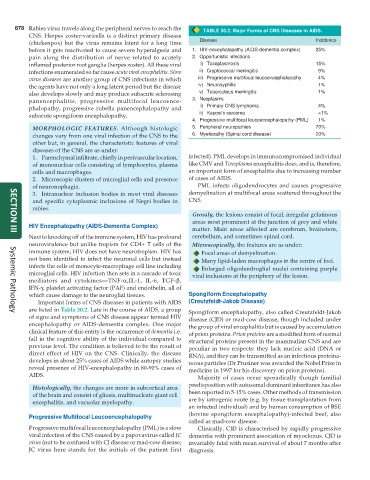
878 Rabies virus travels along the peripheral nerves to reach the TABLE 30.2. Major Forms of CNS Diseases in AIDS.
CNS. Herpes zoster-varicella is a distinct primary disease
(chickenpox) but the virus remains latent for a long time Disease Incidence
before it gets reactivated to cause severe hyperalgesia and 1. HIV-encephalopathy (AIDS-dementia complex) 25%
pain along the distribution of nerve related to acutely 2. Opportunistic infections
inflamed posterior root ganglia (herpes zoster). All these viral i) Toxoplasmosis 15%
infections enumerated so far cause acute viral encephalitis. Slow ii) Cryptococcal meningitis 9%
virus diseases are another group of CNS infections in which iii) Progressive multifocal leucoencephalopathy 4%
the agents have not only a long latent period but the disease iv) Neurosyphilis 1%
also develops slowly and may produce subacute sclerosing v) Tuberculous meningitis 1%
panencephalitis, progressive multifocal leucoence- 3. Neoplasms
phalopathy, progressive rubella panencephalopathy and i) Primary CNS lymphoma 4%
subacute spongiform encephalopathy. ii) Kaposi’s sarcoma <1%
4. Progressive multifocal leucoencephalopathy (PML) 1%
MORPHOLOGIC FEATURES. Although histologic 5. Peripheral neuropathies 70%
changes vary from one viral infection of the CNS to the 6. Myelopathy (Spinal cord disease) 20%
other but, in general, the characteristic features of viral
diseases of the CNS are as under:
1. Parenchymal infiltrate, chiefly in perivascular location, infected). PML develops in immunocompromised individual
of mononuclear cells consisting of lymphocytes, plasma like CMV and Toxoplasma encephalitis does, and is, therefore,
cells and macrophages. an important form of encephalitis due to increasing number
2. Microscopic clusters of microglial cells and presence of cases of AIDS.
of neuronophagia. PML infects oligodendrocytes and causes progressive
3. Intranuclear inclusion bodies in most viral diseases demyelination at multifocal areas scattered throughout the
and specific cytoplasmic inclusions of Negri bodies in CNS.
rabies.
Grossly, the lesions consist of focal, irregular gelatinous
areas most prominent at the junction of grey and white
HIV Encephalopathy (AIDS-Dementia Complex)
matter. Main areas affected are cerebrum, brainstem,
SECTION III
Next to knocking off of the immune system, HIV has profound cerebellum, and sometimes spinal cord.
neurovirulence but unlike tropism for CD4+ T cells of the Microscopically, the features are as under:
immune system, HIV does not have neurotropism. HIV has Focal areas of demyelination.
not been identified to infect the neuronal cells but instead Many lipid-laden macrophages in the centre of foci.
infects the cells of monocyte-macrophage cell line including Enlarged oligodendroglial nuclei containing purple
microglial cells. HIV infection then sets in a cascade of toxic viral inclusions at the periphery of the lesion.
mediators and cytokines—TNF-α,IL-1, IL-6, TGF-β,
IFN-γ, platelet activating factor (PAF) and endothelin, all of
which cause damage to the neuroglial tissues. Spongiform Encephalopathy
Important forms of CNS diseases in patients with AIDS (Creutzfeldt-Jakob Disease)
are listed in Table 30.2. Late in the course of AIDS, a group Spongiform encephalopathy, also called Creutzfeldt-Jakob
Systemic Pathology
of signs and symptoms of CNS disease appear termed HIV disease (CJD) or mad-cow disease, though included under
encephalopathy or AIDS-dementia complex. One major the group of viral encephalitis but is caused by accumulation
clinical feature of this entity is the occurrence of dementia i.e. of prion proteins. Prion proteins are a modified form of normal
fall in the cognitive ability of the individual compared to structural proteins present in the mammalian CNS and are
previous level. The condition is believed to be the result of peculiar in two respects: they lack nucleic acid (DNA or
direct effect of HIV on the CNS. Clinically, the disease RNA), and they can be transmitted as an infectious proteina-
develops in about 25% cases of AIDS while autopsy studies ceous particles (Dr Prusiner was awarded the Nobel Prize in
reveal presence of HIV-encephalopathy in 80-90% cases of medicine in 1997 for his discovery on prion proteins).
AIDS. Majority of cases occur sporadically though familial
predisposition with autosomal dominant inheritance has also
Histologically, the changes are more in subcortical area
of the brain and consist of gliosis, multinucleate giant cell been reported in 5-15% cases. Other methods of transmission
encephalitis, and vacuolar myelopathy. are by iatrogenic route (e.g. by tissue transplantation from
an infected individual) and by human consumption of BSE
(bovine spongiform encephalopathy)-infected beef, also
Progressive Multifocal Leucoencephalopathy
called as mad-cow disease.
Progressive multifocal leucoencephalopathy (PML) is a slow Clinically, CJD is characterised by rapidly progressive
viral infection of the CNS caused by a papovavirus called JC dementia with prominent association of myoclonus. CJD is
virus (not to be confused with CJ disease or mad-cow disease; invariably fatal with mean survival of about 7 months after
JC virus here stands for the initials of the patient first diagnosis.

