


Page 140 - 9780077418427.pdf
P. 140
/Users/user-f465/Desktop
          tiL12214_ch05_115-138.indd Page 117  9/1/10  9:39 PM user-f465
          tiL12214_ch05_115-138.indd Page 117  9/1/10  9:39 PM user-f465                                                /Users/user-f465/Desktop


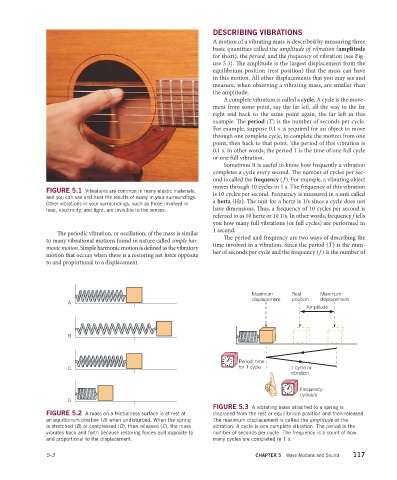
                                                                               DESCRIBING VIBRATIONS
                                                                               A motion of a vibrating mass is described by measuring three
                                                                               basic quantities called the amplitude of vibration (amplitude
                                                                               for short), the period, and the frequency of vibration (see Fig-
                                                                               ure 5.3). The amplitude is the largest displacement from the

                                                                               equilibrium position (rest position) that the mass can have
                                                                               in this motion. All other displacements that you may see and
                                                                               measure, when observing a vibrating mass, are smaller than
                                                                               the amplitude.
                                                                                  A complete vibration is called a cycle. A cycle is the move-

                                                                               ment from some point, say the far left, all the way to the far
                                                                               right and back to the same point again, the far left in this

                                                                               example. Th e period (T) is the number of seconds per cycle.
                                                                               For example, suppose 0.1 s is required for an object to move
                                                                               through one complete cycle, to complete the motion from one
                                                                               point, then back to that point. The period of this vibration is

                                                                               0.1 s. In other words, the period T is the time of one full cycle
                                                                               or one full vibration.
                                                                                  Sometimes it is useful to know how frequently a vibration

                                                                               completes a cycle every second. The number of cycles per sec-
                                                                               ond is called the frequency ( f ). For example, a vibrating object

                                                                               moves through 10 cycles in 1 s. The frequency of this vibration
                       FIGURE 5.1  Vibrations are common in many elastic materials,   is 10 cycles per second. Frequency is measured in a unit called
                        and you can see and hear the results of many in your surroundings.

                        Other vibrations in your surroundings, such as those involved in   a hertz (Hz). The unit for a hertz is 1/s since a cycle does not

                        heat, electricity, and light, are invisible to the senses.  have dimensions. Thus, a frequency of 10 cycles per second is
                                                                               referred to as 10 hertz or 10 1/s. In other words, frequency f tells
                                                                               you how many full vibrations (or full cycles) are performed in
                                                                               1 second.
                           The periodic vibration, or oscillation, of the mass is similar


                       to many vibrational motions found in nature called simple har-  The period and frequency are two ways of describing the
                       monic motion. Simple harmonic motion is defined as the vibratory   time involved in a vibration. Since the period (T) is the num-

                       motion that occurs when there is a restoring net force opposite   ber of seconds per cycle and the frequency (f ) is the number of
                       to and proportional to a displacement.


                                                                                            Maximum      Rest     Maximum
                                                                                            displacement  position  displacement
                               A
                                                                                                              Amplitude


                               B


                                                                                       Period: time
                               C                                                       for 1 cycle       1 cycle or
                                                                                                         vibration

                                                                                                            Frequency:
                                                                                                            cycles/s
                               D
                                                                               FIGURE 5.3  A vibrating mass attached to a spring is
                       FIGURE 5.2  A mass on a frictionless surface is at rest at   displaced from the rest or equilibrium position and then released.
                        an equilibrium position (A) when undisturbed. When the spring   The maximum displacement is called the amplitude of the
                       is stretched (B) or compressed (D), then released (C), the mass   vibration. A cycle is one complete vibration. The period is the
                       vibrates back and forth because restoring forces pull opposite to   number of seconds per cycle. The frequency is a count of how
                       and proportional to the displacement.                   many cycles are completed in 1 s.

                       5-3                                                                   CHAPTER 5  Wave Motions and Sound   117

