


Page 143 - 9780077418427.pdf
P. 143
/Users/user-f465/Desktop
          tiL12214_ch05_115-138.indd Page 120  9/1/10  9:39 PM user-f465
          tiL12214_ch05_115-138.indd Page 120  9/1/10  9:39 PM user-f465                                                /Users/user-f465/Desktop


                   molecule, and the pulse of compression spreads through the room.
                   In the example of the closing door, the pulse of greater density and
                   increased pressure of air reached the door at the other side of the

                   room, and the composite effect of the molecules hitting the door,
                   that is, the increased pressure, caused it to close.
                      If the door at the other side of the room does not latch, you
                   can probably cause it to open again by pulling on the fi rst door
                   quickly. By so doing, you send a pulse of thinned-out molecules

                   of lowered density and pressure. The door you pulled quickly
                   pushed some of the molecules out of the room. Other mole-
                   cules quickly move into the region of less pressure, then back
                   to their normal positions. The overall effect is the movement


                   of a thinned-out pulse that travels through the room. When
                   the pulse of slightly reduced pressure reaches the other door,   A
                   molecules exerting their normal pressure on the other side of
                   the door cause it to move. After a pulse has passed a particular

                   place, the molecules are very soon homogeneously distributed
                   again due to their rapid, random movement.
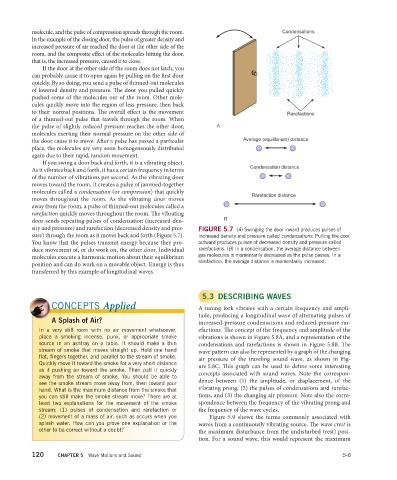
                      If you swing a door back and forth, it is a vibrating object.
                   As it vibrates back and forth, it has a certain frequency in terms
                   of the number of vibrations per second. As the vibrating door
                   moves toward the room, it creates a pulse of jammed-together
                   molecules called a condensation (or compression) that quickly
                   moves throughout the room. As the vibrating door moves
                   away from the room, a pulse of thinned-out molecules called a
                   rarefaction quickly moves throughout the room. Th e vibrating
                   door sends repeating pulses of condensation (increased den-    B
                   sity and pressure) and rarefaction (decreased density and pres-  FIGURE 5.7  (A) Swinging the door inward produces pulses of
                   sure) through the room as it moves back and forth ( Figure 5.7).   increased density and pressure called condensations. Pulling the door
                   You know that the pulses transmit energy because they pro-  outward produces pulses of decreased density and pressure called
                   duce movement of, or do work on, the other door. Individual   rarefactions. (B) In a condensation, the average distance between
                   molecules execute a harmonic motion about their equilibrium   gas molecules is momentarily decreased as the pulse passes. In a
                                                                          rarefaction, the average distance is momentarily increased.
                   position and can do work on a movable object. Energy is thus
                   transferred by this example of longitudinal waves.


                                                                           5.3 DESCRIBING WAVES
                         CONCEPTS Applied                                 A tuning fork vibrates with a certain frequency and ampli-
                                                                          tude, producing a longitudinal wave of alternating pulses of
                         A Splash of Air?                                 increased-pressure condensations and reduced-pressure rar-

                     In a very still room with no air movement whatsoever,   efactions. The concept of the frequency and amplitude of the
                     place a smoking incense, punk, or appropriate smoke   vibrations is shown in Figure 5.8A, and a representation of the
                     source in an ashtray on a table. It should make a thin   condensations and rarefactions is shown in  Figure 5.8B. Th e
                     stream of smoke that moves straight up. Hold one hand   wave pattern can also be represented by a graph of the changing
                     flat, fingers together, and parallel to the stream of smoke.
                                                                          air pressure of the traveling sound wave, as shown in Fig-
                     Quickly move it toward the smoke for a very short distance
                                                                          ure 5.8C.  This graph can be used to define some interesting


                     as if pushing air toward the smoke. Then pull it quickly
                                                                          concepts associated with sound waves. Note the correspon-
                     away from the stream of smoke. You should be able to
                                                                          dence between (1) the amplitude, or displacement, of the
                     see the smoke stream move away from, then toward your
                                                                          vibrating prong, (2) the pulses of condensations and rarefac-
                     hand. What is the maximum distance from the smoke that
                     you can still make the smoke stream move? There are at   tions, and (3) the changing air pressure. Note also the corre-
                     least two explanations for the movement of the smoke   spondence between the frequency of the vibrating prong and
                     stream: (1) pulses of condensation and rarefaction or   the frequency of the wave cycles.
                     (2) movement of a mass of air, such as occurs when you   Figure 5.9 shows the terms commonly associated with
                     splash water. How can you prove one explanation or the   waves from a continuously vibrating source. Th e wave crest is
                     other to be correct without a doubt?                 the maximum disturbance from the undisturbed (rest) posi-
                                                                          tion. For a sound wave, this would represent the maximum
                   120     CHAPTER 5  Wave Motions and Sound                                                              5-6

