


Page 142 - 9780077418427.pdf
P. 142
/Users/user-f465/Desktop
          tiL12214_ch05_115-138.indd Page 119  9/1/10  9:39 PM user-f465
          tiL12214_ch05_115-138.indd Page 119  9/1/10  9:39 PM user-f465                                                /Users/user-f465/Desktop


                       motion (vibrations), and this periodic motion moved out in the   that causes motion perpendicular to the direction that the wave
                       medium away from the point where the rock fell (the center or   is moving. Particles responding to a transverse wave do not move

                       source of disturbance). The water did not move away from the cen-  closer together or farther apart in response to the disturbance;
                       ter of disturbance, but the vibrations moved away. Th ese traveling   rather, they vibrate up and then down in a direction perpen-
                       vibrations of the medium are called waves. Suppose you use your   dicular to the direction of the wave motion (see Figure 5.6B).
                       finger or some other object to disturb the still water surface at

                       exactly one point not just once but many times, repeatedly, one
                       time after another in regular time intervals; for example, you tap   CONCEPTS Applied

                       the surface every one-third of a sound. In this example, vibrations
                       of your finger are the source of periodic disturbances that travel in   Making Waves

                       the medium. In short, you generated waves. The world around us

                                                                                 Obtain a Slinky or a long, coiled spring and stretch it out
                       provides us with many examples of waves or wave motion.
                                                                                 on the floor. Have another person hold the opposite end
                                                                                 stationary while you make waves move along the spring.
                       KINDS OF MECHANICAL WAVES                                 Make longitudinal and transverse waves, observing how
                                                                                 the disturbance moves in each case. If the spring is long
                       If you could see the motion of an individual water molecule near
                                                                                 enough, measure the distance, then time the movement of
                       the surface as a water wave passed, you would see it trace out a   each type of wave. How fast were your waves?
                       circular path as it moves up and over, down and back. Th is cir-
                       cular motion is characteristic of the motion of a particle reacting

                       to a water wave disturbance. There are other kinds of mechanical
                       waves, and each involves particles in a characteristic motion.
                                                                                  Whether you make mechanical longitudinal or transverse
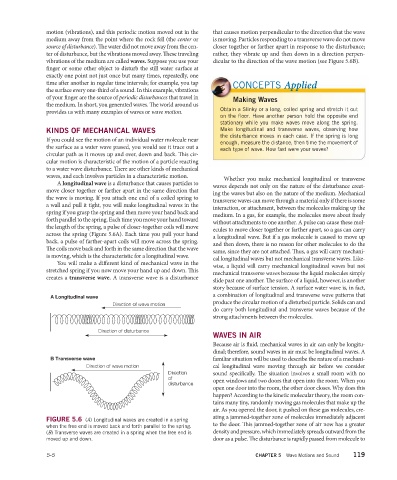
                           A longitudinal wave is a disturbance that causes particles to
                                                                               waves depends not only on the nature of the disturbance creat-
                       move closer together or farther apart in the same direction that
                                                                               ing the waves but also on the nature of the medium. Mechanical
                       the wave is moving. If you attach one end of a coiled spring to
                                                                               transverse waves can move through a material only if there is some
                       a wall and pull it tight, you will make longitudinal waves in the
                                                                               interaction, or attachment, between the molecules making up the
                       spring if you grasp the spring and then move your hand back and
                                                                               medium. In a gas, for example, the molecules move about freely
                       forth parallel to the spring. Each time you move your hand toward
                                                                               without attachments to one another. A pulse can cause these mol-
                       the length of the spring, a pulse of closer-together coils will move
                                                                               ecules to move closer together or farther apart, so a gas can carry
                       across the spring (Figure 5.6A). Each time you pull your hand
                                                                               a longitudinal wave. But if a gas molecule is caused to move up
                       back, a pulse of farther-apart coils will move across the spring.
                                                                               and then down, there is no reason for other molecules to do the

                       The coils move back and forth in the same direction that the wave
                                                                               same, since they are not attached. Thus, a gas will carry mechani-

                       is moving, which is the characteristic for a longitudinal wave.
                                                                               cal longitudinal waves but not mechanical transverse waves. Like-
                           You will make a different kind of mechanical wave in the

                                                                               wise, a liquid will carry mechanical longitudinal waves but not
                       stretched spring if you now move your hand up and down. Th is
                                                                               mechanical transverse waves because the liquid molecules simply
                       creates a transverse wave. A transverse wave is a disturbance
                                                                               slide past one another. The surface of a liquid, however, is another

                                                                               story because of surface tension. A surface water wave is, in fact,
                                                                               a combination of longitudinal and transverse wave patterns that
                         A Longitudinal wave
                                             Direction of wave motion          produce the circular motion of a disturbed particle. Solids can and
                                                                               do carry both longitudinal and transverse waves because of the
                                                                               strong attachments between the molecules.
                                         Direction of disturbance
                                                                               WAVES IN AIR
                                                                               Because air is fluid, mechanical waves in air can only be longitu-

                                                                               dinal; therefore, sound waves in air must be longitudinal waves. A
                         B Transverse wave                                     familiar situation will be used to describe the nature of a mechani-
                                     Direction of wave motion                  cal longitudinal wave moving through air before we consider
                                                                Direction      sound specifi cally. The situation involves a small room with no

                                                                of
                                                                disturbance    open windows and two doors that open into the room. When you
                                                                               open one door into the room, the other door closes. Why does this
                                                                               happen? According to the kinetic molecular theory, the room con-
                                                                               tains many tiny, randomly moving gas molecules that make up the
                                                                               air. As you opened the door, it pushed on these gas molecules, cre-
                                                                               ating a jammed-together zone of molecules immediately adjacent
                       FIGURE 5.6  (A) Longitudinal waves are created in a spring

                        when the free end is moved back and forth parallel to the spring.   to the door. This jammed-together zone of air now has a greater
                        (B) Transverse waves are created in a spring when the free end is   density and pressure, which immediately spreads outward from the

                        moved up and down.                                     door as a pulse. The disturbance is rapidly passed from molecule to
                       5-5                                                                   CHAPTER 5  Wave Motions and Sound   119

