


Page 145 - 9780077418427.pdf
P. 145
/Users/user-f465/Desktop
          tiL12214_ch05_115-138.indd Page 122  9/1/10  9:39 PM user-f465
          tiL12214_ch05_115-138.indd Page 122  9/1/10  9:39 PM user-f465                                                /Users/user-f465/Desktop


                                                                                  Outer Ear      Middle    Inner Ear
                    5.4 SOUND WAVES                                               External        Ear
                                                                                  auditory canal
                   SOUND WAVES IN AIR AND HEARING
                                                                                                          Horizontal
                   You cannot hear a vibrating door because the human ear normally
                                                                                                            Posterior  Semicircular
                   hears sounds originating from vibrating objects with a frequency                         Anterior  canals
                   between 20 and 20,000 Hz. Longitudinal waves with frequen-                                Vestibule
                   cies less than 20 Hz are called infrasonic. You usually feel sounds                       Cochlea
                   below 20 Hz rather than hear them, particularly if you are listening
                   to a good sound system. Longitudinal waves above 20,000 Hz are                                     Auditory
                   called ultrasonic. Although 20,000 Hz is usually considered the                                    nerve
                   upper limit of hearing, the actual limit varies from person to per-
                                                                                                              Round window
                   son and becomes lower and lower with increasing age. Humans
                   do not hear infrasonic or ultrasonic sounds, but various animals                              Eustachian tube
                   have different limits. Dogs, cats, rats, and bats can hear higher fre-       Incus

                                                                                            Malleus
                   quencies than humans. Dogs can hear an ultrasonic whistle when                 Stapes   Bone
                   a human hears nothing, for example. Some bats make and hear          Tympanic      Oval
                   sounds of frequencies up to 100,000 Hz as they navigate and search   membrane      window

                   for flying insects in total darkness. Scientists discovered recently
                   that elephants communicate with extremely low- frequency sounds
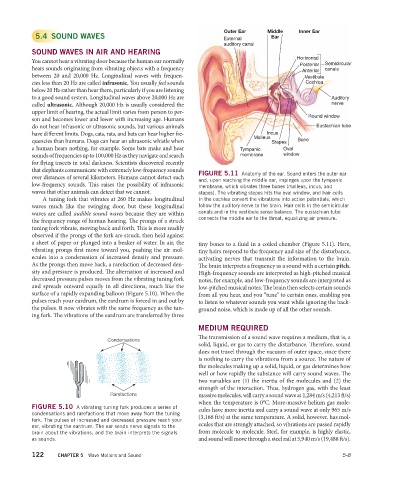
                                                                          FIGURE 5.11  Anatomy of the ear. Sound enters the outer ear
                   over distances of several kilometers. Humans cannot detect such
                                                                          and, upon reaching the middle ear, impinges upon the tympanic

                   low-frequency sounds. This raises the possibility of infrasonic   membrane, which vibrates three bones (malleus, incus, and
                   waves that other animals can detect that we cannot.    stapes). The vibrating stapes hits the oval window, and hair cells
                      A tuning fork that vibrates at 260 Hz makes longitudinal   in the cochlea convert the vibrations into action potentials, which
                   waves much like the swinging door, but these longitudinal   follow the auditory nerve to the brain. Hair cells in the semicircular
                   waves are called audible sound waves because they are within   canals and in the vestibule sense balance. The eustachian tube
                                                                          connects the middle ear to the throat, equalizing air pressure.
                   the frequency range of human hearing. The prongs of a struck


                   tuning fork vibrate, moving back and forth. This is more readily
                   observed if the prongs of the fork are struck, then held against
                   a sheet of paper or plunged into a beaker of water. In air, the   tiny bones to a fluid in a coiled chamber (Figure 5.11). Here,


                   vibrating prongs first move toward you, pushing the air mol-  tiny hairs respond to the frequency and size of the disturbance,
                   ecules into a condensation of increased density and pressure.   activating nerves that transmit the information to the brain.
                   As the prongs then move back, a rarefaction of decreased den-  The brain interprets a frequency as a sound with a certain pitch.


                   sity and pressure is produced. The alternation of increased and   High-frequency sounds are interpreted as high-pitched musical
                   decreased pressure pulses moves from the vibrating tuning fork   notes, for example, and low-frequency sounds are interpreted as
                   and spreads outward equally in all directions, much like the   low-pitched musical notes. The brain then selects certain sounds

                   surface of a rapidly expanding balloon (Figure 5.10). When the   from all you hear, and you “tune” to certain ones, enabling you
                   pulses reach your eardrum, the eardrum is forced in and out by   to listen to whatever sounds you want while ignoring the back-
                   the pulses. It now vibrates with the same frequency as the tun-  ground noise, which is made up of all the other sounds.

                   ing fork. The vibrations of the eardrum are transferred by three
                                                                          MEDIUM REQUIRED

                                            Condensations                 The transmission of a sound wave requires a medium, that is, a
                                                                          solid, liquid, or gas to carry the disturbance. Th erefore, sound
                                                                          does not travel through the vacuum of outer space, since there
                                                                          is nothing to carry the vibrations from a source. The nature of

                                                                          the molecules making up a solid, liquid, or gas determines how
                                                                          well or how rapidly the substance will carry sound waves. Th e
                                                                          two variables are (1) the inertia of the molecules and (2) the

                                                                          strength of the interaction. Thus, hydrogen gas, with the least
                                             Rarefactions                 massive molecules, will carry a sound wave at 1,284 m/s (4,213 ft /s)
                                                                          when the temperature is 0°C. More-massive helium gas mole-
                   FIGURE 5.10  A vibrating tuning fork produces a series of   cules have more inertia and carry a sound wave at only  965 m/s
                   condensations and rarefactions that move away from the tuning
                                                                          (3,166 ft/s) at the same temperature. A solid, however, has mol-

                   fork. The pulses of increased and decreased pressure reach your
                   ear, vibrating the eardrum. The ear sends nerve signals to the   ecules that are strongly attached, so vibrations are passed rapidly
                   brain about the vibrations, and the brain interprets the signals   from molecule to molecule. Steel, for example, is highly elastic,
                   as sounds.                                             and sound will move through a steel rail at 5,940 m/s (19,488 ft /s).
                   122     CHAPTER 5  Wave Motions and Sound                                                              5-8

