


Page 144 - 9780077418427.pdf
P. 144
/Users/user-f465/Desktop
          tiL12214_ch05_115-138.indd Page 121  9/1/10  9:39 PM user-f465
          tiL12214_ch05_115-138.indd Page 121  9/1/10  9:39 PM user-f465                                                /Users/user-f465/Desktop


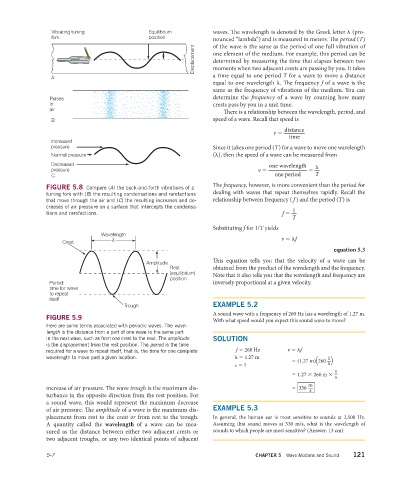
                         Vibrating tuning                Equilibrium           waves. The wavelength is denoted by the Greek letter λ (pro-

                         fork                            position              nounced “lambda”) and is measured in meters. Th e period (T)
                                                                               of the wave is the same as the period of one full vibration of
                                                                        Displacement  one element of the medium. For example, this period can be
                                                                               determined by measuring the time that elapses between two
                                                                               moments when two adjacent crests are passing by you. It takes
                         A                                                     a time equal to one period T for a wave to move a distance
                                                                               equal to one wavelength λ. Th e frequency f of a wave is the
                                                                               same as the frequency of vibrations of the medium. You can
                         Pulses                                                determine the  frequency of a wave by counting how many
                         in                                                    crests pass by you in a unit time.
                         air

                                                                                  There is a relationship between the wavelength, period, and
                         B                                                     speed of a wave. Recall that speed is
                                                                                                      _
                                                                                                      distance

                                                                                                   v =
                                                                                                        time
                         Increased
                         pressure                                              Since it takes one period (T) for a wave to move one wavelength
                         Normal pressure                                       (λ), then the speed of a wave can be measured from
                         Decreased                                                               one wavelength  λ
                                                                                                              =

                         pressure                                                             v =   __ _


                         C                                                                         one period    T
                                                                               Th e frequency, however, is more convenient than the period for
                       FIGURE 5.8  Compare (A) the back-and-forth vibrations of a
                       tuning fork with (B) the resulting condensations and rarefactions   dealing with waves that repeat themselves rapidly. Recall the
                       that move through the air and (C) the resulting increases and de-  relationship between frequency ( f ) and the period (T) is
                       creases of air pressure on a surface that intercepts the condensa-                1 _

                       tions and rarefactions.                                                        f =
                                                                                                         T
                                                                               Substituting f for 1/T yields
                                          Wavelength
                             Crest           λ                                                       v = λf
                                                                                                                       equation 5.3

                                                         Amplitude             This equation tells you that the velocity of a wave can be
                                                                Rest           obtained from the product of the wavelength and the frequency.
                                                                (equilibrium)  Note that it also tells you that the wavelength and frequency are
                                                                position
                         Period:                                               inversely proportional at a given velocity.
                         time for wave
                         to repeat
                         itself
                                                 Trough                        EXAMPLE 5.2
                                                                               A sound wave with a frequency of 260 Hz has a wavelength of 1.27 m.
                       FIGURE 5.9
                                                                               With what speed would you expect this sound wave to move?
                       Here are some terms associated with periodic waves. The wave-
                       length is the distance from a part of one wave to the same part
                       in the next wave, such as from one crest to the next. The amplitude   SOLUTION
                       is the displacement from the rest position. The period is the time
                         required for a wave to repeat itself, that is, the time for one  complete    f = 260 Hz   v = λf
                       wavelength to move past a given location.                      λ = 1.27 m                     1 _
                                                                                                          = (1.27 m) (260         )
                                                                                      v = ?                          s
                                                                                                                       1 _
                                                                                                          = 1.27 × 260 m ×

                                                                                                                       s
                                                                                                              m _

                       increase of air pressure. Th e wave trough is  the maximum dis-                     =  330
                                                                                                               s
                       turbance in the opposite direction from the rest position. For
                       a sound wave, this would represent the maximum decrease
                       of air pressure. Th e amplitude of a wave is the maximum dis-  EXAMPLE 5.3
                       placement from rest to the crest or from rest to the trough.   In general, the human ear is most sensitive to sounds at 2,500 Hz.
                       A quantity called the  wavelength  of a wave can be mea-  Assuming that sound moves at 330 m/s, what is the wavelength of
                       sured as the distance between either two adjacent crests or   sounds to which people are most sensitive? (Answer: 13 cm)
                       two adjacent troughs, or any two identical points of adjacent
                       5-7                                                                   CHAPTER 5  Wave Motions and Sound   121

