


Page 150 - 9780077418427.pdf
P. 150
/Users/user-f465/Desktop
          tiL12214_ch05_115-138.indd Page 127  9/1/10  9:39 PM user-f465
          tiL12214_ch05_115-138.indd Page 127  9/1/10  9:39 PM user-f465                                                /Users/user-f465/Desktop


                                                                               the absolute difference in frequency of two interfering waves

                                        a                 b                    with slightly different frequencies, or
                                                                                                    f b  =   f 2  – f 1
                                               a + b                                                                   equation 5.6

                                                                                5.5  ENERGY OF WAVES
                          A             b                 a
                                                                               All waves transport energy, including sound waves. Th e vibrat-
                                                                               ing mass and spring in Figure 5.2 vibrate with an amplitude that
                                                                               depends on how much work you did on the mass in moving it
                                                                               from its equilibrium position. More work on the mass results
                                       a                 b
                                                                               in a greater displacement and a greater amplitude of vibration.
                                                                               A vibrating object that is producing sound waves will produce
                                                                               more intense condensations and rarefactions if it has a greater
                                               a + b

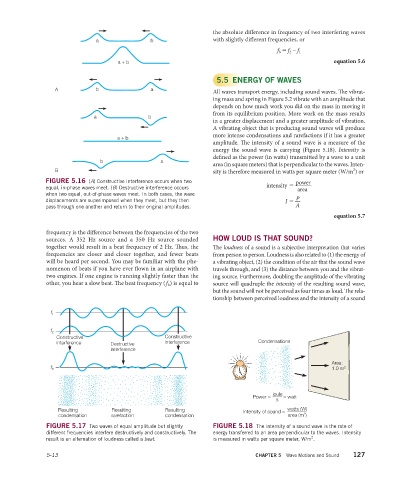
                                                                               amplitude. The intensity of a sound wave is a measure of the
                                                                               energy the sound wave is carrying (Figure 5.18).  Intensity is
                                                                               defi ned as the power (in watts) transmitted by a wave to a unit
                                         b                   a
                                                                               area (in square meters) that is perpendicular to the waves. Inten-
                          B                                                    sity is therefore measured in watts per square meter (W/m ) or
                                                                                                                             2
                       FIGURE 5.16  (A) Constructive interference occurs when two                         _
                                                                                                          power
                                                                                                intensity =
                       equal, in-phase waves meet. (B) Destructive interference occurs                     area
                       when two equal, out-of-phase waves meet. In both cases, the wave
                                                                                                          P _
                       displacements are superimposed when they meet, but they then                    I =

                       pass through one another and return to their original amplitudes.                  A
                                                                                                                       equation 5.7

                       frequency is the difference between the frequencies of the two
                       sources. A 352 Hz source and a 350 Hz source sounded    HOW LOUD IS THAT SOUND?
                       together would result in a beat frequency of 2 Hz. Th us, the   Th e loudness of a sound is a subjective interpretation that varies
                       frequencies are closer and closer together, and fewer beats   from person to person. Loudness is also related to (1) the energy of
                       will be heard per second. You may be familiar with the phe-  a vibrating object, (2) the condition of the air that the sound wave
                       nomenon of beats if you have ever flown in an airplane with   travels through, and (3) the distance between you and the vibrat-

                       two engines. If one engine is running slightly faster than the   ing source. Furthermore, doubling the amplitude of the vibrating

                       other, you hear a slow beat. The beat frequency (f b ) is equal to   source will quadruple the intensity of the resulting sound wave,
                                                                               but the sound will not be perceived as four times as loud. Th e rela-
                                                                               tionship between perceived loudness and the intensity of a sound

                         f 1


                         f 2
                           Constructive                        Constructive
                           interference      Destructive       interference                   Condensations
                                             interference

                                                                                                                      Area:
                         f b                                                                                          1.0 m 2


                                                                                                  joule
                                                                                            Power =         = watt
                                                                                                    s
                           Resulting         Resulting         Resulting                 Intensity of sound =  watts (W)
                                                                                                             2
                           condensation      rarefaction       condensation                             area (m )
                       FIGURE 5.17  Two waves of equal amplitude but slightly   FIGURE 5.18  The intensity of a sound wave is the rate of
                       different frequencies interfere destructively and constructively. The   energy transferred to an area perpendicular to the waves. Intensity
                                                                                                               2
                       result is an alternation of loudness called a beat.     is measured in watts per square meter, W/m .
                       5-13                                                                  CHAPTER 5  Wave Motions and Sound   127

