


Page 186 - 9780077418427.pdf
P. 186
/Users/user-f465/Desktop
          tiL12214_ch06_139-176.indd Page 163  9/1/10  9:40 PM user-f465
          tiL12214_ch06_139-176.indd Page 163  9/1/10  9:40 PM user-f465                                                /Users/user-f465/Desktop


                       the field collapses back across the secondary coil. To use dc in
                       a transformer, the current must be continually interrupted to
                       produce a changing magnetic fi eld.                            Primary                         Secondary
                           When an alternating current or a continually interrupted   coil                            coil
                       direct current is applied to the primary coil, the magnitude of              10 turns
                       the induced voltage in the secondary coil is proportional to the                     1 turn      12 V
                       ratio of wire loops in the two coils. If they have the same num-
                       ber of loops, the primary coil produces just as many magnetic
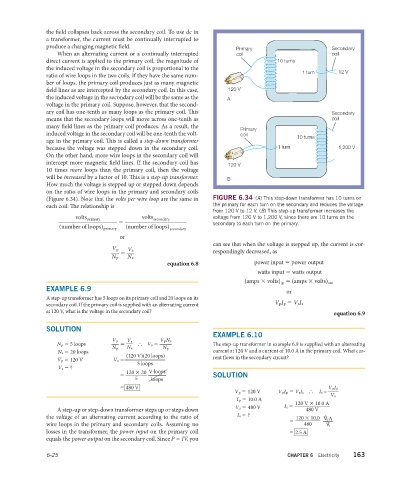
                       fi eld lines as are intercepted by the secondary coil. In this case,   120 V
                       the induced voltage in the secondary coil will be the same as the   A
                       voltage in the primary coil. Suppose, however, that the second-
                       ary coil has one-tenth as many loops as the primary coil. Th is                                Secondary
                       means that the secondary loops will move across one-tenth as                                   coil

                       many field lines as the primary coil produces. As a result, the   Primary
                       induced voltage in the secondary coil will be one-tenth the volt-  coil             10 turns

                       age in the primary coil. This is called a step-down transformer
                       because the voltage was stepped down in the secondary coil.                  1 turn              1,200 V
                       On the other hand, more wire loops in the secondary coil will

                       intercept more magnetic field lines. If the secondary coil has   120 V
                        10  times  more loops than the primary coil, then the voltage
                       will be increased by a factor of 10. This is a step-up transformer.   B

                       How much the voltage is stepped up or stepped down depends
                       on the ratio of wire loops in the primary and secondary coils
                         ( Figure 6.34). Note that the volts per wire loop are the same in   FIGURE 6.34 (A) This step-down transformer has 10 turns on
                       each coil. The relationship is                          the primary for each turn on the secondary and reduces the voltage

                                                                               from 120 V to 12 V. (B) This step-up transformer increases the
                                                        volts
                                  volts


                            __ ___                                             voltage from 120 V to 1,200 V, since there are 10 turns on the
                                     primary
                                                           secondary

                                               =


                              (number of loops)    primary      (number of loops)    secondary    secondary to each turn on the primary.
                                                or
                                                                               can see that when the voltage is stepped up, the current is cor-
                                               V    p
                                             _ _                               respondingly decreased, as
                                                    V    s
                                                   =


                                              N    p    N    s
                                                                equation 6.8                power input = power output
                                                                                              watts input = watts output
                                                                                          (amps × volts)      =  (amps × volts)
                                                                                                                     out
                                                                                                     in
                       EXAMPLE 6.9
                                                                                                       or
                       A step-up transformer has 5 loops on its primary coil and 20 loops on its
                                                                                                     V    p  I    p  =  V    s  I    s
                       secondary coil. If the primary coil is supplied with an alternating current
                       at 120 V, what is the voltage in the secondary coil?
                                                                                                                       equation 6.9
                       SOLUTION
                                                                               EXAMPLE 6.10
                                                               V    p  N    s
                                               V    p
                                                    V    s
                                             _    _          _


                           N    p  = 5 loops         =          ∴  V    s  =              The step-up transformer in example 6.9 is supplied with an alternating
                                               N    p     N    s     N    p
                           N    s  = 20 loops                                  current at 120 V and a current of 10.0 A in the primary coil. What cur-
                                                  (120 V)(20 loops)
                                                 __                            rent flows in the secondary circuit?

                           V    p  = 120 V      V    s  =
                                                      5 loops
                           V    s = ?
                                                  120 × 20 V·loops
                                                =  _ _                         SOLUTION


                                                      5    loops
                                                = 480 V                                                                V    p  I    p
                                                                                                                     _
                                                                                      V    p  = 120 V     V    p  I    p  =  V    s  I    s   ∴   I    s   =

                                                                                                                        V    s
                                                                                       I    p  = 10.0 A   __
                                                                                                          120 V × 10.0 A
                                                                                      V    s  = 480 V         I    s  =
                           A step-up or step-down transformer steps up or steps down                         480 V
                       the voltage of an alternating current according to the ratio of         I    s  = ?  _ _
                                                                                                          120 × 10.0 V·A

                       wire  loops in the primary and secondary  coils.  Assuming  no                         =     480          V
                       losses in the transformer, the power input on the primary coil                         = 2.5 A
                       equals the power output on the secondary coil. Since P = IV, you
                       6-25                                                                            CHAPTER 6  Electricity   163

