


Page 213 - 9780077418427.pdf
P. 213
/Users/user-f465/Desktop
          tiL12214_ch07_177-202.indd Page 190  9/1/10  9:44 PM user-f465
          tiL12214_ch07_177-202.indd Page 190  9/1/10  9:44 PM user-f465                                                /Users/user-f465/Desktop


                           A Closer Look


                           Th e Rainbow
                         rainbow is a spectacular, natural dis-  raindrops into a spherical shape as they fall
                     A lay of color that is supposed to have   through the air.            Sunlight
                         p
                     a pot of gold under one end. Understand-  Box Figure 7.7 shows one thing that        First
                                                                                                          refraction
                     ing the why and how of a rainbow requires   can happen when a ray of sunlight strikes       Reflection
                     information about water droplets and   a single spherical raindrop near the top of
                                                                                                          Enlarged raindrop
                     knowledge of how light is reflected and   the drop. At this point, some of the sunlight
                     refracted. This information will also explain   is reflected, and some is refracted into the
                     why the rainbow seems to move when you   raindrop. The refraction disperses the light
                                                                                                                   Second
                     move—making it impossible to reach the   into its spectrum colors, with the violet light
                                                                                                                   refraction
                     end to obtain that mythical pot of gold.  being refracted most and red the least. The
                                                                                                                Rainbow ray
                        First, note the pattern of conditions   refracted light travels through the drop to
                     that occur when you see a rainbow. It   the opposite side, where some of it might be   Observer
                     usually appears when the Sun is shining   reflected back into the drop. The reflected
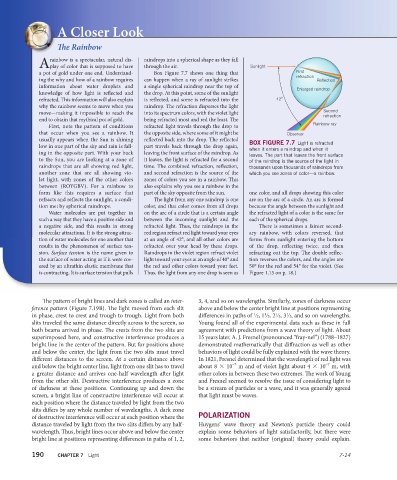
                                                                                           BOX FIGURE 7.7  Light is refracted
                     low in one part of the sky and rain is fall-  part travels back through the drop again,
                                                                                           when it enters a raindrop and when it
                     ing in the opposite part. With your back   leaving the front surface of the raindrop. As
                                                                                           leaves. The part that leaves the front surface
                     to the Sun, you are looking at a zone of   it leaves, the light is refracted for a second   of the raindrop is the source of the light in
                     raindrops that are all showing red light,   time. The combined refraction, reflection,   thousands upon thousands of raindrops from
                     another zone that are all showing vio-  and second refraction is the source of the   which you see zones of color—a rainbow.
                     let light, with zones of the other colors   zones of colors you see in a rainbow. This
                     between (ROYGBV). For a rainbow to   also explains why you see a rainbow in the
                     form like this requires a surface that   part of the sky opposite from the sun.  one color, and all drops showing this color
                     refracts and reflects the sunlight, a condi-  The light from any one raindrop is one   are on the arc of a circle. An arc is formed
                     tion met by spherical raindrops.   color, and that color comes from all drops   because the angle between the sunlight and
                        Water molecules are put together in   on the arc of a circle that is a certain angle   the refracted light of a color is the same for
                     such a way that they have a positive side and   between the incoming sunlight and the   each of the spherical drops.
                     a negative side, and this results in strong   refracted light. Thus, the raindrops in the   There is sometimes a fainter second-
                     molecular attractions. It is the strong attrac-  red region refract red light toward your eyes   ary rainbow, with colors reversed, that
                     tion of water molecules for one another that   at an angle of 42°, and all other colors are   forms from sunlight entering the bottom
                     results in the phenomenon of  surface  ten-  refracted over your head by these drops.   of the drop, reflecting twice, and then
                     sion. Surface tension is the name given to   Raindrops in the violet region refract violet   refracting out the top. The double reflec-
                     the surface of water acting as if it were cov-  light toward your eyes at an angle of 40° and   tion reverses the colors, and the angles are
                     ered by an ultrathin elastic membrane that   the red and other colors toward your feet.   50° for the red and 54° for the violet. (See
                     is contracting. It is surface tension that pulls   Thus, the light from any one drop is seen as   Figure 1.15 on p. 18 .)


                      The pattern of bright lines and dark zones is called an inter-  3, 4, and so on wavelengths. Similarly, zones of darkness occur

                   ference pattern (Figure 7.19B). The light moved from each slit   above and below the center bright line at positions representing
                                                                                                   1
                                                                                                       1

                                                                                            1
                                                                                                1
                   in phase, crest to crest and trough to trough. Light from both   differences in paths of  ⁄2, 1 ⁄2, 2 ⁄2, 3 ⁄2, and so on wavelengths.
                   slits traveled the same distance directly across to the screen, so   Young found all of the experimental data such as these in full
                   both beams arrived in phase. The crests from the two slits are   agreement with predictions from a wave theory of light. About

                   superimposed here, and constructive interference produces a   15 years later, A. J. Fresnel (pronounced “fray-nel”) (1788–1827)

                   bright line in the center of the pattern. But for positions above   demonstrated mathematically that diffraction as well as other
                   and below the center, the light from the two slits must travel   behaviors of light could be fully explained with the wave theory.
                   different distances to the screen. At a certain distance above   In 1821, Fresnel determined that the wavelength of red light was

                                                                                     –7
                                                                                                                    –7
                   and below the bright center line, light from one slit has to travel   about 8 × 10  m and of violet light about 4 × 10  m, with
                   a greater distance and arrives one-half wavelength aft er  light   other colors in between these two extremes. The work of Young

                   from the other slit. Destructive interference produces a zone   and Fresnel seemed to resolve the issue of considering light to
                   of darkness at these positions. Continuing up and down the   be a stream of particles or a wave, and it was generally agreed
                   screen, a bright line of constructive interference will occur at   that light must be waves.
                   each position where the distance traveled by light from the two
                   slits differs by any whole number of wavelengths. A dark zone

                   of destructive interference will occur at each position where the   POLARIZATION
                   distance traveled by light from the two slits differs by any half-  Huygens’ wave theory and Newton’s particle theory could

                   wavelength. Thus, bright lines occur above and below the center   explain some behaviors of light satisfactorily, but there were

                   bright line at positions representing differences in paths of 1, 2,   some behaviors that neither (original) theory could explain.

                   190     CHAPTER 7 Light                                                                              7-14

