


Page 212 - 9780077418427.pdf
P. 212
/Users/user-f465/Desktop
          tiL12214_ch07_177-202.indd Page 189  9/1/10  9:44 PM user-f465
          tiL12214_ch07_177-202.indd Page 189  9/1/10  9:44 PM user-f465                                                /Users/user-f465/Desktop


                           Recall that the index of refraction is related to the speed of
                       light in a transparent substance. A glass prism separates sunlight   7.3  EVIDENCE FOR WAVES
                       into a spectrum of colors because the index of refraction is dif-  The nature of light became a topic of debate toward the end


                       ferent for different wavelengths of light. The same processes that   of the 1600s as Isaac Newton published his particle theory of

                       slow the speed of light in a transparent substance have a greater   light. He believed that the straight-line travel of light could

                       effect on short wavelengths than they do on long wavelengths. As   be better explained as small particles of matter that traveled at
                       a result, violet light is refracted most, red light is refracted least,   great speed from a source of light. Particles, reasoned Newton,
                       and the other colors are refracted between these extremes. Th is   should follow a straight line according to the laws of motion.
                       results in a beam of white light being separated, or dispersed, into   Waves, on the other hand, should bend as they move, much
                       a spectrum when it is refracted. Any transparent material in which   as water waves on a pond bend into circular shapes as they
                       the index of refraction varies with wavelength has the property   move away from a disturbance. About the same time that

                       of dispersion. The dispersion of light by ice crystals sometimes   Newton developed his particle theory of light, Christian
                         produces a colored halo around the Sun and the Moon.  Huygens (pronounced “ni-ganz”) (1629–1695) was conclud-
                                                                               ing that light is not a stream of particles but rather a longitu-
                              CONCEPTS Applied                                 dinal wave.
                                                                                  Both theories had advocates during the 1700s, but the
                                                                               majority favored Newton’s particle theory. By the beginning of
                              Colors and Refraction
                                                                               the 1800s, new evidence was found that favored the wave the-
                          A convex lens is able to magnify by forming an image with   ory, evidence that could not be explained in terms of anything
                          refracted light. This application is concerned with magni-
                                                                               but waves.
                          fying, but it is really more concerned with experimenting
                          to find an explanation.
                             Here are three pairs of words:
                                                                               INTERFERENCE
                                          SCIENCE BOOK

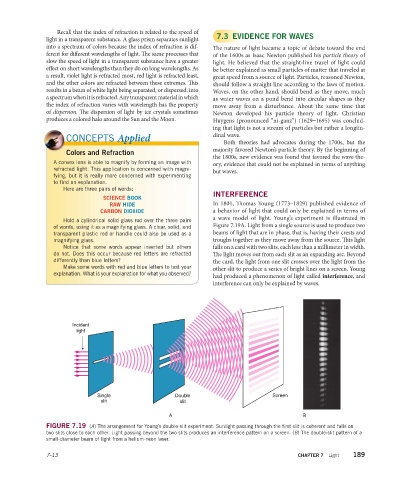
                                            RAW HIDE                           In 1801, Thomas Young (1773–1829) published evidence of
                                         CARBON DIOXIDE                        a behavior of light that could only be explained in terms of
                                                                               a wave model of light. Young’s experiment is illustrated in
                             Hold a cylindrical solid glass rod over the three pairs
                                                                                 Figure 7.19A. Light from a single source is used to produce two
                          of words, using it as a magnifying glass. A clear, solid, and
                          transparent plastic rod or handle could also be used as a   beams of light that are in phase, that is, having their crests and
                          magnifying glass.                                    troughs together as they move away from the source. Th is light
                             Notice that some words appear inverted but others   falls on a card with two slits, each less than a millimeter in width.

                          do not. Does this occur because red letters are refracted   The light moves out from each slit as an expanding arc. Beyond
                          differently than blue letters?                       the card, the light from one slit crosses over the light from the
                             Make some words with red and blue letters to test your   other slit to produce a series of bright lines on a screen. Young
                          explanation. What is your explanation for what you observed?
                                                                               had produced a phenomenon of light called interference, and
                                                                               interference can only be explained by waves.


                                Incident
                                 light


                                        Single                    Double                          Screen
                                          slit                      slit

                                                                A                                           B
                       FIGURE 7.19  (A) The arrangement for Young’s double-slit experiment. Sunlight passing through the first slit is coherent and falls on
                       two slits close to each other. Light passing beyond the two slits produces an interference pattern on a screen. (B) The double-slit pattern of a
                        small-diameter beam of light from a helium-neon laser.

                       7-13                                                                                CHAPTER 7  Light   189

