


Page 234 - 9780077418427.pdf
P. 234
/Users/user-f465/Desktop
          tiL12214_ch08_203-228.indd Page 211  9/1/10  9:45 PM user-f465
          tiL12214_ch08_203-228.indd Page 211  9/1/10  9:45 PM user-f465                                                /Users/user-f465/Desktop


                       which is called the energy of the lowest state. The energy of elec-
                       trons can be expressed in units of the electron volt (eV). An elec-
                       tron volt is defined as the energy of an electron moving through a
                       potential of 1 volt. Since this energy is charge times voltage (from
                                                                      –19
                       equation 6.3, V = W/q), 1.00 eV is equivalent to 1.60 × 10  J.
                       Therefore, the energy of an  electron in the innermost orbit is its
                                                    –19
                       energy in joules divided by 1.60 × 10  J/eV, or –13.6 eV.
                           Bohr found that the energy of each of the allowed orbits
                       could be found from the simple relationship of
                                                    E
                                                   1 _
                                               E      =

                                              n
                                                   2
                                                    n
                                                                equation 8.3
                       where E l  is the energy of the innermost orbit (–13.6 eV) and n is
                       the quantum number for an orbit, or 1, 2, 3, and so on. Thus, the
                       energy for the second orbit (n = 2) is E 2  = –13.6 eV/4 = –3.40 eV.
                       The energy for the third orbit out (n = 3) is E 3  = –13.6 eV/9 =
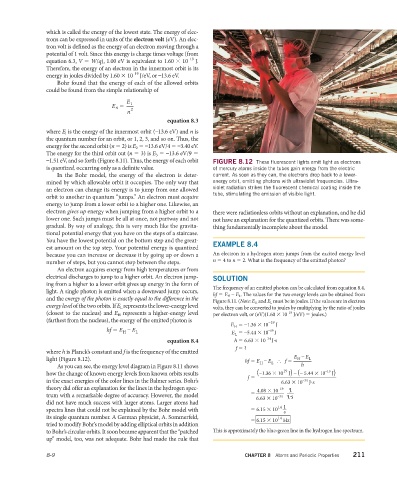
                       –1.51 eV, and so forth (Figure 8.11). Thus, the energy of each orbit   FIGURE 8.12  These fluorescent lights emit light as electrons
                       is quantized, occurring only as a definite value.       of mercury atoms inside the tubes gain energy from the electric
                           In the Bohr model, the energy of the electron is deter-  current. As soon as they can, the electrons drop back to a lower-
                       mined by which allowable orbit it occupies. The only way that   energy orbit, emitting photons with ultraviolet frequencies. Ultra-
                       an electron can change its energy is to jump from one allowed   violet radiation strikes the fluorescent chemical coating inside the
                                                                               tube, stimulating the emission of visible light.
                       orbit to another in quantum “jumps.” An electron must acquire
                       energy to jump from a lower orbit to a higher one. Likewise, an
                       electron gives up energy when jumping from a higher orbit to a   there were radiationless orbits without an explanation, and he did
                       lower one. Such jumps must be all at once, not partway and not   not have an explanation for the quantized orbits. There was some-
                         gradual. By way of analogy, this is very much like the gravita-  thing fundamentally incomplete about the model.
                       tional potential energy that you have on the steps of a staircase.
                       You have the lowest potential on the bottom step and the great-  EXAMPLE 8.4
                       est amount on the top step. Your potential energy is quantized
                       because you can increase or decrease it by going up or down a   An electron in a hydrogen atom jumps from the excited energy level
                       number of steps, but you cannot stop between the steps.  n = 4 to n = 2. What is the frequency of the emitted photon?
                           An electron acquires energy from high temperatures or from
                       electrical discharges to jump to a higher orbit. An electron jump-  SOLUTION
                       ing from a higher to a lower orbit gives up energy in the form of
                                                                               The frequency of an emitted photon can be calculated from equation 8.4,
                       light. A single photon is emitted when a downward jump occurs,
                                                                               hf = E H  – E L . The values for the two energy levels can be obtained from
                       and the energy of the photon is exactly equal to the difference in the
                                                                               Figure 8.11. (Note: E H  and E L  must be in joules. If the values are in electron
                       energy level of the two orbits. If E L  represents the lower-energy level   volts, they can be converted to joules by  multiplying by the ratio of joules
                       (closest to the nucleus) and E H  represents a higher-energy level   per electron volt, or (eV)(1.60 × 10  J/eV) = joules.)
                                                                                                       –19
                       (farthest from the nucleus), the energy of the emitted photon is          –19
                                                                                     E      = –1.36 × 1 0     J
                                                                                      H
                                           hf =  E      –  E                                     –19
                                                 H   L                               E     = –5.44 × 10  J
                                                                                      L
                                                                equation  8.4         h = 6.63 × 10 –34  J⋅s
                                                                                      f = ?
                       where h is Planck’s constant and f is the frequency of the emitted
                                                                                                           H _
                       light (Figure 8.12).                                              hf =  E      –  E        ∴   f =       E      –  E
                                                                                                              L

                                                                                              H
                                                                                                  L
                           As you can see, the energy level diagram in Figure 8.11 shows                    h
                                                                                                      19            –19
                       how the change of known energy levels from known orbits results         (–1.36 ×  10     J)  –   (– 5.44 × 10  J)
                                                                                              ___

                                                                                          f =
                       in the exact energies of the color lines in the Balmer series. Bohr’s         6.63 × 10  J⋅s
                                                                                                            –34
                       theory did offer an explanation for the lines in the hydrogen spec-   __ _
                                                                                                        J
                                                                                                    –19
                                                                                             4.08 × 10


                       trum with a remarkable degree of accuracy. However, the model       =        –34 J⋅s
                                                                                             6.63 × 10
                       did not have much success with larger atoms. Larger atoms had                14 1 _
                       spectra lines that could not be explained by the Bohr model with    = 6.15 ×  10
                                                                                                      s
                       its single quantum number. A German physicist, A. Sommerfeld,                14
                                                                                           = 6.15 ×  10     Hz
                       tried to modify Bohr’s model by adding elliptical orbits in  addition
                       to Bohr’s circular orbits. It soon became apparent that the “patched   This is approximately the blue-green line in the hydrogen line  spectrum.
                       up” model, too, was not adequate. Bohr had made the rule that
                       8-9                                                               CHAPTER 8  Atoms and Periodic Properties   211

