


Page 24 - 9780077418427.pdf
P. 24
/Users/user-f465/Desktop
          tiL12214_ch01_001-024.indd Page 1  9/3/10  7:27 PM user-f465
          tiL12214_ch01_001-024.indd Page 1  9/3/10  7:27 PM user-f465                                                  /Users/user-f465/Desktop


                                                                                                  What Is


                                                                                   1 1 Science?


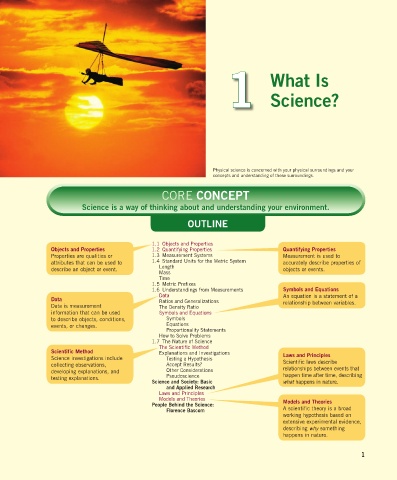
                                                                               Physical science is concerned with your physical surroundings and your
                                                                               concepts and  understanding of these surroundings.


                                                              CORE CONCEPT

                                   Science is a way of thinking about and understanding your environment.

                                                                      OUTLINE


                                                          1.1  Objects and Properties
                         Objects and Properties           1.2 Quantifying Properties                  Quantifying Properties
                         Properties are qualities or      1.3 Measurement Systems                     Measurement is used to

                         attributes that can be used to   1.4  Standard Units for the Metric System   accurately describe properties of
                                                             Length
                         describe an object or event.                                                 objects or events.
                                                             Mass
                                                             Time
                                                          1.5 Metric Prefixes
                                                          1.6  Understandings from Measurements       Symbols and Equations
                                                             Data                                     An equation is a statement of a
                         Data                                Ratios and Generalizations               relationship between variables.
                         Data is measurement                 The Density Ratio
                         information that can be used        Symbols and Equations
                         to describe objects, conditions,        Symbols
                         events, or changes.                     Equations
                                                                 Proportionality Statements
                                                             How to Solve Problems
                                                          1.7  The Nature of Science
                                                             The Scientific Method
                         Scientific Method                   Explanations and Investigations
                         Science investigations include          Testing a Hypothesis                 Laws and Principles
                         collecting observations,                Accept Results?                      Scientific laws describe
                         developing explanations, and            Other Considerations                 relationships between events that
                         testing explanations.                   Pseudoscience                        happen time after time, describing
                                                          Science and Society: Basic                  what happens in nature.
                                                               and Applied Research
                                                             Laws and Principles
                                                             Models and Theories
                                                          People Behind the Science:                  Models and Theories
                                                               Florence Bascom                        A scientific theory is a broad
                                                                                                      working hypothesis based on
                                                                                                      extensive experimental evidence,
                                                                                                      describing why something
                                                                                                      happens in nature.


                                                                                                                                1

