


Page 27 - 9780077418427.pdf
P. 27
/Users/user-f465/Desktop
          tiL12214_ch01_001-024.indd Page 4  9/1/10  9:51 PM user-f465
          tiL12214_ch01_001-024.indd Page 4  9/1/10  9:51 PM user-f465                                                  /Users/user-f465/Desktop


                   or may not have in mind. Thus, such attributes as “long” fin-     Yard
                   gernails or “short” hair may have entirely different meanings to                                Cubit
                   different people involved in a conversation. Assumptions and   Inch
                   vagueness can be avoided by using measurement in a descrip-
                   tion. Measurement is a process of comparing a property to a
                   well-defined and agreed-upon referent. The well-defined and
                   agreed-upon referent is used as a standard called a unit. The
                   measurement process involves three steps: (1)  comparing the
                   referent unit to the property being described, (2) following a                             Fathom
                   procedure, or operation, that specifies how the comparison is
                   made, and (3) counting how many standard units describe the
                   property being considered.
                      The measurement process uses a defined referent unit,
                   which is compared to a property being measured. The value of
                   the property is determined by counting the number of referent
                   units. The name of the unit implies the procedure that results
                   in the number. A measurement statement always contains a
                     number and name for the referent unit. The number answers
                   the question “How much?” and the name answers the question
                   “Of what?” Thus, a measurement always tells you “how much
                                                                                                        1,000 double paces = 1 mile
                   of what.” You will find that using measurements will sharpen
                   your communications. You will also find that using measure-             Foot
                   ments is one of the first steps in understanding your physical
                   environment.
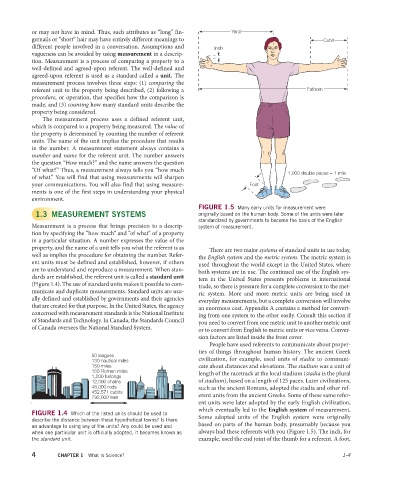
                                                                          FIGURE 1.5  Many early units for measurement were
                    1.3 MEASUREMENT SYSTEMS                               originally based on the human body. Some of the units were later
                                                                          standardized by governments to become the basis of the English
                   Measurement is a process that brings precision to a descrip-  system of measurement.
                   tion by specifying the “how much” and “of what” of a property
                   in a particular situation. A number expresses the value of the
                   property, and the name of a unit tells you what the referent is as
                                                                             There are two major systems of standard units in use today,
                   well as implies the procedure for obtaining the number. Refer-
                                                                          the English system and the metric system. The metric system is
                   ent units must be defined and established, however, if others
                                                                          used throughout the world except in the United States, where
                   are to understand and reproduce a measurement. When stan-
                                                                          both systems are in use. The continued use of the English sys-
                   dards are established, the referent unit is called a standard unit
                                                                          tem in the United States presents problems in internation al
                   (Figure 1.4). The use of standard units makes it possible to com-
                                                                          trade, so there is pressure for a complete conversion to the met-
                   municate and duplicate measurements. Standard units are usu-
                                                                          ric system. More and more metric units are being used in
                   ally defined and established by governments and their agencies
                                                                            everyday mea surements, but a complete conversion will involve
                   that are created for that purpose. In the United States, the agency
                                                                          an enormous cost. Appendix A contains a method for convert-
                   concerned with measurement standards is the National Institute
                                                                          ing from one system to the other easily. Consult this section if
                   of  Standards and Technology. In Canada, the Standards Council
                                                                          you need to convert from one metric unit to another metric unit
                   of Canada oversees the National Standard  System.
                                                                          or to convert from English to metric units or vice versa. Conver-
                                                                          sion factors are listed inside the front cover.
                                                                             People have used referents to communicate about proper-
                                                                          ties of things throughout human history. The ancient Greek
                                       50 leagues
                                       130 nautical miles                   civilization, for example, used units of  stadia to communi-
                                       150 miles                          cate about distances and elevations. The stadium was a unit of
                                       158 Roman miles                    length of the racetrack at the local stadium (stadia is the plural
                                       1,200 furlongs
                                       12,000 chains                      of stadium), based on a length of 125 paces. Later civilizations,
                                       48,000 rods                        such as the ancient Romans, adopted the stadia and other ref-
                                       452,571 cubits
                                       792,000 feet                       erent units from the ancient Greeks. Some of these same refer-
                                                                          ent units were later adopted by the early English civilization,
                                                                          which eventually led to the English system of measurement.
                   FIGURE 1.4  Which of the listed units should be used to
                   describe the distance between these hypothetical towns? Is there   Some adopted units of the English system were originally
                   an advantage to using any of the units? Any could be used and   based on parts of the human body, presumably because you
                   when one particular unit is officially adopted, it becomes known as   always had these referents with you (Figure 1.5). The inch, for
                   the standard unit.                                     example, used the end joint of the thumb for a referent. A foot,
                   4       CHAPTER 1  What Is Science?                                                                    1-4

