


Page 25 - 9780077418427.pdf
P. 25
/Users/user-f465/Desktop
          tiL12214_ch01_001-024.indd Page 2  9/1/10  9:51 PM user-f465
          tiL12214_ch01_001-024.indd Page 2  9/1/10  9:51 PM user-f465                                                  /Users/user-f465/Desktop


                   OVERVIEW


                     Have you ever thought about your thinking and what you know? On a very simplified level, you could say that
                     everything you know came to you through your senses. You see, hear, and touch things of your choosing, and you can
                     also smell and taste things in your surroundings. Information is gathered and sent to your brain by your sense organs.
                     Somehow, your brain processes all this information in an attempt to find order and make sense of it all. Finding order
                     helps you understand the world and what may be happening at a particular place and time. Finding order also helps
                     you predict what may happen next, which can be very important in a lot of situations.
                         This is a book on thinking about and understanding your physical surroundings. These surroundings range from
                     the obvious, such as the landscape and the day-to-day weather, to the not so obvious, such as how atoms are put together.
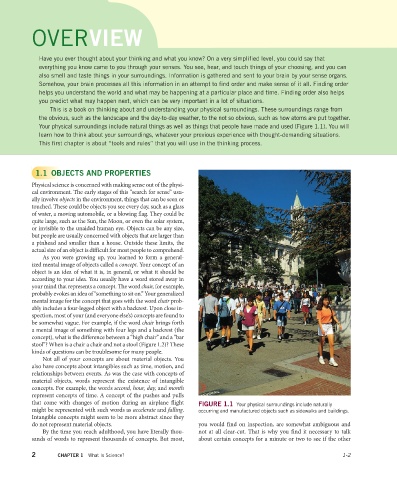
                     Your physical  surroundings include natural things as well as things that people have made and used (Figure 1.1). You will
                     learn how to think about your surroundings, whatever your previous experience with thought-demanding situations.
                     This first chapter is about “tools and rules” that you will use in the thinking process.


                    1.1  OBJECTS AND PROPERTIES
                   Physical science is concerned with making sense out of the physi-
                   cal environment. The early stages of this “search for sense” usu-
                   ally involve objects in the environment, things that can be seen or
                   touched. These could be objects you see every day, such as a glass
                   of water, a moving automobile, or a blowing flag. They could be
                   quite large, such as the Sun, the Moon, or even the  solar system,
                   or invisible to the unaided human eye. Objects can be any size,
                   but people are usually concerned with objects that are larger than
                   a pinhead and smaller than a house. Outside these limits, the
                   actual size of an object is difficult for most  people to comprehend.
                      As you were growing up, you learned to form a general-
                   ized mental image of objects called a concept. Your concept of an
                   object is an idea of what it is, in general, or what it should be
                     according to your idea. You usually have a word stored away in
                   your mind that represents a concept. The word chair, for example,
                   probably evokes an idea of “something to sit on.” Your generalized
                   mental image for the concept that goes with the word chair prob-
                   ably includes a four-legged object with a backrest. Upon close in-
                   spection, most of your (and everyone else’s) concepts are found to
                   be somewhat vague. For example, if the word chair brings forth
                   a mental image of something with four legs and a backrest (the
                   concept), what is the difference between a “high chair” and a “bar
                   stool”? When is a chair a chair and not a stool (Figure 1.2)? These
                   kinds of questions can be troublesome for many people.
                      Not all of your concepts are about material objects. You
                   also have concepts about intangibles such as time, motion, and
                   relationships between events. As was the case with concepts of
                     material objects, words represent the existence of intangible
                   concepts. For example, the words second, hour, day, and month
                   represent concepts of time. A concept of the pushes and pulls
                   that come with changes of motion during an airplane flight   FIGURE 1.1  Your physical surroundings include naturally
                   might be represented with such words as accelerate and falling.   occurring and manufactured objects such as sidewalks and buildings.
                   Intangible concepts might seem to be more abstract since they
                   do not represent material objects.                     you would find on inspection, are somewhat ambiguous and
                      By the time you reach adulthood, you have literally thou-  not at all clear-cut. That is why you find it necessary to talk
                   sands of words to represent thousands of concepts. But most,   about certain concepts for a minute or two to see if the other

                   2       CHAPTER 1  What Is Science?                                                                    1-2

