


Page 28 - 9780077418427.pdf
P. 28
/Users/user-f465/Desktop
          tiL12214_ch01_001-024.indd Page 5  9/1/10  9:51 PM user-f465
          tiL12214_ch01_001-024.indd Page 5  9/1/10  9:51 PM user-f465                                                  /Users/user-f465/Desktop


                                                                                                   Length
                         TABLE 1.1
                         The SI base units
                         Property                 Unit             Symbol                                                Height
                         Length                   meter             m                  Width  Area       Volume
                         Mass                     kilogram          kg
                         Time                     second            s
                                                                                                                    Width
                         Electric current         ampere            A
                                                                                            Length      Length
                         Temperature              kelvin            K
                         Amount of substance      mole              mol
                                                                                         A = L   W         V = L   W   H


                         Luminous intensity       candela           cd
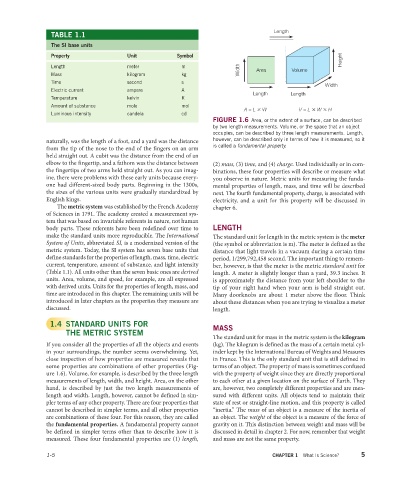
                                                                               FIGURE 1.6  Area, or the extent of a surface, can be described
                                                                               by two length measurements. Volume, or the space that an object
                                                                               occupies, can be described by three length measurements. Length,
                       naturally, was the length of a foot, and a yard was the distance   however, can be described only in terms of how it is measured, so it
                                                                               is called a fundamental property.
                       from the tip of the nose to the end of the fingers on an arm
                       held straight out. A cubit was the distance from the end of an
                       elbow to the fingertip, and a fathom was the distance between   (2) mass, (3) time, and (4) charge. Used individually or in com-
                       the fingertips of two arms held straight out. As you can imag-  binations, these four properties will describe or measure what
                       ine, there were problems with these early units because every-  you observe in nature. Metric units for measuring the funda-
                       one had different-sized body parts. Beginning in the 1300s,   mental properties of length, mass, and time will be described
                       the sizes of the various units were gradually standardized by   next. The fourth fundamental property, charge, is associated with
                       English kings.                                          electricity, and a unit for this property will be discussed in
                           The metric system was established by the French Academy   chapter 6.
                       of Sciences in 1791. The academy created a measurement sys-
                       tem that was based on invariable referents in nature, not human
                       body parts. These referents have been redefined over time to   LENGTH
                       make the standard units more reproducible. The International   The standard unit for length in the metric system is the  meter
                       System of Units, abbreviated SI, is a modernized version of the   (the symbol or abbreviation is m). The meter is defined as the
                       metric system. Today, the SI system has seven base units that   distance that light travels in a vacuum during a certain time
                         define standards for the properties of length, mass, time, electric     period, 1/299,792,458 second. The important  thing to remem-
                       current, temperature, amount of substance, and light intensity   ber, however, is that the meter is the metric standard unit for
                       (Table 1.1). All units other than the seven basic ones are derived   length. A meter is slightly longer than a yard, 39.3 inches. It
                       units. Area, volume, and speed, for example, are all expressed   is approximately the distance from your left shoulder to the
                       with derived units. Units for the properties of length, mass, and   tip of your right hand when your arm is held straight out.
                       time are introduced in this chapter. The remaining units will be   Many doorknobs are about 1 meter above the floor. Think
                       introduced in later chapters as the properties they measure are   about these  distances when you are trying to visualize a meter
                       discussed.                                              length.

                         1.4  STANDARD UNITS FOR                               MASS
                              THE METRIC SYSTEM
                                                                               The standard unit for mass in the metric system is the kilogram
                       If you consider all the properties of all the objects and events   (kg). The kilogram is defined as the mass of a certain metal cyl-
                       in your surroundings, the number seems overwhelming. Yet,   inder kept by the International Bureau of Weights and Measures
                       close inspection of how properties are measured reveals that   in France. This is the only standard unit that is still defined in
                       some properties are combinations of other properties (Fig-  terms of an object. The property of mass is sometimes confused
                       ure 1.6). Volume, for example, is described by the three length   with the property of weight since they are directly proportional
                       measurements of length, width, and height. Area, on the ot her   to each other at a given location on the surface of Earth. They
                       hand, is described by just the two length measurements of   are, however, two completely different properties and are mea-
                       length and width. Length, however, cannot be defined in sim-  sured with different units. All objects tend to maintain their
                       pler terms of any other property. There are four properties that   state of rest or straight-line motion, and this property is called
                       cannot be  described in simpler terms, and all other properties   “inertia.” The mass of an object is a measure of the inertia of
                       are combinations of these four. For this reason, they are called   an object. The weight of the object is a measure of the force of
                       the fundamental  properties. A fundamental property cannot   gravity on it. This distinction between weight and mass will be
                       be defined in simpler terms other than to describe how it is   discussed in detail in chapter 2. For now, remember that weight
                       measured. These four fundamental properties are (1) length,   and mass are not the same property.

                       1-5                                                                        CHAPTER 1  What Is Science?   5

