


Page 244 - 9780077418427.pdf
P. 244
/Users/user-f465/Desktop
          tiL12214_ch08_203-228.indd Page 221  9/1/10  9:45 PM user-f465
          tiL12214_ch08_203-228.indd Page 221  9/1/10  9:45 PM user-f465                                                /Users/user-f465/Desktop


                                                                               these elements conduct electric currents under certain condi-
                                     1–
                                   2–                   2–                     tions. The ability to conduct an electric current is a property of
                                3+                   3+      +    e            a metal, and nonmalleability is a property of nonmetals, so as
                                                                               you can see, these semiconductors have the properties of both
                                                                       3+      metals and nonmetals.
                                                                       2–
                        A                                                         The transition elements, which are all metals, are located
                                Li                   Li +              1+      in the B-group families. Unlike the representative elements,
                                                                               which form vertical families of similar properties, the transi-
                                                                               tion  elements tend to form horizontal groups of elements with
                                                                                 similar properties. Iron (Fe), cobalt (Co), and nickel (Ni) in
                                      7–                             8–
                                   2–                             2–           group  VIIIB, for example, are three horizontally arranged
                                9+         +   e               9+              metallic  elements that show magnetic properties.
                                                                                  A family of representative elements all form ions with the
                                                                               same charge. Alkali metals, for example, all lose an electron to
                                                                       9+      form a 1+ ion. The transition elements have variable charges.
                                                                       10–
                        B        F                             F –     1–      Some transition elements, for example, lose their one outer
                                                                               electron to form 1+ ions (copper, silver). Copper, because of
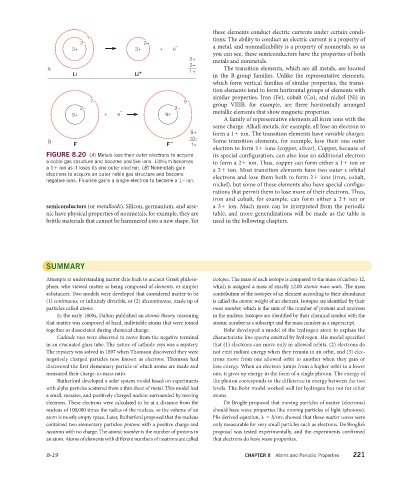
                       FIGURE 8.20  (A) Metals lose their outer electrons to acquire   its special configuration, can also lose an additional electron
                       a noble gas structure and become positive ions. Lithium becomes   to form a 2+ ion. Thus, copper can form either a 1+ ion or
                       a 1+ ion as it loses its one outer electron. (B) Nonmetals gain   a 2+ ion. Most transition elements have two outer s orbital
                        electrons to acquire an outer noble gas structure and become
                                                                               electrons and lose them both to form 2+ ions (iron, cobalt,
                        negative ions. Fluorine gains a single electron to become a 1– ion.
                                                                               nickel), but some of these elements also have special configu-
                                                                               rations that permit them to lose more of their electrons. Thus,
                                                                               iron and cobalt, for example, can form either a 2+ ion or
                       semi conductors (or metalloids). Silicon, germanium, and arse-  a 3+ ion. Much more can be interpreted from the periodic
                       nic have physical properties of nonmetals; for example, they are   table, and more generalizations will be made as the table is
                       brittle materials that cannot be hammered into a new shape. Yet   used in the following chapters.


                       SUMMARY

                       Attempts at understanding matter date back to ancient Greek philoso-  isotopes. The mass of each isotope is compared to the mass of carbon-12,
                       phers, who viewed matter as being composed of elements, or simpler   which is assigned a mass of exactly 12.00 atomic mass units. The mass
                       substances. Two models were developed that considered matter to be   contribution of the isotopes of an element according to their abundance
                       (1) continuous, or infinitely divisible, or (2) discontinuous, made up of   is called the atomic weight of an element. Isotopes are identified by their
                       particles called atoms.                                 mass number, which is the sum of the number of protons and neutrons
                           In the early 1800s, Dalton published an atomic theory, reasoning   in the nucleus. Isotopes are identified by their chemical symbol with the
                       that matter was composed of hard, indivisible atoms that were joined   atomic number as a subscript and the mass number as a superscript.
                       together or dissociated during chemical change.            Bohr developed a model of the hydrogen atom to explain the
                           Cathode rays were observed to move from the negative terminal   characteristic line spectra emitted by hydrogen. His model specified
                       in an evacuated glass tube. The nature of cathode rays was a mystery.   that (1) electrons can move only in allowed orbits, (2) electrons do
                       The mystery was solved in 1897 when Thomson discovered they were   not emit radiant energy when they remain in an orbit, and (3) elec-
                       negatively charged particles now known as  electrons. Thomson had   trons move from one allowed orbit to another when they gain or
                       discovered the first elementary particle of which atoms are made and   lose energy. When an electron jumps from a higher orbit to a lower
                       measured their charge-to-mass ratio.                    one, it gives up energy in the form of a single photon. The energy of
                           Rutherford developed a solar system model based on experiments   the photon corresponds to the difference in energy between the two
                       with alpha particles scattered from a thin sheet of metal. This model had   levels. The Bohr model worked well for hydrogen but not for other
                       a small, massive, and positively charged nucleus surrounded by moving   atoms.
                       electrons. These electrons were calculated to be at a distance from the   De Broglie proposed that moving particles of matter (electrons)
                       nucleus of 100,000 times the radius of the nucleus, so the volume of an   should have wave properties like moving particles of light (photons).
                       atom is mostly empty space. Later, Rutherford proposed that the nucleus   His derived equation, λ = h/mv, showed that these matter waves were
                       contained two elementary particles: protons with a positive charge and   only measurable for very small particles such as electrons. De Broglie’s
                       neutrons with no charge. The atomic number is the number of protons in   proposal was tested experimentally, and the experiments confirmed
                       an atom. Atoms of elements with different numbers of neutrons are called   that electrons do have wave properties.

                       8-19                                                              CHAPTER 8  Atoms and Periodic Properties   221

