


Page 241 - 9780077418427.pdf
P. 241
/Users/user-f465/Desktop
          tiL12214_ch08_203-228.indd Page 218  9/1/10  9:45 PM user-f465
          tiL12214_ch08_203-228.indd Page 218  9/1/10  9:45 PM user-f465                                                /Users/user-f465/Desktop


                    TABLE 8.5
                                                                            number of 14. The square with the symbol Si and the
                    Electron structures of the noble gas family             atomic number 14 is located in the third period (third row)
                                                                            and in the column  identified as IVA (14).
                                               Number of Electrons in
                              Electron           Main Energy Level             Now, can you identify the period and family of the
                    Element   Configuration   1st  2nd 3rd 4th 5th 6th  7th  element iron (Fe)? Compare your answer with a classmate’s
                                                                            to check.
                               2
                    Helium (He) 1s           2   —  —  — — —  —
                                   2
                                     6
                    Neon (Ne)  [He] 2s 2p    2   8   —  — — —  —
                                     6
                                   2
                    Argon (Ar)   [Ne] 3s 3p    2   8    8  —  —  —  —      8.6  METALS, NONMETALS,
                                     10
                                        6
                                  2
                    Krypton (Kr) [Ar] 4s 3d 4p    2   8  18    8  —  —  —
                                                                                AND SEMICONDUCTORS
                                        6
                                  2
                                     10
                    Xenon (Xe)  [Kr] 5s 4d 5p    2   8  18  18    8  —  —
                                  2
                                           6
                                     14
                                        10
                    Radon (Rn)  [Xe] 6s 4f 5d 6p  2   8  18  32  18  8   —  As indicated earlier, chemical behavior is mostly concerned with
                                                                          the outer orbital electrons. The outer orbital electrons, that is, the
                                                                          highest energy level electrons, are conveniently represented with
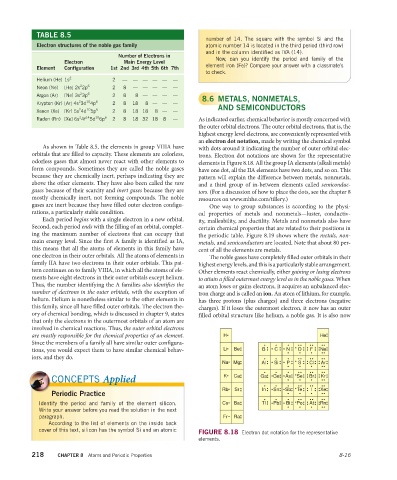
                                                                          an electron dot notation, made by writing the chemical symbol
                      As shown in Table 8.5, the elements in group VIIIA have   with dots around it indicating the number of outer orbital elec-
                   orbitals that are filled to capacity. These elements are color less,   trons. Electron dot notations are shown for the representative
                   odorless gases that almost never react with other ele ments to   elements in Figure 8.18. All the group IA elements (alkali metals)
                   form compounds. Sometimes they are called the noble gases   have one dot, all the IIA elements have two dots, and so on. This
                   because they are chemically inert, perhaps indicating they are   pattern will explain the difference between metals, nonmetals,
                   above the other elements. They have also been called the rare   and a third group of in-between elements called  semiconduc-
                   gases because of their scarcity and inert gases because they are   tors. (For a discussion of how to place the dots, see the chapter 8
                   mostly chemically inert, not forming compounds. The noble   resources on www.mhhe.com/tillery.)
                   gases are inert because they have filled outer electron configu-  One way to group substances is according to the physi-
                   rations, a particularly stable condition.              cal properties of metals and nonmetals—luster, conductiv-
                      Each period begins with a single electron in a new orbital.   ity,  malleability, and ductility. Metals and nonmetals also have
                   Second, each period ends with the filling of an orbital, complet-    certain chemical properties that are related to their positions in
                   ing the maximum number of electrons that can occupy that   the periodic table. Figure 8.19 shows where the metals, non-
                   main energy level. Since the first A family is identified as IA,   metals, and semiconductors are located. Note that about 80 per-
                   this means that all the atoms of elements in this family have   cent of all the elements are metals.
                   one electron in their outer orbitals. All the atoms of elements in   The noble gases have completely filled outer orbitals in their
                   family IIA have two electrons in their outer orbitals. This pat-  highest energy levels, and this is a particularly stable arrangement.
                   tern continues on to family VIIIA, in which all the atoms of ele-  Other elements react chemically, either gaining or losing electrons
                   ments have eight electrons in their outer orbitals except helium.   to attain a filled outermost energy level as in the noble gases. When
                   Thus, the number identifying the A families also identifies the   an atom loses or gains electrons, it acquires an unbalanced elec-
                   number of electrons in the outer orbitals, with the exception of   tron charge and is called an ion. An atom of lithium, for example,
                   helium. Helium is nonetheless similar to the other elements in   has three protons (plus charges) and three electrons (negative
                   this family, since all have filled outer orbitals. The electron the-  charges). If it loses the outermost electron, it now has an outer
                   ory of chemical bonding, which is discussed in chapter 9, states   filled orbital structure like helium, a noble gas. It is also now
                   that only the electrons in the outermost orbitals of an atom are
                   involved in chemical reactions. Thus, the outer orbital electrons
                   are mostly responsible for the chemical properties of an element.
                   Since the members of a family all have similar outer configura-
                   tions, you would expect them to have similar chemical behav-
                   iors, and they do.


                         CONCEPTS Applied

                         Periodic Practice

                     Identify the period and family of the element  silicon.
                     Write your answer before you read the solution in the next
                     paragraph.
                        According to the list of elements on the inside back
                     cover of this text, silicon has the symbol Si and an atomic
                                                                            FIGURE 8.18  Electron dot notation for the representative
                                                                            elements.

                   218     CHAPTER 8  Atoms and Periodic Properties                                                     8-16

