


Page 242 - 9780077418427.pdf
P. 242
/Users/user-f465/Desktop
          tiL12214_ch08_203-228.indd Page 219  9/1/10  9:45 PM user-f465
          tiL12214_ch08_203-228.indd Page 219  9/1/10  9:45 PM user-f465                                                /Users/user-f465/Desktop


                                                                                            A Closer Look

                                                                                                      The Rare Earths

                             ompounds of the rare earths were first   rows contain two series of elements that actu-  lasers. Samarium, ytterbium, and terbium
                          Cidentified when they were isolated from   ally belong in periods 6 and 7, but they are   have special magnetic properties that have
                          uncommon minerals in the late 1700s. The   moved below so that the entire table is not   made  possible new electric motor designs,
                          elements are very reactive and have similar   so wide. Together, the two series are called   magnetic-optical devices in computers, and
                          chemical properties, so they were not recog-  the inner transition elements. The top series is   the creation of a ceramic superconductor.
                          nized as elements until some 50 years later.     14 elements wide from elements 58 through   Other rare earth metals are being researched
                          Thus, they were first recognized as earths,   71. Since this series belongs next to element   for use in possible high- temperature super-
                          that is, nonmetal substances, when in fact   57, lanthanum, it is sometimes called the   conductivity materials. Many rare earths are
                          they are metallic elements. They were also   lanthanide series. This series is also known as   used in metal alloys; for example, an alloy
                          considered to be rare since, at that time, they   the rare earths. The second series of 14 ele-  of cerium is used to make heat- resistant
                          were known to occur only in uncommon   ments is called the actinide series. These are   jet engine parts. Erbium is used in high-
                          minerals. Today, these metallic elements are   mostly the artificially prepared elements that   performance metal alloys. Dysprosium and
                          known to be more abundant in the earth   do not occur naturally.     holmium have neutron-absorbing proper-
                          than gold, silver, mercury, or tungsten. The   You may never have heard of the rare   ties and are used in control rods to control
                          rarest of the rare earths, thulium, is twice as   earth elements, but they are key materials in   nuclear fission. Europium is known because
                          abundant as silver. The rare earth elements   many advanced or high-technology prod-  of its role in making the red color of color
                          are neither rare nor earths, and they are   ucts. Lanthanum, for example, gives glass   television screens. The rare earths are rela-
                          important materials in glass, electronic, and   special refractive properties and is used in   tively abundant metallic elements that play
                          metallurgical industries.          optic fibers and expensive camera lenses.   a key role in many common and high-
                             You can identify the rare earths in the   Samarium, neodymium, and dysprosium     technology applications. They may also play
                          two lowest rows of the periodic table. These   are used to manufacture crystals used in   a key role in super conductivity research.


                                      1                        Metals                                         2
                                        H                                                                      He
                                                             Nonmetals
                                      3    4                                             5   6    7   8   9   10
                                        Li  Be                                            B    C   N   O   F   Ne
                                                           Semiconductors
                                      11   12                                            13   14  15  16  17  18
                                       Na Mg                                              Al   Si  P   S   Cl  Ar
                                      19   20  21  22  23   24  25  26  27   28  29  30  31   32  33  34  35  36
                                        K  Ca Sc    Ti   V  Cr Mn Fe Co Ni Cu Zn Ga Ge As Se               Br  Kr

                                      37   38  39  40  41   42  43  44  45   46  47  48  49  50   51  52  53  54
                                       Rb Sr    Y   Zr Nb Mo Tc Ru Rh Pd Ag Cd            In  Sn Sb Te      I  Xe
                                      55   56  57  72  73   74  75  76  77   78  79  80  81  82   83  84  85  86
                                       Cs Ba La     Hf  Ta   W  Re Os     Ir  Pt Au Hg    Tl  Pb   Bi  Po  At Rn
                                      87   88  89  104  105  106  107  108  109  110  111  112  113  114  115  116  118
                                       Fr  Ra Ac    Rf  Db Sg Bh Hs Mt Ds

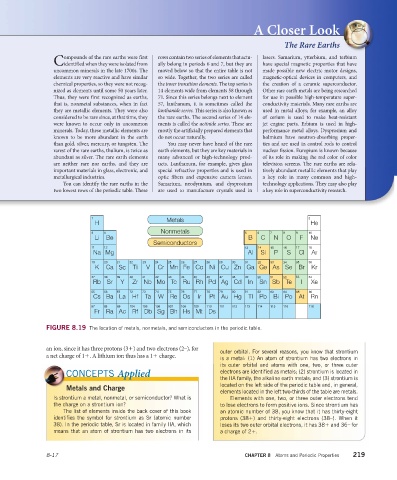
                       FIGURE 8.19  The location of metals, nonmetals, and semiconductors in the periodic table.


                       an ion, since it has three protons (3+) and two electrons (2–), for
                                                                                 outer orbital. For several  reasons, you know that strontium
                       a net charge of 1+. A lithium ion thus has a 1+ charge.
                                                                                 is a metal: (1) An atom of strontium has two electrons in
                                                                                 its outer orbital and atoms with one, two, or three outer
                              CONCEPTS Applied                                   electrons are identified as metals; (2) strontium is located in
                                                                                 the IIA family, the alkaline earth metals; and (3) strontium is
                                                                                 located on the left side of the  periodic table and, in general,
                              Metals and Charge
                                                                                 elements located in the left two-thirds of the table are metals.
                          Is strontium a metal, nonmetal, or semiconductor? What is   Elements with one, two, or three outer electrons tend
                          the charge on a strontium ion?                         to lose electrons to form positive ions. Since strontium has
                             The list of elements inside the back cover of this book   an atomic number of 38, you know that it has thirty-eight
                          identifies the symbol for strontium as Sr (atomic number     protons (38+) and thirty-eight electrons (38–). When it
                          38). In the periodic table, Sr is located in family IIA, which   loses its two outer orbital electrons, it has 38+ and 36– for
                          means that an atom of strontium has two electrons in its   a charge of 2+.


                       8-17                                                              CHAPTER 8  Atoms and Periodic Properties   219

