


Page 239 - 9780077418427.pdf
P. 239
/Users/user-f465/Desktop
          tiL12214_ch08_203-228.indd Page 216  9/1/10  9:45 PM user-f465
          tiL12214_ch08_203-228.indd Page 216  9/1/10  9:45 PM user-f465                                                /Users/user-f465/Desktop


                                                                          the element, and the number below the symbol is the rounded
                                                                          atomic weight of the element. Horizontal rows of elements run
                                   1s
                                                                          from left to right with increasing atomic numbers. Each row is
                                                                          called a period. The periods are numbered from 1 to 7 on the left
                                   2s   2p
                                                                          side. A vertical column of elements is called a family (or group)
                                                                          of elements. Elements in families have similar properties, but
                                   3s   3p    3d
                                                                          this is more true of some families than of others. The table is
                                                                          subdivided into A and B groups. The members of the A-group
                                   4s   4p    4d   4f                     families are called the main group, or representative elements.
                                                                          The members of the B group are called the transition elements
                                   5s   5p    5d   5f                     (or metals). Some science organizations use a 1-to-18 designa-
                                                                          tion for the A and B groups, as shown in Figure 8.17. The A and
                                   6s   6p    6d   6f                     B designations will be used throughout this text.
                                                                             As shown in Table 8.4, all of the elements in the first column
                                   7s   7p    7d                          have an outside electron configuration of one electron. With the
                                                                          exception of hydrogen, the elements of the first  column are shiny,
                                                                          low-density metals that are so soft you can cut them easily with a
                                                                          knife. These metals are called the alkali metals because they react
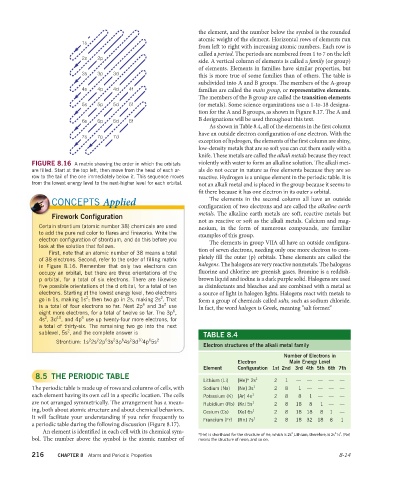
                   FIGURE 8.16  A matrix showing the order in which the orbitals   violently with water to form an alkaline solution. The alkali met-
                   are filled. Start at the top left, then move from the head of each ar-  als do not occur in nature as free  elements because they are so
                   row to the tail of the one immediately below it. This sequence moves   reactive. Hydrogen is a unique  element in the periodic table. It is
                   from the lowest energy level to the next-higher level for each orbital.  not an alkali metal and is placed in the group because it seems to
                                                                          fit there because it has one  electron in its outer s orbital.
                         CONCEPTS Applied                                    The elements in the second column all have an outside
                                                                            configuration of two electrons and are called the alkaline earth
                                                                          metals. The alkaline earth metals are soft, reactive metals but
                         Firework Configuration
                                                                          not as reactive or soft as the alkali metals. Calcium and mag-
                     Certain strontium (atomic number 38) chemicals are used   nesium, in the form of numerous compounds, are familiar
                     to add the pure red color to flares and fireworks. Write the     examples of this group.
                     electron configuration of strontium, and do this before you   The elements in group VIIA all have an outside configura-
                     look at the  solution that follows.
                        First, note that an atomic number of 38 means a total   tion of seven electrons, needing only one more electron to com-
                     of 38 electrons. Second, refer to the order of filling matrix   pletely fill the outer (p) orbitals. These elements are called the
                     in Figure 8.16. Remember that only two electrons can   halogens. The halogens are very reactive nonmetals. The halogens
                     occupy an orbital, but there are three orientations of the   fluorine and chlorine are greenish gases. Bromine is a reddish-
                     p orbital, for a  total of six electrons. There are likewise   brown liquid and iodine is a dark purple solid. Halogens are used
                     five possible orientations of the d orbital, for a total of ten   as disinfectants and bleaches and are combined with a metal as
                     electrons. Starting at the lowest energy level, two electrons   a source of light in halogen lights. Halogens react with metals to
                                     2
                                                             2
                     go in 1s, making 1s ; then two go in 2s, making 2s . That   form a group of chemicals called salts, such as sodium chloride.
                                                       6
                                                               2
                     is a total of four electrons so far. Next 2p  and 3s  use   In fact, the word halogen is Greek, meaning “salt former.”
                                                                 6
                     eight more electrons, for a  total of twelve so far. The 3p ,
                           10
                                   6
                       2
                     4s , 3d , and 4p  use up twenty-four more electrons, for
                     a total of thirty-six. The remaining two go into the next
                               2
                     sublevel, 5s , and the complete answer is             TABLE 8.4
                                           6
                                        2
                                                6
                                              2
                                      2
                                                      10
                                                         6
                                                   2
                           Strontium: 1s 2s 2p 3s 3p 4s 3d 4p 5s 2
                                                                           Electron structures of the alkali metal family
                                                                                                      Number of Electrons in
                                                                                       Electron         Main Energy Level
                                                                           Element     Configuration  1st  2nd  3rd 4th 5th 6th 7th
                    8.5  THE PERIODIC TABLE
                                                                                             1
                                                                           Lithium (Li)   [He]* 2s    2   1   — — — — —
                                                                                            1
                   The periodic table is made up of rows and columns of cells, with   Sodium (Na)   [Ne] 3s    2   8     1  — — — —
                   each element having its own cell in a specific location. The cells   Potassium (K)  [Ar] 4s 1  2  8  8  1  —  —  —
                   are not arranged symmetrically. The arrangement has a mean-  Rubidium (Rb)  [Kr] 5s    2   8   18   8   1  —  —
                                                                                            1
                   ing, both about atomic structure and about chemical behaviors.           1
                                                                           Cesium (Cs)   [Xe] 6s   2   8  18  18  8  1   —
                   It will facilitate your understanding if you refer frequently to         1
                                                                            Francium (Fr)  [Rn] 7s    2   8   18 32 18   8   1
                   a periodic table during the following discussion (Figure 8.17).
                      An element is identified in each cell with its chemical sym-
                                                                                                         2
                                                                                                                       2
                                                                                                                         1
                                                                          *[He] is shorthand for the structure of He, which is 2s .  Lithium, therefore, is 2s 1s . [Ne]
                   bol. The number above the symbol is the atomic number of   means the structure of neon, and so on.
                   216     CHAPTER 8  Atoms and Periodic Properties                                                     8-14

