


Page 300 - 9780077418427.pdf
P. 300
/Users/user-f465/Desktop
          tiL12214_ch11_275-298.indd Page 277  9/3/10  6:12 PM user-f465
          tiL12214_ch11_275-298.indd Page 277  9/3/10  6:12 PM user-f465                                                /Users/user-f465/Desktop


                                                                                TABLE 11.1
                                                                                Possible pollution problems in the U.S. water supply
                                                                                Pollutant       Source            Risk
                                                                                Lead            Lead pipes in     Nerve damage,
                                                                                                  older homes;      miscarriage, birth
                                                                                                  solder in copper      defects, high
                                                                                                  pipes; brass      blood pressure,
                                                                                                 fixtures          hearing problems
                                                                                Chlorinated     Industrial        Cancer
                                                                                 solvents        pollution
                                                                                Trihalomethanes   Chlorine       Liver damage,
                                                                                                  disinfectant      kidney damage,
                                                                                                  reacting with      possible cancer
                                                                                                 other pollutants
                                                                                PCBs            Industrial waste,    Liver damage,
                                                                                                  older transformers     possible cancer
                                                                                Bacteria and    Septic tanks,     Gastrointestinal
                                                                                 viruses          outhouses,        problems, serious
                                                                                                 overflowing       disease
                                                                                                 sewer lines


                                                                               unique solvent abilities, why solid water is less dense than liquid
                                                                               water, its high specific heat, its high latent heat of vaporization,
                                                                               and perhaps why no two snowflakes seem to be alike.


                                                                               STRUCTURE OF WATER MOLECULES
                                                                               In chapter 9, you learned that atoms combine in two ways.
                                                                                Atoms from opposite sides of the periodic table form ionic
                                                                               bonds after transferring one or more electrons. Atoms from
                                                                               the right side of the periodic table form covalent bonds by
                                                                               sharing one or more pairs of electrons. This distinction is
                                                                               clear-cut in many compounds but not in water. The way atoms
                                                                               share electrons in a water molecule is not exactly covalent, but
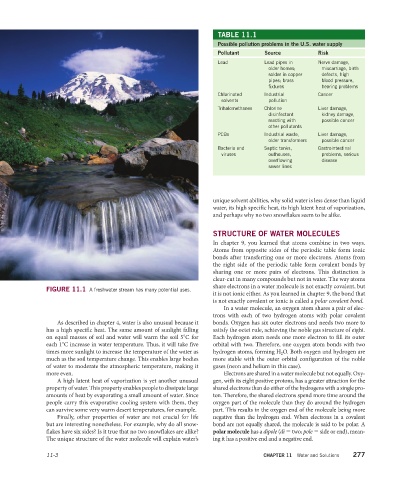
                       FIGURE 11.1  A freshwater stream has many potential uses.
                                                                               it is not ionic either. As you learned in chapter 9, the bond that
                                                                               is not  exactly covalent or ionic is called a polar covalent bond.
                                                                                  In a water molecule, an oxygen atom shares a pair of elec-
                                                                               trons with each of two hydrogen atoms with polar covalent
                           As described in chapter 4, water is also unusual because it   bonds. Oxygen has six outer electrons and needs two more to
                       has a high specific heat. The same amount of sunlight falling   satisfy the octet rule, achieving the noble gas structure of eight.
                       on equal masses of soil and water will warm the soil 5°C for   Each hydrogen atom needs one more electron to fill its outer
                       each 1°C increase in water temperature. Thus, it will take five   orbital with two. Therefore, one oxygen atom bonds with two
                       times more sunlight to increase the temperature of the water as   hydrogen atoms, forming H 2 O. Both oxygen and hydrogen are
                       much as the soil temperature change. This enables large bodies   more stable with the outer orbital configuration of the noble
                       of  water to moderate the atmospheric temperature, making it   gases (neon and helium in this case).
                       more even.                                                 Electrons are shared in a water molecule but not equally. Oxy-
                           A high latent heat of vaporization is yet another unusual   gen, with its eight positive protons, has a greater attraction for the
                       property of water. This property enables people to dissipate large   shared electrons than do either of the hydrogens with a single pro-
                       amounts of heat by evaporating a small amount of water. Since   ton. Therefore, the shared electrons spend more time around the
                       people carry this evaporative cooling system with them, they   oxygen part of the molecule than they do around the hydrogen
                       can survive some very warm desert temperatures, for  example.  part. This results in the oxygen end of the molecule being more
                           Finally, other properties of water are not crucial for life   negative than the hydrogen end. When electrons in a covalent
                       but are interesting nonetheless. For example, why do all snow-  bond are not equally shared, the molecule is said to be polar. A
                       flakes have six sides? Is it true that no two snowflakes are alike?   polar molecule has a dipole (di = two; pole = side or end), mean-
                       The unique structure of the water molecule will explain water’s   ing it has a positive end and a negative end.

                       11-3                                                                    CHAPTER 11  Water and Solutions   277

