


Page 301 - 9780077418427.pdf
P. 301
/Users/user-f465/Desktop
          tiL12214_ch11_275-298.indd Page 278  9/3/10  6:12 PM user-f465
          tiL12214_ch11_275-298.indd Page 278  9/3/10  6:12 PM user-f465                                                /Users/user-f465/Desktop


                            Science and Society

                            Who Has the Right?

                         s the population grows and new   dustrial interests claim they should have   QUESTIONS TO DISCUSS
                     Aindustries develop, more and more   the water because they create jobs and
                     demands are placed on the water supply.   products that people must have. Cities, on     1.  Who should have the first priority for
                     This raises some issues about how water   the other hand, claim that domestic con-  water use?
                     should be divided among agriculture, in-  sumption is the most important because     2.  Who should have the last priority for
                     dustries, and urban domestic use. Agri-  people cannot survive without water. Yet   water use?
                     cultural interests claim they should have   others claim that no group has a right to
                                                                                             3.  What determined your answers to
                     the water because they produce the food   use  water when it is needed to maintain
                                                                                              questions 1 and 2?
                     and fibers that people must have. In-  habitats.


                                          Negative oxygen end                                                     Oxygen atom


                                                                                                                 Hydrogen bond
                          A               Positive hydrogens


                                                                                                                 Hydrogen atom


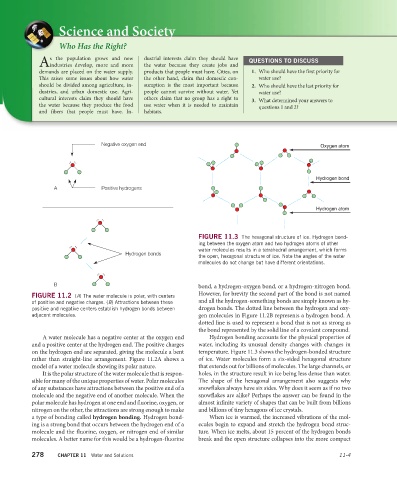
                                                                          FIGURE 11.3  The hexagonal structure of ice. Hydrogen bond-
                                                                          ing between the oxygen atom and two hydrogen atoms of other
                                                                          water molecules results in a tetrahedral arrangement, which forms
                                                  Hydrogen bonds
                                                                          the open, hexagonal structure of ice. Note the angles of the water
                                                                          molecules do not change but have different orientations.


                          B                                               bond, a hydrogen-oxygen bond, or a hydrogen-nitrogen bond.
                                                                          However, for brevity the second part of the bond is not named
                   FIGURE 11.2  (A) The water molecule is polar, with centers
                   of positive and negative charges. (B) Attractions between these   and all the hydrogen-something bonds are simply known as hy-
                   positive and negative centers establish hydrogen bonds between   drogen bonds. The dotted line between the hydrogen and oxy-
                   adjacent molecules.                                    gen molecules in Figure 11.2B represents a hydrogen bond. A
                                                                          dotted line is used to represent a bond that is not as strong as
                                                                          the bond represented by the solid line of a covalent compound.
                      A water molecule has a negative center at the oxygen end   Hydrogen bonding accounts for the physical properties of
                   and a positive center at the hydrogen end. The positive charges   water, including its unusual density changes with changes in
                   on the hydrogen end are separated, giving the molecule a bent   temperature. Figure 11.3 shows the hydrogen-bonded structure
                   rather than straight-line arrangement. Figure 11.2A shows a   of ice. Water molecules form a six-sided hexagonal structure
                   model of a water molecule showing its polar nature.    that extends out for billions of molecules. The large channels, or
                      It is the polar structure of the water molecule that is respon-  holes, in the structure result in ice being less dense than  water.
                   sible for many of the unique properties of water. Polar molecules   The shape of the hexagonal arrangement also suggests why
                   of any substances have attractions between the positive end of a   snowflakes always have six sides. Why does it seem as if no two
                   molecule and the negative end of another molecule. When the   snowflakes are alike? Perhaps the answer can be found in the
                   polar molecule has hydrogen at one end and fluorine, oxygen, or     almost infinite variety of shapes that can be built from billions
                   nitrogen on the other, the attractions are strong enough to make   and billions of tiny hexagons of ice crystals.
                   a type of bonding called hydrogen bonding. Hydrogen bond-  When ice is warmed, the increased vibrations of the mol-
                   ing is a strong bond that occurs between the hydrogen end of a   ecules begin to expand and stretch the hydrogen bond struc-
                   molecule and the fluorine, oxygen, or nitrogen end of similar   ture. When ice melts, about 15 percent of the hydrogen bonds
                   molecules. A better name for this would be a hydrogen-fluorine   break and the open structure collapses into the more compact

                   278     CHAPTER 11  Water and Solutions                                                              11-4

