


Page 302 - 9780077418427.pdf
P. 302
/Users/user-f465/Desktop
          tiL12214_ch11_275-298.indd Page 279  9/3/10  6:12 PM user-f465
          tiL12214_ch11_275-298.indd Page 279  9/3/10  6:12 PM user-f465                                                /Users/user-f465/Desktop


                                                                               substances are insoluble, not dissolving at all or at least not no-
                            1.00006
                            1.00003                                            ticeably. In general, the forces of attraction between molecules
                            1.00000                                            or ions of the solvent and solute determine if something will
                            0.99997                                            dissolve and if there are any limits on the solubility. These forces
                          Density (g/cm 3 )  0.99991                           sidered in the following examples.
                            0.99994
                                                                               of attraction and their role in the dissolving process will be con-
                            0.99988
                                                                                  First, consider the dissolving process in gaseous and liquid
                            0.99985
                                                                               solutions. In a gas, the intermolecular forces are small, so gases
                            0.99982
                            0.99979
                            0.99976                                            can mix in any proportion. Fluids that can mix in any propor-
                                                                               tion without separating into phases are called miscible fl uids.
                            0.99973                                            Fluids that do not mix are called immiscible fluids. Air is a mix-
                            0.99970
                            0.99967                                            ture of gases, so gases (including vapors) are miscible.
                                                                                  Liquid solutions can dissolve a gas, another liquid, or a
                                      0  1  2  3  4  5  6  7  8  9  10         solid. Gases are miscible in liquids, and a carbonated beverage
                                               Temperature ( C)
                                                         O
                                                                               (your favorite cola) is the common example, consisting of car-
                                                                               bon  dioxide dissolved in water. Whether or not two given liquids
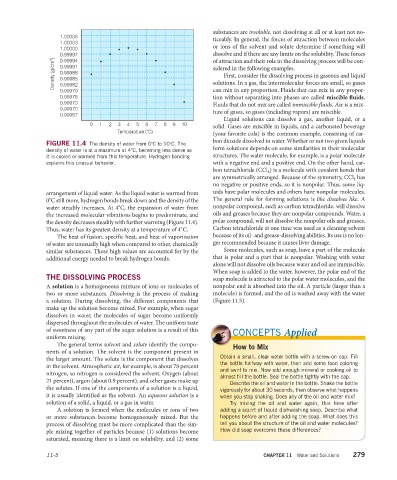
                       FIGURE 11.4  The density of water from 0°C to 10°C. The
                                                                               form solutions depends on some similarities in their molecular
                       density of water is at a maximum at 4°C, becoming less dense as
                       it is cooled or warmed from this temperature. Hydrogen bonding   structures. The water molecule, for example, is a polar molecule
                       explains this unusual behavior.                         with a negative end and a positive end. On the other hand, car-
                                                                               bon tetrachloride (CCl 4 ) is a molecule with  covalent bonds that
                                                                               are symmetrically arranged. Because of the symmetry, CCl 4  has
                                                                               no negative or positive ends, so it is non polar. Thus, some liq-
                       arrangement of liquid water. As the liquid water is warmed from   uids have polar molecules and others have nonpolar molecules.
                       0°C still more, hydrogen bonds break down and the density of  the   The general rule for forming solutions is like dissolves like. A
                       water steadily increases. At 4°C, the expansion of water from   nonpolar compound, such as carbon tetrachloride, will dissolve
                       the increased molecular vibrations begins to  predominate, and   oils and greases because they are non polar compounds. Water, a
                       the density decreases steadily with further warming (Figure 11.4).     polar compound, will not dissolve the nonpolar oils and greases.
                       Thus, water has its greatest density at a temperature of 4°C.  Carbon tetrachloride at one time was used as a cleaning solvent
                           The heat of fusion, specific heat, and heat of vaporization   because of its oil- and grease-dissolving  abilities. Its use is no lon-
                       of water are unusually high when compared to other, chemically   ger recommended because it causes liver damage.
                       similar substances. These high values are accounted for by the   Some molecules, such as soap, have a part of the molecule
                         additional energy needed to break hydrogen bonds.     that is polar and a part that is nonpolar. Washing with water
                                                                               alone will not dissolve oils because water and oil are immiscible.
                                                                               When soap is added to the water, however, the polar end of the
                       THE DISSOLVING PROCESS                                  soap molecule is attracted to the polar water molecules, and the
                       A solution is a homogeneous mixture of ions or molecules of   nonpolar end is absorbed into the oil. A particle (larger than a
                       two or more substances.  Dissolving is the process of making   molecule) is formed, and the oil is washed away with the water
                       a solution. During dissolving, the different components that   (Figure 11.5).
                       make up the  solution become mixed. For example, when sugar
                       dissolves in water, the molecules of sugar become uniformly
                       dispersed throughout the molecules of water. The uniform taste
                       of sweetness of any part of the sugar solution is a result of this   CONCEPTS Applied
                       uniform mixing.
                           The general terms solvent and solute identify the compo-  How to Mix
                       nents of a solution. The solvent is the component present in
                       the larger amount. The solute is the component that dissolves   Obtain a small, clear water bottle with a screw-on cap. Fill
                                                                                 the bottle halfway with water, then add some food coloring
                       in the solvent. Atmospheric air, for example, is about 78 percent
                                                                                 and swirl to mix. Now add enough mineral or  cooking oil to
                       nitrogen, so nitrogen is considered the solvent. Oxygen (about
                                                                                 almost fill the bottle. Seal the bottle tightly with the cap.
                       21 percent), argon (about 0.9 percent), and other gases make up
                                                                                    Describe the oil and water in the bottle. Shake the bottle
                       the solutes. If one of the components of a solution is a liquid,   vigorously for about 30 seconds, then observe what happens
                       it is usually identified as the solvent. An aqueous solution is a   when you stop shaking. Does any of the oil and water mix?
                       solution of a solid, a liquid, or a gas in water.            Try mixing the oil and water again, this time after
                           A solution is formed when the molecules or ions of two   adding a squirt of liquid dishwashing soap. Describe what
                       or more substances become homogeneously mixed. But the    happens  before and after adding the soap. What does this
                       process of dissolving must be more complicated than the sim-  tell you about the structure of the oil and water molecules?
                       ple mixing together of particles because (1) solutions become   How did soap overcome these differences?
                       saturated, meaning there is a limit on solubility, and (2) some

                       11-5                                                                    CHAPTER 11  Water and Solutions   279

