


Page 304 - 9780077418427.pdf
P. 304
/Users/user-f465/Desktop
          tiL12214_ch11_275-298.indd Page 281  9/3/10  6:12 PM user-f465
          tiL12214_ch11_275-298.indd Page 281  9/3/10  6:12 PM user-f465                                                /Users/user-f465/Desktop


                                                                                      H +          H +
                                                                                       O –        O –
                                                                                         H +   H +    Dissolved
                                                                                           Cl –       negative salt
                                                       Water molecules                   H +   H +    ion
                                                       around salt crystal             O –        O –
                                           H +                H +                     H +          H +
                                             O –   H +  H +  O –
                                              H +   O –   H +
                                              Cl –  Na +  Cl –   H +  O –  H +  O –              H +  H +
                                                                           H +  H +                O –
                                                                    +
                                                 +
                                                          +
                                              Na Cl  –  Na Cl  –  Na Cl  –                   H +        H +
                                                                                               O –  Na +  O –
                                                                              H +            H +        H +
                                                                    –
                                                     +
                                              Cl –  Na Cl –  Na +  Cl  Na +  O –                    –
                                                                              H +                H +  O  H +
                                                          +
                                              Na +  Cl –  Na Cl –  Na +  Cl –  H +
                                                                              O –              Dissolved
                                                                                               positive salt
                                              Cl –  Na +  Cl –  Na +  Cl –  Na +  H +          ion
                                                      Salt crystal
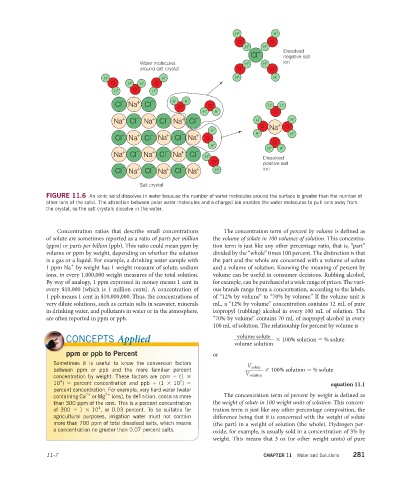
                       FIGURE 11.6  An ionic solid dissolves in water because the number of water molecules around the surface is greater than the number of
                       other ions of the solid. The attraction between polar water molecules and a charged ion enables the water molecules to pull ions away from
                       the crystal, so the salt crystals dissolve in the water.


                           Concentration ratios that describe small concentrations   The concentration term of percent by volume is defined as
                       of solute are sometimes reported as a ratio of parts per million   the volume of solute in 100 volumes of solution. This concentra-
                       (ppm) or parts per billion (ppb). This ratio could mean ppm by   tion term is just like any other percentage ratio, that is, “part”
                       volume or ppm by weight, depending on whether the  solution     divided by the “whole” times 100 percent. The distinction is that
                       is a gas or a liquid. For example, a drinking  water sample with   the part and the whole are concerned with a volume of solute
                                +
                       1 ppm Na  by weight has 1 weight measure of solute, sodium   and a volume of solution. Knowing the meaning of  percent by
                       ions, in every 1,000,000 weight measures of the total solution.   volume can be useful in consumer  decisions. Rubbing alcohol,
                       By way of analogy, 1 ppm expressed in money means 1 cent in   for example, can be purchased at a wide range of prices. The vari-
                       every $10,000 (which is 1 million cents). A concentration of   ous brands range from a concentration, according to the labels,
                       1 ppb means 1 cent in $10,000,000. Thus, the concentrations of   of “12% by volume” to “70% by volume.” If the volume unit is
                       very dilute solutions, such as  certain salts in seawater, minerals   mL, a “12% by volume” concentration contains 12 mL of pure
                       in drinking water, and  pollutants in water or in the atmosphere,   isopropyl (rubbing) alcohol in every 100 mL of solution. The
                       are often reported in ppm or ppb.                       “70% by volume” contains 70 mL of isopropyl alcohol in every
                                                                               100 mL of solution. The relationship for percent by volume is

                                                                                       volume solute
                              CONCEPTS Applied                                        __


                                                                                                    × 100% solution = % solute
                                                                                      volume solution
                              ppm or ppb to Percent                            or
                          Sometimes it is useful to know the conversion factors          _


                          between ppm or ppb and the more familiar percent                   V solute   × 100% solution = % solute
                          concentration by weight. These factors are ppm ÷ (1 ×          V solution
                          10 )  = percent concentration and ppb  ÷ (1  × 10 )  =                                      equation  11.1
                                                                    7
                            4
                          percent concentration. For  example, very hard water (water
                                     2+    2+
                          containing Ca  or Mg  ions), by definition, contains more   The concentration term of percent by weight is defined as
                          than 300 ppm of the ions. This is a percent concentration   the weight of solute in 100 weight units of solution. This concen-
                                         4
                          of 300 ÷ 1 × 10 , or 0.03 percent. To be suitable for   tration term is just like any other percentage composition, the
                          agricultural purposes, irrigation water must not  contain   difference being that it is concerned with the weight of solute
                          more than 700 ppm of total dissolved salts, which means   (the part) in a weight of solution (the whole).  Hydrogen per-
                          a concentration no greater than 0.07 percent salts.  oxide, for example, is usually sold in a concentration of 3% by
                                                                               weight. This means that 3 oz (or other weight units) of pure
                       11-7                                                                    CHAPTER 11  Water and Solutions   281

