


Page 303 - 9780077418427.pdf
P. 303
/Users/user-f465/Desktop
          tiL12214_ch11_275-298.indd Page 280  9/3/10  6:12 PM user-f465
          tiL12214_ch11_275-298.indd Page 280  9/3/10  6:12 PM user-f465                                                /Users/user-f465/Desktop


                                                          Structural formula of a soap molecule

                                        H   H   H   H   H   H   H   H  H   H   H   H   H   H   H
                                                                                                      O
                                    H   C   C   C   C   C   C   C  C   C   C   C   C   C   C   C   C    Na +
                                                                                                       –
                                                                                                     O
                                        H   H   H   H   H   H  H   H   H   H   H   H   H   H   H

                                    Hydrocarbon end                                           Ionic end
                                    (soluble in oil)                                          (soluble in water)


                                    Cloth       Oily dirt
                                    fabric                     Soap molecules                 Dirt washed away
                                                               in wash water
                                                                    –                               –
                                                                                               –      –
                                                                          –  –
                                                                 –                            –        –
                                                                           –
                                                                                             –          –
                                                                 –                           –         –
                                                                         –                            –
                                                                   –              –             –  –

                                                                          –
                                                                              A soap molecule

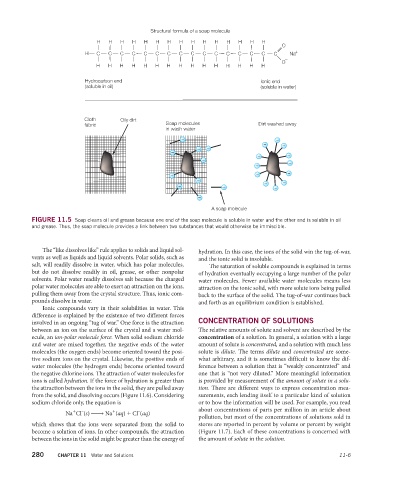
                   FIGURE 11.5  Soap cleans oil and grease because one end of the soap molecule is soluble in water and the other end is soluble in oil
                   and grease. Thus, the soap molecule provides a link between two substances that would otherwise be immiscible.


                      The “like dissolves like” rule applies to solids and liquid sol-  hydration. In this case, the ions of the solid win the tug-of-war,
                   vents as well as liquids and liquid solvents. Polar solids, such as   and the ionic solid is insoluble.
                   salt, will readily dissolve in water, which has polar molecules,   The saturation of soluble compounds is explained in terms
                   but do not dissolve readily in oil, grease, or other nonpolar   of hydration eventually occupying a large number of the polar
                     solvents. Polar  water readily dissolves salt because the charged   water molecules. Fewer available water molecules means less
                   polar water molecules are able to exert an attraction on the ions,     attraction on the ionic solid, with more solute ions being pulled
                   pulling them away from the crystal structure. Thus, ionic com-  back to the surface of the solid. The tug-of-war continues back
                   pounds dissolve in water.                              and forth as an equilibrium condition is  established.
                      Ionic compounds vary in their solubilities in water. This
                   difference is explained by the existence of two different forces
                     involved in an ongoing “tug of war.” One force is the attraction   CONCENTRATION OF SOLUTIONS
                   between an ion on the surface of the crystal and a water mol-  The relative amounts of solute and solvent are described by the
                   ecule, an ion-polar molecule force. When solid sodium chloride   concentration of a solution. In general, a solution with a large
                   and water are mixed together, the negative ends of the water   amount of solute is concentrated, and a solution with much less
                   molecules (the oxygen ends) become oriented toward the posi-  solute is dilute. The terms dilute and concentrated are some-
                   tive sodium ions on the crystal. Likewise, the positive ends of   what arbitrary, and it is sometimes difficult to know the dif-
                   water molecules (the hydrogen ends) become oriented  toward   ference between a solution that is “weakly concentrated” and
                   the negative chlorine ions. The attraction of water molecules for   one that is “not very diluted.” More meaningful information
                   ions is called hydration. If the force of  hydration is greater than   is provided by measurement of the amount of solute in a solu-
                   the attraction between the ions in the solid, they are pulled away   tion. There are different ways to express concentration mea-
                   from the solid, and dissolving  occurs (Figure 11.6). Considering   surements, each lending itself to a particular kind of solution
                   sodium chloride only, the equation is                  or to how the  information will be used. For example, you read
                                +  –         +         –                  about concentrations of parts per million in an article about
                              Na Cl (s)  → Na (aq)   + Cl (aq )
                                                                          pollution, but most of the concentrations of solutions sold in
                   which shows that the ions were separated from the solid to   stores are  reported in percent by volume or  percent by weight
                     become a solution of ions. In other compounds, the attraction   (Figure 11.7). Each of these concentrations is concerned with
                   between the ions in the solid might be greater than the energy of   the amount of solute in the solution.

                   280     CHAPTER 11  Water and Solutions                                                              11-6

