


Page 324 - 9780077418427.pdf
P. 324
/Users/user-f465/Desktop
          tiL12214_ch12_299-322.indd Page 301  9/3/10  6:13 PM user-f465
          tiL12214_ch12_299-322.indd Page 301  9/3/10  6:13 PM user-f465                                                /Users/user-f465/Desktop


                                                                                                     CH 4
                                                                                                 A Molecular formula


                                                                                                      H
                                                                                                  H   C   H

                                                                                                      H
                                                                                                 B Structural formula
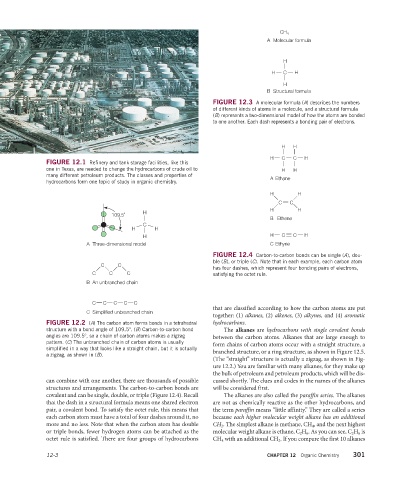
                                                                               FIGURE 12.3  A molecular formula (A) describes the numbers
                                                                               of different kinds of atoms in a molecule, and a structural formula
                                                                               (B) represents a two-dimensional model of how the atoms are bonded
                                                                               to one another. Each dash represents a bonding pair of electrons.


                                                                                                     H   H

                                                                                                  H  C   C   H
                       FIGURE 12.1  Refinery and tank storage facilities, like this
                       one in Texas, are needed to change the hydrocarbons of crude oil to           H   H
                       many different petroleum products. The classes and properties of
                                                                                                  A Ethane
                       hydrocarbons form one topic of study in organic chemistry.
                                                                                                  H        H
                                                                                                    C   C
                                                                                                  H        H
                                                        H
                                             109.5˚
                                                                                                  B Ethene
                                                        C
                                                    H      H
                                                        H                                         H  C   C   H
                                     A Three-dimensional model                                    C Ethyne
                                                                               FIGURE 12.4  Carbon-to-carbon bonds can be single (A), dou-
                                                                               ble (B), or triple (C). Note that in each example, each carbon atom
                                          C    C
                                                                               has four dashes, which represent four bonding pairs of electrons,
                                       C    C     C                            satisfying the octet rule.
                                     B An unbranched chain


                                       C  C   C  C   C
                                                                               that are classified according to how the carbon atoms are put
                                     C Simplified unbranched chain
                                                                                together: (1) alkanes, (2) alkenes, (3) alkynes, and (4) aromatic
                       FIGURE 12.2  (A) The carbon atom forms bonds in a tetrahedral    hydrocarbons.
                        structure with a bond angle of 109.5°. (B) Carbon-to-carbon bond   The  alkanes are  hydrocarbons with single covalent bonds
                        angles are 109.5°, so a chain of carbon atoms makes a zigzag     between the carbon atoms. Alkanes that are large enough to
                          pattern. (C) The unbranched chain of carbon atoms is usually   form chains of carbon atoms occur with a straight structure, a
                        simplified in a way that looks like a straight chain, but it is actually   branched structure, or a ring structure, as shown in Figure 12.5.
                        a zigzag, as shown in (B).
                                                                               (The “straight” structure is actually a zigzag, as shown in Fig-
                                                                               ure 12.2.) You are familiar with many alkanes, for they make up
                                                                               the bulk of petroleum and petroleum products, which will be dis-
                       can combine with one another, there are thousands of possible   cussed shortly. The clues and codes in the names of the alkanes
                       structures and arrangements. The carbon-to-carbon bonds are   will be considered first.
                       covalent and can be single, double, or triple (Figure 12.4). Recall   The alkanes are also called the paraffin series. The alkanes
                       that the dash in a structural formula means one shared electron   are not as chemically reactive as the other hydrocarbons, and
                       pair, a covalent bond. To satisfy the octet rule, this means that   the term paraffin means “little affinity.” They are called a series
                       each carbon atom must have a total of four dashes around it, no   because each higher molecular weight alkane has an additional
                       more and no less. Note that when the carbon atom has double   CH 2 . The simplest alkane is methane, CH 4 , and the next highest
                       or triple bonds, fewer hydrogen atoms can be attached as the   molecular weight alkane is ethane, C 2 H 6 . As you can see, C 2 H 6  is
                       octet rule is satisfied. There are four groups of hydrocarbons   CH 4  with an additional CH 2 . If you compare the first 10 alkanes

                       12-3                                                                      CHAPTER 12  Organic Chemistry   301

