


Page 327 - 9780077418427.pdf
P. 327
/Users/user-f465/Desktop
          tiL12214_ch12_299-322.indd Page 304  9/3/10  6:13 PM user-f465
          tiL12214_ch12_299-322.indd Page 304  9/3/10  6:13 PM user-f465                                                /Users/user-f465/Desktop


                      Perhaps you have heard the terms saturated and unsatu-  CYCLOALKANES AND AROMATIC
                   rated in advertisements for cooking oil and margarine. An   HYDROCARBONS
                     organic molecule, such as a hydrocarbon, that does not contain   The hydrocarbons discussed up until now have been straight
                   the maximum number of hydrogen atoms is an  unsaturated   or branched open-ended chains of carbon atoms. Carbon at-
                     hydrocarbon. For example, ethylene can add more hydrogen   oms can also bond to one another to form a ring, or cyclic,
                     atoms by reacting with hydrogen gas to form ethane:
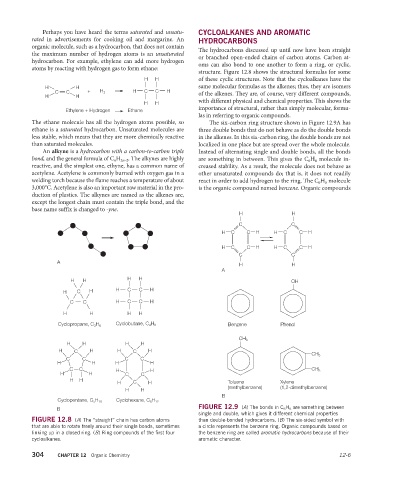
                                                                          structure. Figure 12.8 shows the structural formulas for some
                                                        H   H             of these  cyclic structures. Note that the cycloalkanes have the
                        H        H                                        same  molecular formulas as the alkenes; thus, they are isomers
                          C   C      +   H 2        H   C   C  H          of the alkenes. They are, of course, very different compounds,
                        H        H
                                                        H   H             with different physical and chemical properties. This shows the
                                                                          importance of structural, rather than simply molecular, formu-
                              Ethylene + Hydrogen             Ethane
                                                                          las in referring to organic compounds.
                   The ethane molecule has all the hydrogen atoms possible, so   The six-carbon ring structure shown in Figure 12.9A has
                   ethane is a saturated hydrocarbon. Unsaturated molecules are   three double bonds that do not behave as do the double bonds
                   less stable, which means that they are more chemically reactive   in the alkenes. In this six-carbon ring, the double bonds are not
                   than saturated molecules.                              localized in one place but are spread over the whole molecule.
                      An alkyne is a hydrocarbon with a carbon-to-carbon triple   Instead of alternating single and double bonds, all the bonds
                   bond, and the general formula of C n H 2n–2 . The alkynes are highly   are something in between. This gives the C 6 H 6  molecule in-
                   reactive, and the simplest one, ethyne, has a common name of   creased stability. As a result, the molecule does not  behave as
                   acetylene. Acetylene is commonly burned with oxygen gas in a   other unsaturated compounds do; that is, it does not readily
                   welding torch because the flame reaches a temperature of about   react in order to add hydrogen to the ring. The C 6 H 6  molecule
                   3,000°C. Acetylene is also an important raw material in the pro-  is the organic compound named benzene. Organic compounds
                   duction of plastics. The alkynes are named as the alkenes are,
                   except the longest chain must contain the triple bond, and the
                   base name suffix is changed to -yne.
                                                                                       H                 H
                                                                                       C                 C
                                                                                  H  C    C  H     H  C    C  H

                                                                                  H  C    C  H     H  C    C  H
                                                                                       C                 C
                           A
                                                                                       H                 H
                                                                                  A
                                H   H             H   H                                                  OH
                             H    C   H        H  C   C   H

                               C    C          H  C   C   H
                             H        H           H   H

                           Cyclopropane, C 3 H 6  Cyclobutane, C 4 H 8              Benzene          Phenol

                                                                                       CH 3
                              H    H              H    H
                            H    C    H        H    C    H
                                                                                                               CH 3
                              C    C              C    C
                           H           H      H           H
                               C  C            H          H                                                    CH 3
                            H         H           C    C
                               H  H
                                               H    C    H                          Toluene          Xylene
                                                                                    (methylbenzene)  (1,2-dimethylbenzene)
                                                  H    H
                                                                                  B
                           Cyclopentane, C 5 H 10  Cyclohexane, C 6 H 12
                           B                                              FIGURE 12.9  (A) The bonds in C 6 H 6  are something between
                                                                          single and double, which gives it different chemical properties
                   FIGURE 12.8  (A) The “straight” chain has carbon atoms   than double-bonded hydrocarbons. (B) The six-sided symbol with
                   that are able to rotate freely around their single bonds, sometimes   a circle represents the benzene ring. Organic compounds based on
                   linking up in a closed ring. (B) Ring compounds of the first four   the benzene ring are called aromatic hydrocarbons because of their
                   cycloalkanes.                                          aromatic character.

                   304     CHAPTER 12 Organic Chemistry                                                                 12-6

