


Page 328 - 9780077418427.pdf
P. 328
/Users/user-f465/Desktop
          tiL12214_ch12_299-322.indd Page 305  9/3/10  6:13 PM user-f465
          tiL12214_ch12_299-322.indd Page 305  9/3/10  6:13 PM user-f465                                                /Users/user-f465/Desktop


                       that are based on the benzene ring structure are called aromatic
                        hydrocarbons. To denote the six-carbon ring with delocal-                              Condenser
                       ized electrons, benzene is represented by the symbol shown in
                        Figure 12.9B.
                           The circle in the six-sided benzene symbol represents the                                   Gas
                       delocalized electrons. Figure 12.9B illustrates how this benzene
                                                                                                                  Gasoline
                       ring symbol is used to show the structural formula of some aro-
                                                                                                              Kerosene
                       matic hydrocarbons. You may have noticed some of the names
                       on labels of paints, paint thinners, and lacquers. Toluene and
                                                                                                              Heating oil
                       the xylenes are commonly used in these products as solvents. A
                       benzene ring attached to another molecule or functional group                          Lubricating oil
                       is given the name phenyl.


                         12.3 PETROLEUM
                                                                                       Crude oil
                       Petroleum is a mixture of alkanes, cycloalkanes, and some aro-  vapors
                       matic hydrocarbons. The origin of petroleum is uncertain, but   from
                                                                                       heater
                       it is believed to have formed from the slow decomposition of
                       buried marine life, primarily microscopic plankton and algae
                       in the absence of oxygen (i.e., anaerobic). Time, temperature,
                       pressure, and perhaps bacteria are considered important in the
                                                                                                                Steam
                       formation of petroleum. As the petroleum formed, it was forced
                       through porous rock until it reached a rock type or rock struc-                          Residue
                       ture that stopped it. Here, it accumulated to saturate the porous                        (asphalt, tar)
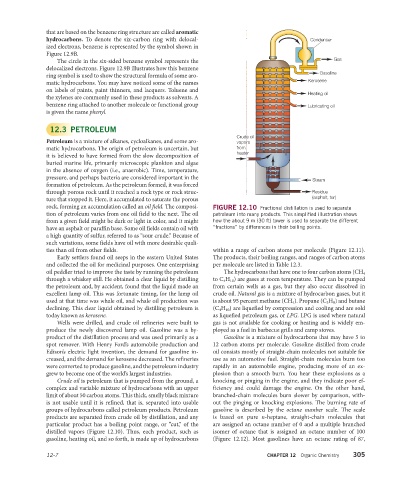
                       rock, forming an accumulation called an oil fi eld. The composi-  FIGURE 12.10  Fractional distillation is used to separate
                       tion of petroleum varies from one oil field to the next. The oil   petroleum into many products. This simplified illustration shows
                       from a given field might be dark or light in color, and it might   how the about 9 m (30 ft) tower is used to separate the different
                       have an asphalt or paraffin base. Some oil fields contain oil with   “fractions” by differences in their boiling points.
                       a high quantity of sulfur, referred to as “sour crude.” Because of
                       such variations, some fields have oil with more desirable quali-
                       ties than oil from other fields.                        within a range of carbon atoms per molecule (Figure 12.11).
                           Early settlers found oil seeps in the eastern United States   The products, their boiling ranges, and ranges of carbon atoms
                       and collected the oil for medicinal purposes. One enterprising   per molecule are listed in Table 12.3.
                       oil peddler tried to improve the taste by running the petroleum   The hydrocarbons that have one to four carbon atoms (CH 4
                       through a whiskey still. He obtained a clear liquid by distilling   to C 4 H 10 ) are gases at room temperature. They can be pumped
                       the petroleum and, by accident, found that the liquid made an   from certain wells as a gas, but they also occur dissolved in
                       excellent lamp oil. This was fortunate timing, for the lamp oil   crude oil. Natural gas is a mixture of hydrocarbon gases, but it
                       used at that time was whale oil, and whale oil production was   is about 95 percent methane (CH 4 ). Propane (C 3 H 8 ) and butane
                       declining. This clear liquid obtained by distilling petroleum is   (C 4 H 10 ) are liquefied by compression and cooling and are sold
                       today known as kerosene.                                as liquefied petroleum gas, or LPG. LPG is used where natural
                           Wells were drilled, and crude oil refineries were built to   gas is not available for cooking or heating and is widely em-
                       produce the newly discovered lamp oil. Gasoline was a by-  ployed as a fuel in barbecue grills and camp stoves.
                       product of the distillation process and was used primarily as a   Gasoline is a mixture of hydrocarbons that may have 5 to
                       spot remover. With Henry Ford’s automobile production and   12 carbon atoms per molecule. Gasoline distilled from crude
                       Edison’s electric light invention, the demand for gasoline in-  oil consists mostly of straight-chain molecules not suitable for
                       creased, and the demand for kerosene decreased. The refineries   use as an automotive fuel. Straight-chain molecules burn too
                       were  converted to produce gasoline, and the petroleum industry   rapidly in an automobile engine, producing more of an ex-
                       grew to become one of the world’s largest industries.   plosion than a smooth burn. You hear these explosions as a
                           Crude oil is petroleum that is pumped from the ground, a   knocking or pinging in the engine, and they indicate poor ef-
                       complex and variable mixture of hydrocarbons with an  upper   ficiency and could damage the engine. On the other hand,
                       limit of about 50 carbon atoms. This thick, smelly black  mixture   branched-chain molecules burn slower by comparison, with-
                       is not usable until it is refined, that is, separated into usable   out the pinging or knocking explosions. The burning rate of
                       groups of hydrocarbons called petroleum products.  Petroleum   gasoline is described by the  octane number scale. The scale
                       products are separated from crude oil by distillation, and any   is based on pure  n-heptane, straight-chain molecules that
                       particular product has a boiling point range, or “cut,” of the   are assigned an octane number of 0 and a multiple branched
                       distilled vapors (Figure 12.10). Thus, each product, such as   isomer of octane that is assigned an octane number of 100
                       gasoline, heating oil, and so forth, is made up of hydrocarbons   (Figure 12.12). Most gasolines have an octane rating of 87,

                       12-7                                                                      CHAPTER 12  Organic Chemistry   305

