


Page 325 - 9780077418427.pdf
P. 325
/Users/user-f465/Desktop
          tiL12214_ch12_299-322.indd Page 302  9/3/10  6:13 PM user-f465
          tiL12214_ch12_299-322.indd Page 302  9/3/10  6:13 PM user-f465                                                /Users/user-f465/Desktop


                                    H   H  H   H   H                                         H   H  H   H
                                H   C   C  C   C   C   H                                 H   C   C  C   C   H

                                    H   H  H   H   H                                         H   H  H   H
                                A Straight chain for C 5 H 12                            A n-butane, C 4 H 10

                                           H                                                        H
                                        H  C   H                                                 H  C   H
                                        H      H                                                 H      H
                                    H   C  C   C   H                                         H   C  C   C   H

                                        H      H                                                 H  H   H
                                        H  C   H
                                                                                              B Isobutane, C 4 H 10
                                           H
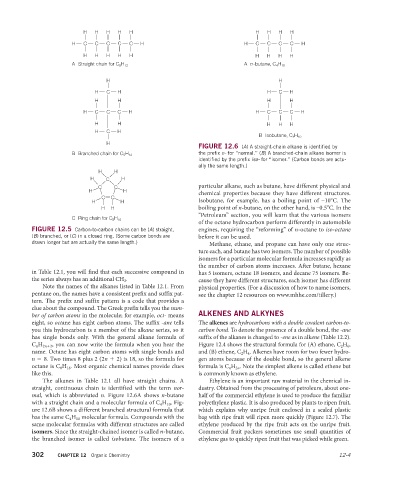
                                                                            FIGURE 12.6  (A) A straight-chain alkane is identified by
                                                                          the prefix n- for “normal.” (B) A branched-chain alkane isomer is
                                B Branched chain for C 5 H 12
                                                                          identified by the prefix iso- for “isomer.” (Carbon bonds are actu-
                                                                          ally the same length.)
                                         H    H
                                      H    C    H
                                         C    C                             par ticular alkane, such as butane, have different physical and
                                      H          H
                                                                          chemical properties because they have different structures.
                                          C  C
                                       H        H                         Isobutane, for example, has a boiling point of  –10°C. The
                                          H  H                            boiling point of n-butane, on the other hand, is –0.5°C. In the
                                                                          “Petroleum” section, you will learn that the various isomers
                                C Ring chain for C 5 H 10
                                                                          of the octane  hydrocarbon perform differently in automobile
                   FIGURE 12.5  Carbon-to-carbon chains can be (A) straight,     engines,  requiring the “reforming” of n-octane to iso-octane
                   (B) branched, or (C) in a closed ring. (Some carbon bonds are   before it can be used.
                   drawn longer but are actually the same length.)           Methane, ethane, and propane can have only one struc-
                                                                          ture each, and butane has two isomers. The number of possible
                                                                          isomers for a particular molecular formula increases rapidly as
                                                                          the number of carbon atoms increases. After  butane, hexane
                   in Table 12.1, you will find that each successive compound in   has 5 isomers, octane 18 isomers, and decane 75 isomers. Be-
                   the series always has an additional CH 2 .             cause they have different structures, each isomer has different
                      Note the names of the alkanes listed in Table 12.1. From   physical properties. (For a discussion of how to name isomers,
                   pentane on, the names have a consistent prefix and suffix pat-  see the chapter 12 resources on www.mhhe.com/tillery.)
                   tern. The prefix and suffix pattern is a code that provides a
                   clue about the compound. The Greek prefix tells you the num-
                   ber of carbon atoms in the molecule; for example, oct- means         ALKENES AND ALKYNES
                   eight, so octane has eight carbon atoms. The suffix -ane tells   The alkenes are hydrocarbons with a double covalent carbon-to-
                   you this hydrocarbon is a member of the alkane series, so it   carbon bond. To denote the presence of a double bond, the -ane
                   has single bonds only. With the general alkane formula of   suffix of the alkanes is changed to -ene as in alkene (Table 12.2).
                   C n H 2n+2 , you can now write the formula when you hear the   Figure 12.4 shows the structural formula for (A) ethane, C 2 H 6 ,
                   name. Octane has eight carbon atoms with single bonds and   and (B) ethene, C 2 H 4 . Alkenes have room for two fewer hydro-
                   n = 8. Two times 8 plus 2 (2n + 2) is 18, so the formula for   gen atoms because of the double bond, so the general alkene
                   octane is C 8 H 18 . Most organic chemical names provide clues   formula is C n H 2n . Note the simplest alkene is called ethene but
                   like this.                                             is commonly known as ethylene.
                      The alkanes in Table 12.1 all have straight chains. A   Ethylene is an important raw material in the chemical in-
                   straight, continuous chain is identified with the term  nor-  dustry. Obtained from the processing of petroleum, about one-
                   mal, which is abbreviated  n. Figure 12.6A shows  n-butane   half of the commercial ethylene is used to produce the familiar
                   with a straight chain and a molecular formula of C 4 H 10 . Fig-  polyethylene plastic. It is also produced by plants to ripen fruit,
                   ure 12.6B shows a different branched structural formula that   which explains why unripe fruit enclosed in a sealed plastic
                   has the same C 4 H 10  molecular formula. Compounds with the   bag with ripe fruit will ripen more quickly (Figure 12.7). The
                   same molecular formulas with different structures are called     ethylene produced by the ripe fruit acts on the unripe fruit.
                     isomers. Since the straight-chained isomer is called n-butane,   Commercial fruit packers sometimes use small quantities of
                   the branched isomer is called  isobutane. The isomers of a   ethylene gas to quickly ripen fruit that was picked while green.

                   302     CHAPTER 12 Organic Chemistry                                                                 12-4

