


Page 36 - 9780077418427.pdf
P. 36
/Users/user-f465/Desktop
          tiL12214_ch01_001-024.indd Page 13  9/1/10  9:51 PM user-f465
          tiL12214_ch01_001-024.indd Page 13  9/1/10  9:51 PM user-f465                                                 /Users/user-f465/Desktop


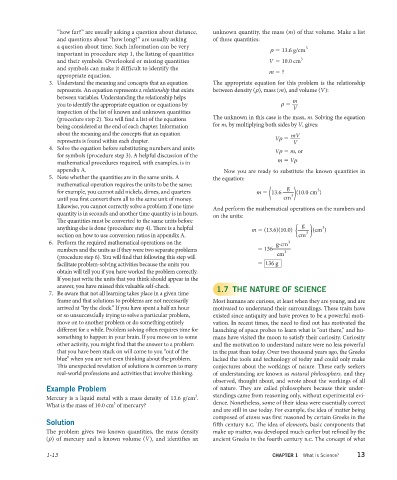
                           “how far?” are usually asking a  question about distance,     unknown quantity, the mass (m) of that volume. Make a list
                           and questions about “how long?” are usually asking   of these quantities:
                           a question about time. Such information can be very                               3
                                                                                                  ρ = 13.6 g/ cm
                           important in procedure step 1, the listing of quantities
                           and their symbols. Overlooked or missing quantities                   V = 10.0 cm 3
                           and symbols can make it difficult to  identify the
                                                                                                 m = ?
                           appropriate equation.
                         3.  Understand the meaning and concepts that an equation   The appropriate equation for this problem is the relationship
                           represents. An equation represents a relationship that exists   between density (ρ), mass (m), and volume (V):
                           between variables. Understanding the relationship helps                       m _

                           you to identify the  appropriate equation or equations by                 ρ =
                                                                                                         V
                           inspection of the list of known and  unknown quantities
                           (procedure step 2). You will find a list of the equations   The unknown in this case is the mass, m. Solving the equation

                           being considered at the end of each  chapter. Information   for m, by multiplying both sides by V, gives:
                           about the meaning and the concepts that an equation                          _
                                                                                                        mV
                                                                                                   Vρ =

                           represents is found within each chapter.                                      V
                         4.  Solve the equation before substituting numbers and units
                                                                                                   Vρ = m, or
                           for symbols (procedure step 3). A helpful discussion of the
                           mathematical procedures required, with examples, is in                   m = Vρ
                           appendix A.                                            Now you are ready to substitute the known quantities in
                         5.  Note whether the quantities are in the same units. A   the equation:
                           mathe matical operation requires the units to be the same;                  g
                                                                                                      _
                                                                                                 (
                                                                                                         3)
                                                                                                                 3
                           for example, you cannot add nickels, dimes, and quarters          m =   13.6       (10.0  cm   )


                           until you first  convert them all to the same unit of money.                cm
                           Likewise, you cannot correctly solve a problem if one time
                                                                               And perform the mathematical operations on the numbers and
                           quantity is in seconds and another time quantity is in hours.
                                                                               on the units:
                           The quantities must be converted to the same units before

                                                                                                            g
                                                                                                           _
                                                                                                          ( )
                                                                                                                   3
                           anything else is done (procedure step 4). There is a helpful    m = (13.6)(10.0)           ( cm   )


                                                                                                              3
                           section on how to use  conversion ratios in  appendix A.                         cm
                         6.  Perform the required mathematical operations on the                  _     3
                                                                                                    g∙ cm

                           numbers and the units as if they were two separate problems          = 136       3
                                                                                                     cm

                           (procedure step 6). You will find that following this step will
                           facilitate problem-solving activities because the units you          =  136 g
                           obtain will tell you if you have worked the problem correctly.
                           If you just write the units that you think should appear in the
                           answer, you have missed this valuable self-check.    1.7  THE NATURE OF SCIENCE
                         7.  Be aware that not all learning takes place in a given time
                           frame and that solutions to problems are not necessarily   Most humans are curious, at least when they are young, and are
                           arrived at “by the clock.” If you have spent a half an hour   motivated to understand their surroundings. These traits have
                           or so unsuccessfully trying to solve a particular problem,   existed since antiquity and have proven to be a powerful moti-
                           move on to another problem or do something entirely   vation. In recent times, the need to find out has motivated the


                           different for a while. Problem solving often requires time for   launching of space probes to learn what is “out there,” and hu-
                           something to happen in your brain. If you move on to some   mans have visited the moon to satisfy their curiosity. Curiosity
                           other activity, you might find that the  answer to a problem   and the motivation to understand nature were no less powerful

                           that you have been stuck on will come to you “out of the   in the past than today. Over two thousand years ago, the Greeks
                           blue” when you are not even thinking about the problem.   lacked the tools and technology of today and could only make

                           This unexpected revelation of solutions is common to many   conjectures about the workings of nature. These early seekers
                           real-world professions and activities that  involve  thinking.  of understanding are known as natural philosophers, and they
                                                                               observed, thought about, and wrote about the workings of all
                       Example Problem                                         of nature. They are called philosophers because their under-
                                                                         3
                       Mercury is a liquid metal with a mass density of 13.6 g/cm .   standings came from reasoning only, without experimental evi-
                                              3
                       What is the mass of 10.0 cm  of mercury?                dence. Nonetheless, some of their ideas were essentially correct
                                                                               and are still in use today. For example, the idea of matter being
                                                                               composed of atoms was first reasoned by certain Greeks in the
                       Solution                                                fifth century b.c. The idea of elements, basic components that
                       The problem gives two known quantities, the mass density   make up matter, was developed much earlier but refined by the
                       (ρ) of mercury and a known volume (V), and identifies an   ancient Greeks in the fourth century b.c. The concept of what
                       1-13                                                                       CHAPTER 1  What Is Science?   13

