


Page 35 - 9780077418427.pdf
P. 35
/Users/user-f465/Desktop
          tiL12214_ch01_001-024.indd Page 12  9/3/10  7:36 PM user-f465
          tiL12214_ch01_001-024.indd Page 12  9/3/10  7:36 PM user-f465                                                 /Users/user-f465/Desktop


                                                                                 all work. If you are not sure how to read the indi-
                                                                                 cated  operations, see the  section on “Symbols and
                                                                                   Operations” in appendix A.
                                                                          Step 7:  Now ask yourself if the number seems reasonable for
                                                                                 the question that was asked, and ask yourself if the
                                                                                 unit is correct. For example, 250 m/s is way too fast for
                                                                                 a running student, and the unit for speed is not liters.

                                                                          Step 8:  Draw a box around your answer (numbers and units)
                                                                                 to communicate that you have found what you were
                                                                                 looking for. The box is a signal that you have finished
                                                                                 your work on this problem.

                                                                             For an example problem, use the equation from the pre-
                                                                          vious section describing the variables of a fuel pump, V = tk,
                                                                          to predict how long it will take to fill an empty 80-liter tank.
                                                                           Assume k = 40 L/min.

                                                                          Step 1
                                                                          V = 80 L             V = tk                  Step 2
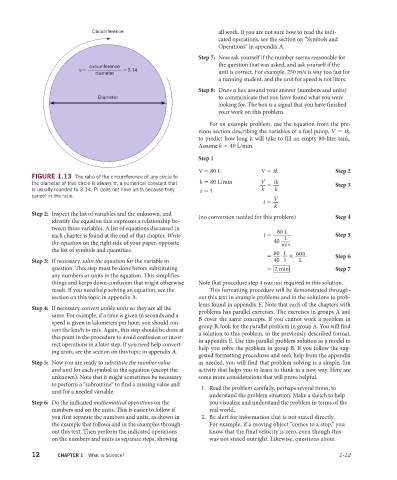
                   FIGURE 1.13  The ratio of the circumference of any circle to
                                                                                                   tk
                                                                                                      =
                   the diameter of that circle is always π, a numerical constant that    k = 80 L/min  V _ _           Step 3

                   is usually rounded to 3.14. Pi does not have units because they    t = ?    k   k
                   cancel in the ratio.                                                            V _
                                                                                               t =

                                                                                                   k
                   Step 2:  Inspect the list of variables and the unknown, and
                                                                          (no conversion needed for this problem)      Step 4
                         identify the equation that expresses a relationship be-
                         tween these variables. A list of equations discussed in                   _
                                                                                                    80 L

                         each chapter is found at the end of that chapter. Write               t =      L _            Step 5


                         the equation on the right side of your paper, opposite                    40
                                                                                                     min
                         the list of symbols and quantities.                                       80 _ L _ _
                                                                                                          min


                                                                                                 =           ×             Step 6


                   Step 3: If necessary, solve the equation for the variable in                    40 1    L
                         question. This step must be done before substituting                    =   2 min             Step 7
                         any numbers or units in the equation. This simplifies
                         things and keeps down confusion that might otherwise   Note that procedure step 4 was not required in this solution.
                         result. If you need help solving an equation, see the   This formatting procedure will be demonstrated through-
                         section on this topic in appendix A.             out this text in example problems and in the solutions to prob-
                                                                          lems found in appendix E. Note that each of the chapters with
                   Step 4: If necessary, convert unlike units so they are all the
                                                                          problems has parallel exercises. The exercises in groups A and
                         same. For example, if a time is given in seconds and a
                                                                          B cover the same concepts. If you cannot work a problem in
                         speed is given in kilo meters per hour, you should con-
                                                                          group B, look for the parallel problem in group A. You will find
                         vert the km/h to m/s. Again, this step should be done at
                                                                          a solution to this problem, in the previously described format,
                         this point in the procedure to avoid confusion or incor-
                                                                          in  appendix E. Use this parallel problem solution as a model to
                         rect operations in a later step. If you need help convert-
                                                                          help you solve the problem in group B. If you follow the sug-
                         ing units, see the section on this topic in appendix A.
                                                                          gested formatting procedures and seek help from the appendix
                   Step 5:  Now you are ready to substitute the number value   as needed, you will find that problem solving is a simple, fun
                         and unit for each symbol in the equation (except the    activity that helps you to learn to think in a new way. Here  are
                         unknown). Note that it might sometimes be necessary   some more considerations that will prove helpful.
                         to perform a “subroutine” to find a missing value and
                                                                            1.  Read the problem carefully, perhaps several times, to
                         unit for a needed variable.
                                                                             understand the problem situation. Make a sketch to help
                   Step 6:  Do the indicated mathematical operations on the   you visualize and understand the problem in terms of the
                         numbers and on the units. This is easier to follow if   real world.
                         you first separate the  numbers and units, as shown in     2.  Be alert for information that is not stated directly.
                         the example that follows and in the examples through-  For example, if a moving object “comes to a stop,” you
                         out this text. Then perform the indicated operations   know that the final  velocity is zero, even though this
                         on the numbers and units as separate steps, showing   was not stated outright.  Likewise, questions about
                   12      CHAPTER 1  What Is Science?                                                                  1-12

