


Page 34 - 9780077418427.pdf
P. 34
/Users/user-f465/Desktop
          tiL12214_ch01_001-024.indd Page 11  9/1/10  9:51 PM user-f465
          tiL12214_ch01_001-024.indd Page 11  9/1/10  9:51 PM user-f465                                                 /Users/user-f465/Desktop


                              CONCEPTS Applied

                              Inverse Square Relationship
                          An inverse square relationship between energy and distance
                          is found in light, sound, gravitational force, electric fields,
                          nuclear radiation, and any other phenomena that spread
                          equally in all directions from a source.
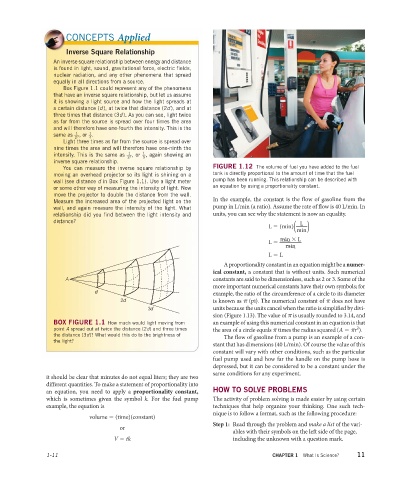
                             Box Figure 1.1 could represent any of the phenomena
                          that have an inverse square relationship, but let us assume
                          it is showing a light source and how the light spreads at
                          a  certain distance (d ), at twice that distance (2d ), and at
                          three times that distance (3d ). As you can see, light twice
                          as far from the source is spread over four times the area
                          and will therefore have one-fourth the intensity. This is the
                                 1 _
                                      1 _
                          same as       , or        .

                                   2
                                   2     4
                             Light three times as far from the source is spread over
                          nine times the area and will therefore have one-ninth the
                                                       1 _
                                                   1 _

                          intensity. This is the same as       , or       , again showing an
                                                    2
                                                    3     9
                          inverse square  relationship.
                             You can measure the inverse square relationship by   FIGURE 1.12  The volume of fuel you have added to the fuel
                            moving an overhead projector so its light is shining on a   tank is directly proportional to the amount of time that the fuel
                          wall (see distance d in Box Figure 1.1). Use a light meter   pump has been running. This relationship can be described with
                          or some other way of measuring the intensity of light. Now   an equation by using a proportionality constant.
                          move the projector to double the distance from the wall.
                          Measure the  increased area of the projected light on the   In the example, the constant is the flow of gasoline from the
                          wall, and again measure the intensity of the light. What   pump in L/min (a ratio). Assume the rate of flow is 40 L/min. In
                          relationship did you find between the light intensity and   units, you can see why the statement is now an equality.
                          distance?                                                                         L _
                                                                                                         ( )
                                                                                                 L = (min)

                                                                                                          min
                                                                                                     _
                                                                                                     min × L

                                                                                                 L =

                                                                                                       min
                                                                                                 L = L
                                                                                  A proportionality constant in an equation might be a numer-
                                                                               ical constant, a constant that is without units. Such numerical
                              A A                                                constants are said to be dimensionless, such as 2 or 3. Some of the
                                                                               more important numerical constants have their own symbols; for
                                        d                                      example, the ratio of the circumference of a circle to its  diameter
                                                2d                             is known as π (pi). The numerical constant of π does not have
                                                         3d                    units because the units cancel when the ratio is simplified by divi-
                                                                               sion (Figure 1.13). The value of π is usually rounded to 3.14, and
                          BOX FIGURE 1.1  How much would light moving from     an example of using this numerical constant in an equation is that
                                                                                                                              2
                          point A spread out at twice the distance (2d) and three times   the area of a circle equals π times the radius squared (A = πr ).
                          the distance (3d)? What would this do to the brightness of   The flow of gasoline from a pump is an example of a con-
                          the light?
                                                                               stant that has dimensions (40 L/min). Of course the value of this
                                                                               constant will vary with other conditions, such as the particular
                                                                               fuel pump used and how far the handle on the pump hose is
                                                                               depressed, but it can be considered to be a constant under the
                                                                               same conditions for any experiment.
                       it should be clear that minutes do not equal liters; they are two
                       different quantities. To make a statement of proportionality into
                       an equation, you need to apply a  proportionality constant,  HOW TO SOLVE PROBLEMS
                       which is sometimes given the symbol  k. For the fuel pump   The activity of problem solving is made easier by using certain
                         example, the equation is                              techniques that help organize your thinking. One such tech-
                                                                               nique is to follow a format, such as the following procedure:
                                      volume = (time)(constant)
                                                                               Step 1:  Read through the problem and make a list of the vari-
                                                or
                                                                                     ables with their symbols on the left side of the page,
                                              V = tk                                 including the unknown with a question mark.

                       1-11                                                                       CHAPTER 1  What Is Science?  11

