


Page 31 - 9780077418427.pdf
P. 31
/Users/user-f465/Desktop
          tiL12214_ch01_001-024.indd Page 8  9/3/10  7:29 PM user-f465
          tiL12214_ch01_001-024.indd Page 8  9/3/10  7:29 PM user-f465                                                  /Users/user-f465/Desktop


                      Applying the ratio concept to the three cubes in Figure 1.10,
                   the ratio of surface area to volume for the smallest cube, cube a,        1 cm                    1 cm
                               3
                        2
                   is 6 cm  to 1 cm , or
                                      _   2    _  2
                                                cm
                                      6  cm

                                          3      = 6     3
                                      1  cm      cm
                   meaning there are 6 square centimeters of area for each cubic
                   centimeter of volume.
                                                                    2
                      The middle-sized cube, cube b, had a surface area of 24 cm
                                    3
                   and a volume of 8 cm . The ratio of surface area to volume for
                   this cube is therefore
                                                                                             1 cm                    1 cm
                                     _    2    _  2
                                     24  cm
                                                cm

                                          3      = 3      3
                                      8  cm      cm
                   meaning there are 3  square centimeters of area for each cubic
                   centimeter of volume.
                                                                2
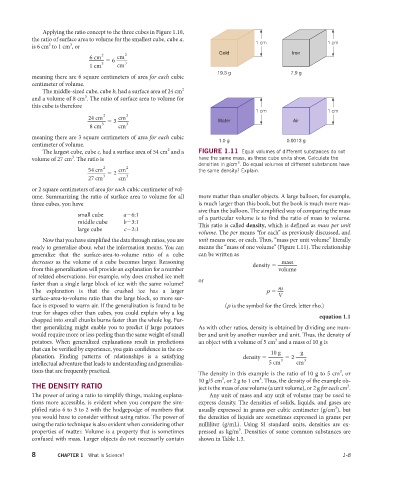
                      The largest cube, cube c, had a surface area of 54 cm  and a   FIGURE 1.11  Equal volumes of different substances do not
                                3
                   volume of 27 cm . The ratio is                         have the same mass, as these cube units show. Calculate the
                                                                                       3
                                                                          densities in g/cm . Do equal volumes of different substances have
                                     _    2    _  2                       the same density? Explain.
                                                cm
                                     54  cm

                                          3      = 2      3
                                     27  cm      cm
                   or 2 square centimeters of area for each cubic centimeter of vol-
                   ume. Summarizing the ratio of surface area to volume for all   more matter than smaller objects. A large balloon, for example,
                   three cubes, you have                                  is much larger than this book, but the book is much more mas-
                                                                          sive than the balloon. The simplified way of comparing the mass
                                  small cube     a−6:1
                                                                          of a particular volume is to find the ratio of mass to volume.
                                  middle cube    b−3:1
                                                                          This ratio is called density, which is defined as mass per  unit
                                  large  cube    c−2:1
                                                                          volume. The per means “for each” as previously discussed, and
                      Now that you have simplified the data through ratios, you are   unit means one, or each. Thus, “mass per unit volume” literally
                   ready to generalize about what the information means. You can   means the “mass of one volume” (Figure 1.11). The  relationship
                   generalize that the surface-area-to-volume ratio of a cube   can be written as
                     decreases as the volume of a cube becomes larger. Reasoning                    _
                                                                                                     mass

                                                                                            density =
                   from this generalization will provide an  explanation for a number               volume
                   of related observations. For example, why does crushed ice melt
                                                                          or
                   faster than a single large block of ice with the same volume?                    m _
                   The  explanation is that the crushed ice has a larger                        ρ =

                                                                                                    V
                     surface-area-to-volume ratio than the large block, so more sur-
                   face is exposed to warm air. If the generalization is found to be   (ρ is the symbol for the Greek letter rho.)
                   true for shapes other than cubes, you could explain why a log
                                                                                                                  equation 1.1
                   chopped into small chunks burns faster than the whole log. Fur-
                   ther generalizing might enable you to predict if large potatoes   As with other ratios, density is obtained by dividing one num-
                   would require more or less peeling than the same weight of small   ber and unit by another number and unit. Thus, the density of
                                                                                                   3
                   potatoes. When generalized explanations result in predictions   an object with a volume of 5 cm  and a mass of 10 g is
                   that can be verified by experience, you gain confidence in the ex-             10 g      g

                   planation. Finding patterns of relationships is a satisfying          density =   _   = 2    _


                                                                                                             3
                                                                                                     3
                     intellectual adventure that leads to understanding and generaliza-          5  cm      cm
                   tions that are frequently practical.                                                                  3
                                                                          The density in this example is the ratio of 10 g to 5 cm , or
                                                                                  3
                                                                                              3
                                                                          10 g/5 cm , or 2 g to 1 cm . Thus, the density of the example ob-
                   THE DENSITY RATIO                                      ject is the mass of one volume (a unit volume), or 2 g for each cm .
                                                                                                                           3
                   The power of using a ratio to simplify things, making explana-  Any unit of mass and any unit of volume may be used to
                   tions more accessible, is evident when you compare the sim-  express density. The densities of solids, liquids, and gases are
                                                                                                                       3
                   plified ratio 6 to 3 to 2 with the hodgepodge of numbers that   usually expressed in grams per cubic centimeter (g/cm ), but
                   you would have to consider without using ratios. The power of   the densities of liquids are sometimes expressed in grams per
                     using the ratio technique is also evident when considering other   milli liter (g/mL). Using SI standard units, densities are ex-
                                                                                       3
                   properties of matter. Volume is a property that is sometimes   pressed as kg/m . Densities of some common substances are
                   confused with mass. Larger objects do not necessarily contain   shown in Table 1.3.
                   8       CHAPTER 1  What Is Science?                                                                    1-8

