


Page 32 - 9780077418427.pdf
P. 32
/Users/user-f465/Desktop
tiL12214_ch01_001-024.indd Page 9 9/1/10 9:51 PM user-f465
tiL12214_ch01_001-024.indd Page 9 9/1/10 9:51 PM user-f465 /Users/user-f465/Desktop
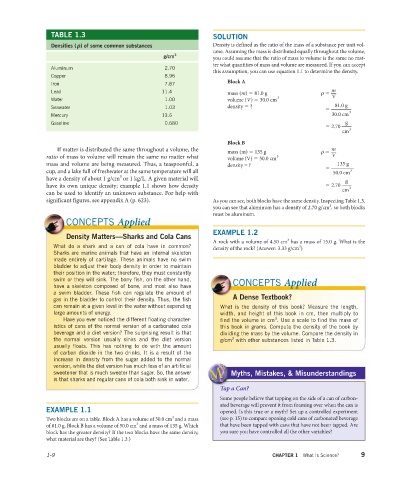
TABLE 1.3 SOLUTION
Densities (ρ) of some common substances Density is defined as the ratio of the mass of a substance per unit vol-
ume. Assuming the mass is distributed equally throughout the volume,
g/cm 3 you could assume that the ratio of mass to volume is the same no mat-
ter what quantities of mass and volume are mea sured. If you can accept
Aluminum 2.70
this assumption, you can use equation 1.1 to determine the density.
Copper 8.96
Block A
Iron 7.87
m _
Lead 11.4 mass (m) = 81.0 g ρ =
3
Water 1.00 volume (V) = 30.0 c m V
81.0 g
Seawater 1.03 density = ? = _
3
Mercury 13.6 30.0 cm
g
Gasoline 0.680 _
= 2.70
3
cm
Block B
m _
If matter is distributed the same throughout a volume, the mass (m) = 135 g ρ =
ratio of mass to volume will remain the same no matter what volume (V) = 50.0 cm V
3
mass and volume are being measured. Thus, a teaspoonful, a density = ? = _
135 g
3
cup, and a lake full of freshwater at the same tem perature will all 50.0 cm
3
have a density of about 1 g/cm or 1 kg/L. A given material will _
g
have its own unique density; example 1.1 shows how density = 2.70
3
cm
can be used to identify an unknown substance. For help with
significant figures, see appendix A (p. 623 ). As you can see, both blocks have the same density. Inspecting Table 1.3,
3
you can see that aluminum has a density of 2.70 g/cm , so both blocks
must be aluminum.
CONCEPTS Applied
EXAMPLE 1.2
Density Matters—Sharks and Cola Cans
3
A rock with a volume of 4.50 cm has a mass of 15.0 g. What is the
What do a shark and a can of cola have in common? density of the rock? (Answer: 3.33 g/cm )
3
Sharks are marine animals that have an internal skeleton
made entirely of cartilage. These animals have no swim
bladder to adjust their body density in order to maintain
their position in the water; therefore, they must constantly
swim or they will sink. The bony fish, on the other hand, CONCEPTS Applied
have a skeleton composed of bone, and most also have
a swim bladder. These fish can regulate the amount of
gas in the bladder to control their density. Thus, the fish A Dense Textbook?
can remain at a given level in the water without expending What is the density of this book? Measure the length,
large amounts of energy. width, and height of this book in cm, then multiply to
Have you ever noticed the different floating character- find the volume in cm . Use a scale to find the mass of
3
istics of cans of the normal version of a carbonated cola this book in grams. Compute the density of the book by
beverage and a diet version? The surprising result is that dividing the mass by the volume. Compare the density in
3
the normal version usually sinks and the diet version g/cm with other substances listed in Table 1.3.
usually floats. This has nothing to do with the amount
of carbon dioxide in the two drinks. It is a result of the
increase in density from the sugar added to the normal
version, while the diet version has much less of an artificial
sweetener that is much sweeter than sugar. So, the answer Myths, Mistakes, & Misunderstandings
is that sharks and regular cans of cola both sink in water.
Tap a Can?
Some people believe that tapping on the side of a can of carbon-
ated beverage will prevent it from foaming over when the can is
EXAMPLE 1.1 opened. Is this true or a myth? Set up a controlled experiment
3
Two blocks are on a table. Block A has a volume of 30.0 cm and a mass (see p. 15) to compare opening cold cans of carbonated beverage
3
of 81.0 g. Block B has a volume of 50.0 cm and a mass of 135 g. Which that have been tapped with cans that have not been tapped. Are
block has the greater density? If the two blocks have the same density, you sure you have controlled all the other variables?
what material are they? (See Table 1.3.)
1-9 CHAPTER 1 What Is Science? 9

