


Page 364 - 9780077418427.pdf
P. 364
/Users/user-f465/Desktop
          tiL12214_ch13_323-350.indd Page 341  9/3/10  6:15 PM user-f465
          tiL12214_ch13_323-350.indd Page 341  9/3/10  6:15 PM user-f465                                                /Users/user-f465/Desktop


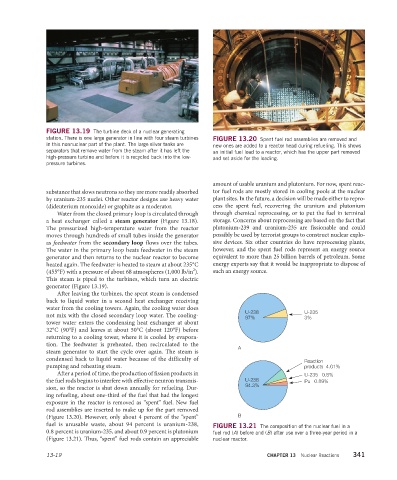
                       FIGURE 13.19  The turbine deck of a nuclear generating
                       station. There is one large generator in line with four steam turbines   FIGURE 13.20  Spent fuel rod assemblies are removed and
                       in this nonnuclear part of the plant. The large silver tanks are   new ones are added to a reactor head during refueling. This shows
                       separators that remove water from the steam after it has left the   an initial fuel load to a reactor, which has the upper part removed
                       high-pressure turbine and before it is recycled back into the low-  and set aside for the loading.
                       pressure turbines.


                                                                               amount of usable uranium and plutonium. For now, spent reac-
                       substance that slows neutrons so they are more readily absorbed   tor fuel rods are mostly stored in cooling pools at the nuclear
                       by uranium-235 nuclei. Other reactor designs use heavy water   plant sites. In the future, a decision will be made either to repro-
                       (dideuterium monoxide) or graphite as a moderator.      cess the spent fuel, recovering the uranium and plutonium
                           Water from the closed primary loop is circulated through   through chemical reprocessing, or to put the fuel in terminal
                       a heat exchanger called a  steam generator (Figure 13.18).   storage. Concerns about reprocessing are based on the fact that
                       The pressurized high-temperature water from the reactor   plutonium-239 and uranium-235 are fissionable and could
                       moves through hundreds of small tubes inside the generator   possibly be used by terrorist groups to construct nuclear explo-
                       as feedwater from the secondary loop flows over the tubes.   sive devices. Six other countries do have reprocessing plants,
                       The water in the primary loop heats feedwater in the steam   however, and the spent fuel rods represent an energy source
                       generator and then returns to the nuclear reactor to become   equivalent to more than 25 billion barrels of petroleum. Some
                       heated again. The feedwater is heated to steam at about 235°C   energy experts say that it would be inappropriate to dispose of
                                                                        2
                       (455°F) with a pressure of about 68 atmospheres (1,000 lb/in ).   such an energy source.
                       This steam is piped to the turbines, which turn an electric
                       generator (Figure 13.19).
                           After leaving the turbines, the spent steam is condensed
                       back to liquid water in a second heat exchanger receiving
                       water from the cooling towers. Again, the cooling water does
                                                                                         U-238               U-235
                       not mix with the closed secondary loop water. The cooling-        97%                 3%
                       tower water enters the condensing heat exchanger at about
                       32°C (90°F) and leaves at about 50°C (about 120°F) before
                       returning to a cooling tower, where it is cooled by evapora-
                       tion. The feedwater is preheated, then recirculated to the
                                                                                       A
                       steam generator to start the cycle over again. The steam is
                       condensed back to liquid water because of the difficulty of                           Reaction
                       pumping and  reheating steam.                                                         products  4.01%
                           After a period of time, the production of fission products in                     U-235   0.8%
                       the fuel rods begins to interfere with effective neutron transmis-  U-238             Pu   0.89%
                                                                                         94.3%
                       sion, so the reactor is shut down annually for refueling. Dur-
                       ing refueling, about one-third of the fuel that had the longest
                       exposure in the reactor is removed as “spent” fuel. New fuel
                       rod assemblies are inserted to make up for the part  removed
                       (Figure 13.20). However, only about 4 percent of the “spent”    B
                       fuel is unusable waste, about 94 percent is uranium-238,   FIGURE 13.21  The composition of the nuclear fuel in a
                         0.8 percent is uranium-235, and about 0.9 percent is plutonium   fuel rod (A) before and (B) after use over a three-year period in a
                       (Figure 13.21). Thus, “spent” fuel rods contain an appreciable   nuclear reactor.

                       13-19                                                                     CHAPTER 13  Nuclear Reactions   341

