


Page 362 - 9780077418427.pdf
P. 362
/Users/user-f465/Desktop
          tiL12214_ch13_323-350.indd Page 339  9/3/10  6:14 PM user-f465
          tiL12214_ch13_323-350.indd Page 339  9/3/10  6:14 PM user-f465                                                /Users/user-f465/Desktop


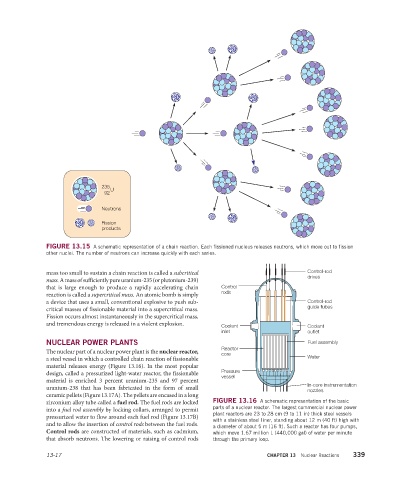
                                          235 U
                                           92

                                          Neutrons

                                          Fission
                                          products


                       FIGURE 13.15  A schematic representation of a chain reaction. Each fissioned nucleus releases neutrons, which move out to fission
                       other nuclei. The number of neutrons can increase quickly with each series.


                       mass too small to sustain a chain reaction is called a sub critical                    Control-rod
                                                                                                              drives
                       mass. A mass of sufficiently pure uranium-235 (or  plutonium-239)
                        that is large enough to produce a rapidly accelerating chain   Control
                                                                                  rods
                        reaction is called a supercritical mass. An atomic bomb is simply
                        a device that uses a small, conventional explosive to push sub-                       Control-rod
                        critical masses of fissionable material into a supercritical mass.                    guide tubes
                        Fission occurs almost instantaneously in the supercritical mass,
                        and tremendous energy is released in a violent explosion.  Coolant                    Coolant
                                                                                  inlet                       outlet

                       NUCLEAR POWER PLANTS                                                                   Fuel assembly
                                                                                  Reactor
                       The nuclear part of a nuclear power plant is the nuclear reactor,   core
                       a steel vessel in which a controlled chain reaction of fissionable                     Water
                       material releases energy (Figure 13.16). In the most popular
                         design, called a pressurized light-water reactor, the fissionable   Pressure
                                                                                  vessel
                       material is enriched 3 percent uranium-235 and 97 percent                              In-core instrumentation
                         uranium-238 that has been fabricated in the form of small                            nozzles
                         ceramic pellets (Figure 13.17A). The pellets are encased in a long
                       zirconium alloy tube called a fuel rod. The fuel rods are locked   FIGURE 13.16  A schematic representation of the basic
                       into a fuel rod assembly by locking collars, arranged to permit   parts of a nuclear reactor. The largest commercial nuclear power
                                                                               plant reactors are 23 to 28 cm (9 to 11 in) thick steel vessels
                       pressurized water to flow around each fuel rod (Figure 13.17B)
                                                                               with a stainless steel liner, standing about 12 m (40 ft) high with
                       and to allow the insertion of control rods between the fuel rods.   a diameter of about 5 m (16 ft). Such a reactor has four pumps,
                       Control rods are constructed of materials, such as cadmium,   which move 1.67 million L (440,000 gal) of water per minute
                       that absorb neutrons. The lowering or raising of control rods   through the primary loop.

                       13-17                                                                     CHAPTER 13  Nuclear Reactions   339

