


Page 359 - 9780077418427.pdf
P. 359
/Users/user-f465/Desktop
          tiL12214_ch13_323-350.indd Page 336  9/3/10  6:14 PM user-f465
          tiL12214_ch13_323-350.indd Page 336  9/3/10  6:14 PM user-f465                                                /Users/user-f465/Desktop


                           A Closer Look


                           Nuclear Medicine
                         uclear medicine had its beginnings
                     N in 1946 when radioactive iodine was
                     first successfully used to treat thyroid can-
                     cer patients. Then physicians learned that
                     radioactive iodine could also be used as a
                     diagnostic tool, providing a way to measure
                     the function of the thyroid and to diagnose
                     thyroid disease. More and more physicians
                     began to use nuclear medicine to diagnose
                     thyroid disease as well as to treat hyper-
                     thyroidism and other thyroid problems.
                     Nuclear medicine is a branch of medicine
                     using radiation or radioactive materials to
                     diagnose as well as treat diseases.
                        The development of new nuclear medi-
                     cine technologies, such as cameras, detec-
                     tion instruments, and computers, has led to
                     a remarkable increase in the use of nuclear   A                       B
                     medicine as a diagnostic tool. Today, there
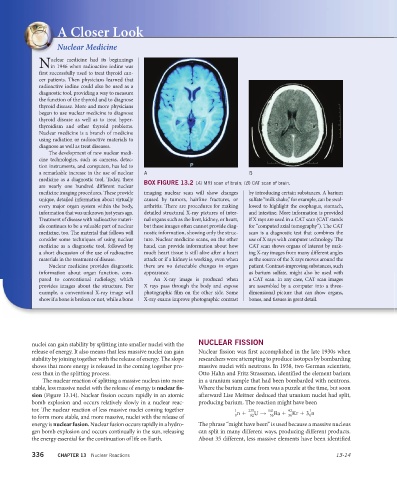
                                                        BOX FIGURE 13.2 (A) MRI scan of brain; (B) CAT scan of brain.
                     are nearly one hundred different nuclear
                     medicine imaging procedures. These provide   imaging nuclear scan will show changes   by  introducing certain substances. A barium
                     unique, detailed information about virtually   caused by tumors, hairline fractures, or     sulfate “milk shake,” for example, can be swal-
                     every major organ system within the body,   arthritis. There are procedures for making   lowed to highlight the esophagus, stomach,
                     information that was unknown just years ago.   detailed structural X-ray pictures of inter-  and intestine. More information is provided
                     Treatment of disease with radioactive materi-  nal organs such as the liver, kidney, or heart,   if X rays are used in a CAT scan (CAT stands
                     als continues to be a valuable part of nuclear   but these images often cannot  provide diag-  for “computed axial tomography”). The CAT
                     medicine, too. The material that follows will   nostic information, showing only the struc-  scan is a diagnostic test that  combines the
                     consider some techniques of using nuclear   ture. Nuclear medicine scans, on the other   use of X rays with computer technology. The
                     medicine as a diagnostic tool, followed by   hand, can provide information about how   CAT scan shows organs of interest by mak-
                     a short discussion of the use of radioactive   much heart tissue is still alive  after a heart   ing X-ray images from many different angles
                     materials in the treatment of disease.  attack or if a kidney is working, even when   as the source of the X rays moves around the
                        Nuclear medicine provides diagnostic   there are no detectable changes in organ   patient. Contrast-improving substances, such
                     information about organ function, com-  appearance.                   as barium sulfate, might also be used with
                     pared to conventional radiology, which   An X-ray image is produced when   a CAT scan. In any case, CAT scan images
                       provides images about the structure. For   X rays pass through the body and expose   are assembled by a computer into a three-
                       example, a conventional X-ray image will   photographic film on the other side. Some   dimensional picture that can show organs,
                     show if a bone is broken or not, while a bone   X-ray exams improve photographic contrast   bones, and  tissues in great detail.


                   nuclei can gain stability by splitting into smaller nuclei with the   NUCLEAR FISSION
                   release of energy. It also means that less massive nuclei can gain   Nuclear fission was first accomplished in the late 1930s when
                   stability by joining together with the release of energy. The slope   researchers were attempting to produce isotopes by bombarding
                   shows that more energy is released in the coming together pro-  massive nuclei with neutrons. In 1938, two German scientists,
                   cess than in the splitting process.                    Otto Hahn and Fritz Strassman, identified the element barium
                      The nuclear reaction of splitting a massive nucleus into more   in a uranium sample that had been bombarded with neutrons.
                   stable, less massive nuclei with the release of energy is  nuclear fi s-  Where the barium came from was a puzzle at the time, but soon
                   sion (Figure 13.14). Nuclear fission occurs rapidly in an atomic   afterward Lise Meitner deduced that uranium nuclei had split,
                   bomb explosion and occurs relatively slowly in a nuclear reac-  producing barium. The reaction might have been
                   tor. The nuclear reaction of less massive nuclei coming together   1   235    141    92     1
                                                                                              n +          U →          Ba +          Kr +  3       n
                                                                                                        36
                                                                                      0
                                                                                                   56
                                                                                            92
                                                                                                               0
                   to form more stable, and more massive, nuclei with the release of
                   energy is nuclear fusion. Nuclear fusion occurs rapidly in a hydro-  The phrase “might have been” is used because a massive nucleus
                   gen bomb explosion and occurs continually in the sun, releasing   can split in many different ways, producing different products.
                   the energy essential for the continuation of life on Earth.  About 35 different, less massive elements have been identified
                   336     CHAPTER 13 Nuclear Reactions                                                                13-14

