


Page 363 - 9780077418427.pdf
P. 363
/Users/user-f465/Desktop
          tiL12214_ch13_323-350.indd Page 340  9/3/10  6:14 PM user-f465
          tiL12214_ch13_323-350.indd Page 340  9/3/10  6:14 PM user-f465                                                /Users/user-f465/Desktop


                   A                                                      B
                   FIGURE 13.17  (A) These are uranium oxide fuel pellets that are stacked inside fuel rods, which are then locked together in a fuel rod
                   assembly. (B) A fuel rod assembly. See also Figure 13.20, which shows a fuel rod assembly being loaded into a reactor.


                   within the fuel rod assemblies slows or increases the chain reac-    explosion. In a pressurized water reactor, the energy released is
                   tion by varying the amount of neutrons absorbed. When they   carried away from the reactor by pressurized water in a closed
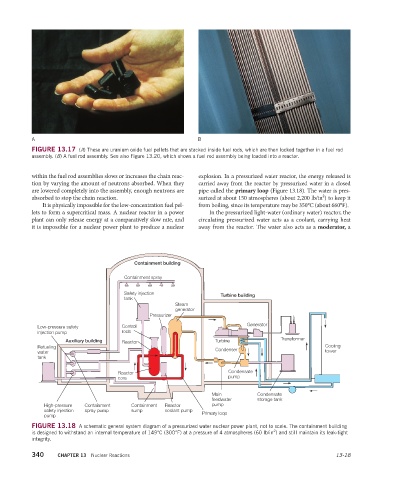
                   are lowered completely into the assembly, enough neutrons are   pipe called the primary loop (Figure 13.18). The water is pres-
                                                                                                                   2
                   absorbed to stop the chain reaction.                   surized at about 150 atmospheres (about 2,200 lb/in ) to keep it
                      It is physically impossible for the low-concentration fuel pel-  from boiling, since its temperature may be 350°C (about 660°F).
                   lets to form a supercritical mass. A nuclear reactor in a power   In the pressurized light-water (ordinary water) reactor, the
                   plant can only release energy at a comparatively slow rate, and   circulating pressurized water acts as a coolant, carrying heat
                   it is impossible for a nuclear power plant to produce a nuclear   away from the reactor. The water also acts as a moderator, a


                                                     Containment building

                                                 Containment spray


                                                 Safety injection                Turbine building
                                                 tank
                                                                  Steam
                                                                  generator
                                                          Pressurizer

                     Low-pressure safety         Control                                  Generator
                     injection pump              rods
                              Auxiliary building  Reactor                      Turbine               Transformer
                     Refueling                                                 Condenser                            Cooling
                     water                                                                                          tower
                     tank

                                               Reactor                              Condensate
                                               core                                 pump


                                                                              Main           Condensate
                                                                              feedwater      storage tank
                       High-pressure  Containment   Containment  Reactor      pump
                       safety injection  spray pump  sump      coolant pump
                       pump                                                Primary loop
                   FIGURE 13.18  A schematic general system diagram of a pressurized water nuclear power plant, not to scale. The containment building
                                                                                                   2
                   is designed to withstand an internal temperature of 149°C (300°F) at a pressure of 4 atmospheres (60 lb/in ) and still maintain its leak-tight
                   integrity.

                   340     CHAPTER 13 Nuclear Reactions                                                                13-18

