


Page 428 - 9780077418427.pdf
P. 428
/Users/user-f465/Desktop
          tiL12214_ch16_405-432.indd Page 405  9/3/10  6:19 PM user-f465
          tiL12214_ch16_405-432.indd Page 405  9/3/10  6:19 PM user-f465                                                /Users/user-f465/Desktop


                                                                             16                   Earth in
                                                                             16

                                                                                                  Space


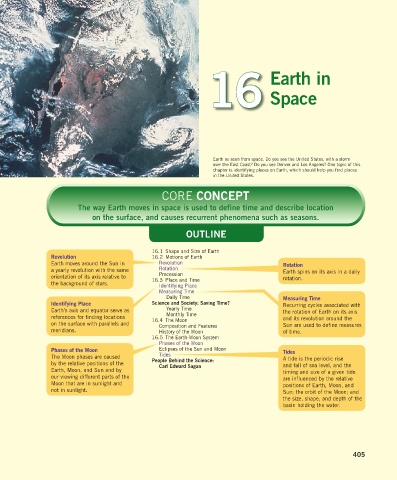
                                                                               Earth as seen from space. Do you see the United States, with a storm
                                                                               over the East Coast? Do you see Denver and Los Angeles? One topic of this
                                                                               chapter is identifying places on Earth, which should help you find places
                                                                               in the United States.


                                                              CORE CONCEPT

                                  The way Earth moves in space is used to define time and describe location
                                       on the surface, and causes recurrent phenomena such as seasons.

                                                                      OUTLINE


                                                          16.1  Shape and Size of Earth
                         Revolution                       16.2  Motions of Earth
                         Earth moves around the Sun in       Revolution                               Rotation
                         a yearly revolution with the same   Rotation                                 Earth spins on its axis in a daily
                                                             Precession
                         orientation of its axis relative to
                                                          16.3  Place and Time                        rotation.
                         the background of stars.
                                                             Identifying Place
                                                             Measuring Time
                                                               Daily Time                             Measuring Time
                         Identifying Place                Science and Society: Saving Time?           Recurring cycles associated with
                         Earth’s axis and equator serve as     Yearly Time                            the rotation of Earth on its axis
                                                               Monthly Time
                         references for finding locations   16.4 The Moon                             and its revolution around the
                         on the surface with parallels and   Composition and Features                 Sun are used to define measures
                         meridians.                          History of the Moon                      of time.
                                                          16.5  The Earth-Moon System
                                                             Phases of the Moon
                         Phases of the Moon                  Eclipses of the Sun and Moon             Tides
                                                             Tides
                         The Moon phases are caused       People Behind the Science:                  A tide is the periodic rise
                         by the relative positions of the    Carl Edward Sagan                        and fall of sea level, and the
                         Earth, Moon, and Sun and by                                                  timing and size of a given tide
                         our viewing different parts of the                                           are influenced by the relative
                         Moon that are in sunlight and                                                positions of Earth, Moon, and
                         not in sunlight.                                                             Sun; the orbit of the Moon; and
                                                                                                      the size, shape, and depth of the
                                                                                                      basin holding the water.


                                                                                                                             405

