


Page 431 - 9780077418427.pdf
P. 431
/Users/user-f465/Desktop
          tiL12214_ch16_405-432.indd Page 408  9/3/10  6:19 PM user-f465
          tiL12214_ch16_405-432.indd Page 408  9/3/10  6:19 PM user-f465                                                /Users/user-f465/Desktop


                                   Sphere                                                         March 20 or 21
                                                                              June 21 or 22                     December 22 or 23
                                                                                  NP                                 NP
                                                                          23.5°N
                                                  (7,900 mi)                            Direct sunlight
                        Oblate
                        spheroid                                                                                        23.5°S
                                       12,756 km   (7,926 mi)                  23.5°            September 22 or 23  23.5°
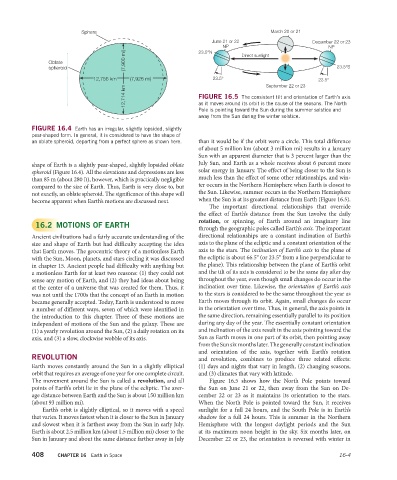
                                                  12,714 km               FIGURE 16.5  The consistent tilt and orientation of Earth’s axis


                                                                          as it moves around its orbit is the cause of the seasons. The North
                                                                          Pole is pointing toward the Sun during the summer solstice and
                                                                          away from the Sun during the winter solstice.

                   FIGURE 16.4  Earth has an irregular, slightly lopsided, slightly
                   pear-shaped form. In general, it is considered to have the shape of
                   an oblate spheroid, departing from a perfect sphere as shown here.  than it would be if the orbit were a circle. This total difference
                                                                          of about 5 million km (about 3 million mi)  results in a January
                                                                          Sun with an apparent diameter that is 3 percent larger than the
                   shape of Earth is a slightly pear-shaped, slightly lopsided oblate   July Sun, and Earth as a whole receives about 6 percent more
                   spheroid (Figure 16.4). All the elevations and depressions are less   solar energy in January. The effect of being closer to the Sun is
                   than 85 m (about 280 ft), however, which is practically negligible   much less than the effect of some other relationships, and win-
                   compared to the size of Earth. Thus, Earth is very close to, but   ter occurs in the Northern Hemisphere when Earth is closest to
                   not  exactly, an oblate spheroid. The significance of this shape will   the Sun. Likewise, summer occurs in the Northern Hemisphere
                   become apparent when Earth’s  motions are discussed next.  when the Sun is at its greatest distance from Earth (Figure 16.5).
                                                                             The important directional relationships that override
                                                                          the effect of Earth’s distance from the Sun involve the daily
                                                                          rotation, or spinning, of Earth around an imaginary line
                    16.2  MOTIONS OF EARTH
                                                                          through the  geographic poles called Earth’s axis. The important
                   Ancient civilizations had a fairly accurate understanding of the   directional relationships are a constant inclination of Earth’s
                   size and shape of Earth but had difficulty accepting the idea   axis to the plane of the ecliptic and a constant orientation of the
                   that Earth moves. The geocentric theory of a motionless Earth   axis to the stars. The inclination of Earth’s axis to the plane of
                   with the Sun, Moon, planets, and stars circling it was discussed   the ecliptic is about 66.5° (or 23.5° from a line perpendicular to
                   in chapter 15. Ancient people had difficulty with anything but   the plane). This relationship between the plane of Earth’s orbit
                   a motionless Earth for at least two reasons: (1) they could not   and the tilt of its axis is considered to be the same day after day
                   sense any motion of Earth, and (2) they had ideas about being   throughout the year, even though small changes do occur in the
                   at the center of a universe that was created for them. Thus, it   inclination over time. Likewise, the orientation of Earth’s axis
                   was not until the 1700s that the concept of an Earth in motion   to the stars is considered to be the same throughout the year as
                   became generally accepted. Today, Earth is understood to move   Earth moves through its orbit. Again, small changes do occur
                   a number of different ways, seven of which were identified in   in the orientation over time. Thus, in general, the axis points in
                   the introduction to this chapter. Three of these motions are   the same direction, remaining essentially parallel to its position
                   independent of motions of the Sun and the galaxy. These are   during any day of the year. The essentially constant orientation
                   (1) a yearly revolution around the Sun, (2) a daily rotation on its   and inclination of the axis result in the axis pointing toward the
                   axis, and (3) a slow, clockwise wobble of its axis.    Sun as Earth moves in one part of its orbit, then pointing away
                                                                          from the Sun six months later. The generally constant inclination
                                                                          and orientation of the axis, together with Earth’s rotation
                   REVOLUTION                                             and revolution, combines to produce three related effects:
                   Earth moves constantly around the Sun in a slightly elliptical   (1) days and nights that vary in length, (2) changing seasons,
                     orbit that requires an average of one year for one complete circuit.   and (3) climates that vary with latitude.
                   The movement around the Sun is called a revolution, and all   Figure 16.5 shows how the North Pole points toward
                   points of Earth’s orbit lie in the plane of the ecliptic. The aver-  the Sun on June 21 or 22, then away from the Sun on De-
                   age distance between Earth and the Sun is about 150 million km   cember 22 or 23 as it maintains its orientation to the stars.
                   (about 93 million mi).                                 When the North Pole is pointed toward the Sun, it receives
                      Earth’s orbit is slightly elliptical, so it moves with a speed   sunlight for a full 24 hours, and the South Pole is in Earth’s
                   that varies. It moves fastest when it is closer to the Sun in January   shadow for a full 24 hours. This is summer in the Northern
                   and slowest when it is farthest away from the Sun in early July.   Hemisphere with the longest daylight periods and the Sun
                   Earth is about 2.5 million km (about 1.5 million mi) closer to the   at its maximum noon height in the sky. Six months later, on
                   Sun in January and about the same distance farther away in July   December 22 or 23, the orientation is reversed with winter in

                   408     CHAPTER 16  Earth in Space                                                                   16-4

