


Page 430 - 9780077418427.pdf
P. 430
/Users/user-f465/Desktop
          tiL12214_ch16_405-432.indd Page 407  9/3/10  6:19 PM user-f465
          tiL12214_ch16_405-432.indd Page 407  9/3/10  6:19 PM user-f465                                                /Users/user-f465/Desktop


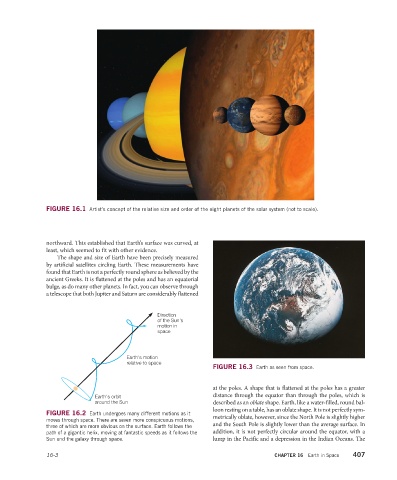
                         FIGURE 16.1  Artist’s concept of the relative size and order of the eight planets of the solar system (not to scale).


                       northward. This established that Earth’s surface was curved, at
                       least, which seemed to fit with other evidence.
                           The shape and size of Earth have been precisely mea sured
                       by artificial satellites circling Earth. These measurements have
                       found that Earth is not a perfectly round sphere as believed by the
                       ancient Greeks. It is flattened at the poles and has an equatorial
                       bulge, as do many other planets. In fact, you can observe through
                       a telescope that both Jupiter and Saturn are considerably flattened


                                                            Direction
                                                            of the Sun's
                                                            motion in
                                                            space


                                                  Earth's motion
                                                  relative to space
                                                                               FIGURE 16.3  Earth as seen from space.


                                                                               at the poles. A shape that is flattened at the poles has a greater
                                        Earth's orbit                          distance through the equator than through the poles, which is
                                        around the Sun                         described as an oblate shape. Earth, like a  water-filled, round bal-
                                                                               loon resting on a table, has an oblate shape. It is not perfectly sym-
                       FIGURE 16.2  Earth undergoes many different motions as it
                                                                               metrically oblate, however, since the North Pole is slightly higher
                       moves through space. There are seven more conspicuous motions,
                       three of which are more obvious on the surface. Earth follows the   and the South Pole is slightly lower than the average surface. In
                       path of a gigantic helix, moving at fantastic speeds as it follows the   addition, it is not perfectly circular around the equator, with a
                       Sun and the galaxy through space.                       lump in the Pacific and a depression in the Indian Oceans. The

                       16-3                                                                        CHAPTER 16  Earth in Space   407

