


Page 433 - 9780077418427.pdf
P. 433
/Users/user-f465/Desktop
          tiL12214_ch16_405-432.indd Page 410  9/3/10  6:19 PM user-f465
          tiL12214_ch16_405-432.indd Page 410  9/3/10  6:19 PM user-f465                                                /Users/user-f465/Desktop


                         CONCEPTS Applied

                         Sunrise, Sunset
                     Make a chart to show the time of sunrise and sunset for
                     a month. Calculate the amount of daylight and darkness.
                     Does the sunrise change in step with the sunset, or do
                     they change  differently? What models can you think of that
                     would explain all your findings?


                   ROTATION
                   Observing the apparent turning of the celestial sphere once a
                   day and seeing the east-to-west movement of the Sun, Moon,
                   and stars, one could certainly get the impression that it is the
                   heavenly bodies and not Earth doing the moving. You can-
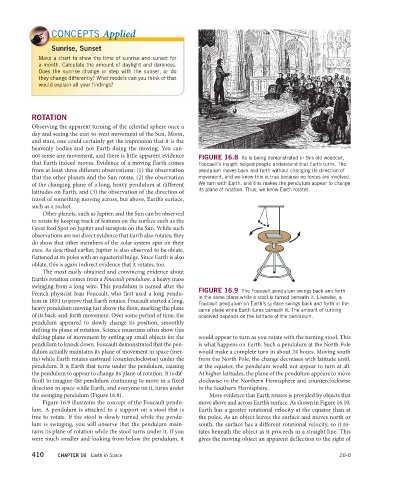
                   not sense any movement, and there is little apparent evidence   FIGURE 16.8  As is being demonstrated in this old woodcut,
                   that Earth indeed moves. Evidence of a moving Earth comes   Foucault’s insight helped people understand that Earth turns. The
                   from at least three different  observations: (1) the observation   pendulum moves back and forth without changing its direction of
                   that the other planets and the Sun rotate, (2) the observation   movement, and we know this is true because no forces are involved.
                   of the changing plane of a long, heavy pendulum at different   We turn with Earth, and this makes the pendulum appear to change
                   latitudes on Earth, and (3) the observation of the direction of   its plane of rotation. Thus, we know Earth rotates.
                   travel of something moving across, but above, Earth’s surface,
                   such as a rocket.
                      Other planets, such as Jupiter, and the Sun can be observed
                   to rotate by keeping track of features on the surface such as the
                   Great Red Spot on Jupiter and sunspots on the Sun. While such
                   observations are not direct evidence that Earth also rotates, they
                   do show that other members of the solar system spin on their
                   axes. As described earlier, Jupiter is also observed to be oblate,
                   flattened at its poles with an equatorial bulge. Since Earth is also
                   oblate, this is again indirect evidence that it rotates, too.
                      The most easily obtained and convincing evidence about
                   Earth’s rotation comes from a Foucault pendulum, a heavy mass
                   swinging from a long wire. This pendulum is named after the
                                                                          FIGURE 16.9  The Foucault pendulum swings back and forth
                   French physicist Jean Foucault, who first used a long pendu-
                                                                          in the same plane while a stool is turned beneath it. Likewise, a
                   lum in 1851 to prove that Earth rotates. Foucault started a long,
                                                                          Foucault pendulum on Earth’s surface swings back and forth in the
                   heavy pendulum moving just above the floor, marking the plane   same plane while Earth turns beneath it. The amount of turning
                   of its back-and-forth movement. Over some period of time, the   observed depends on the latitude of the pendulum.
                   pendulum appeared to slowly change its position, smoothly
                   shifting its plane of rotation. Science museums often show this
                   shifting plane of movement by setting up small objects for the   would appear to turn as you rotate with the turning stool. This
                   pendulum to knock down. Foucault demonstrated that the pen-  is what happens on Earth. Such a pendulum at the North Pole
                   dulum actually maintains its plane of movement in space (iner-  would make a complete turn in about 24 hours. Moving south
                   tia) while Earth rotates eastward (counterclockwise) under the   from the North Pole, the change decreases with latitude until,
                   pendulum. It is Earth that turns under the pendulum, causing   at the equator, the pendulum would not appear to turn at all.
                   the pendulum to appear to change its plane of rotation. It is dif-  At higher latitudes, the plane of the pendulum  appears to move
                   ficult to imagine the pendulum con tinuing to move in a fixed   clockwise in the Northern Hemisphere and counter clockwise
                   direction in space while Earth, and everyone on it, turns under   in the Southern Hemisphere.
                   the swinging pendulum (Figure 16.8).                      More evidence that Earth rotates is provided by objects that
                      Figure 16.9 illustrates the concept of the Foucault pendu-  move above and across Earth’s surface. As shown in  Figure 16.10,
                   lum. A pendulum is attached to a support on a stool that is   Earth has a greater rotational velocity at the  equator than at
                   free to rotate. If the stool is slowly turned while the pendu-  the poles. As an object leaves the surface and moves north or
                   lum is swinging, you will observe that the pendulum main-  south, the surface has a different rotational  velocity, so it ro-
                   tains its plane of rotation while the stool turns under it. If you   tates beneath the object as it proceeds in a straight line. This
                   were much smaller and looking from below the pendulum, it   gives the moving object an apparent deflection to the right of

                   410     CHAPTER 16  Earth in Space                                                                   16-6

