


Page 48 - 9780077418427.pdf
P. 48
/Users/user-f465/Desktop
          tiL12214_ch02_025-060.indd Page 25  9/3/10  7:56 PM user-f465
          tiL12214_ch02_025-060.indd Page 25  9/3/10  7:56 PM user-f465                                                 /Users/user-f465/Desktop


                                                                                                                       PHYSICS


                                                                                   2 2            Motion


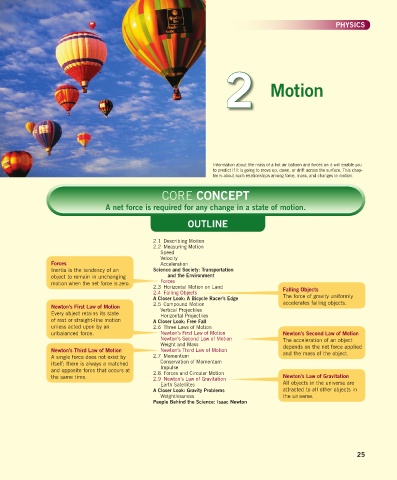
                                                                               Information about the mass of a hot air balloon and forces on it will enable you
                                                                               to predict if it is going to move up, down, or drift across the surface. This chap-
                                                                               ter is about such relationships among force, mass, and changes in motion.


                                                              CORE CONCEPT

                                           A net force is required for any change in a state of motion.

                                                                      OUTLINE


                                                           2.1 Describing Motion
                                                           2.2 Measuring Motion
                                                             Speed
                                                             Velocity
                         Forces                              Acceleration
                         Inertia is the tendency of an     Science and Society: Transportation
                         object to remain in unchanging         and the Environment
                                                             Forces
                         motion when the net force is zero.
                                                           2.3  Horizontal Motion on Land             Falling Objects
                                                           2.4 Falling Objects
                                                           A Closer Look: A Bicycle Racer’s Edge      The force of gravity uniformly
                                                           2.5 Compound Motion                        accelerates falling objects.
                         Newton’s First Law of Motion        Vertical Projectiles
                         Every object retains its state      Horizontal Projectiles
                         of rest or straight-line motion   A Closer Look: Free Fall
                         unless acted upon by an           2.6  Three Laws of Motion
                         unbalanced force.                   Newton’s First Law of Motion             Newton’s Second Law of Motion
                                                             Newton’s Second Law of Motion            The acceleration of an object
                                                             Weight and Mass                          depends on the net force applied
                         Newton’s Third Law of Motion        Newton’s Third Law of Motion             and the mass of the object.
                         A single force does not exist by   2.7 Momentum
                         itself; there is always a matched   Conservation of Momentum
                                                             Impulse
                         and opposite force that occurs at   2.8  Forces and Circular Motion
                         the same time.                    2.9  Newton’s Law of Gravitation           Newton’s Law of Gravitation
                                                             Earth Satellites                         All objects in the universe are
                                                           A Closer Look: Gravity Problems            attracted to all other objects in
                                                             Weightlessness                           the universe.
                                                           People Behind the Science: Isaac Newton


                                                                                                                              25
                                                                                                                              25

