


Page 480 - 9780077418427.pdf
P. 480
/Users/user-f465/Desktop
          tiL12214_ch18_455-476.indd Page 457  9/3/10  6:21 PM user-f465
          tiL12214_ch18_455-476.indd Page 457  9/3/10  6:21 PM user-f465                                                /Users/user-f465/Desktop


                                                                                                 Particle motion


                                                                                                            Wave propagation


                       FIGURE 18.1  This drilling ship samples sediment and rock
                       from the deep ocean floor. It can only sample materials well within   A
                       the upper crust of Earth, however, barely scratching the surface of
                       Earth’s interior.
                                                                                           Particle motion
                       material that is predominantly iron. The environment of the
                       center of Earth today is extreme, with estimates of pressures up
                       to 3.5 million atmospheres (3.5 million times the pressure of
                       the atmosphere at the surface). Recent estimates of the tempera-                       Wave propagation
                       tures at Earth’s core are about the same as the temperature of the
                       surface of the Sun, about 6,000°C (11,000°F).
                           The melting and flowing of iron to Earth’s center were the
                       beginnings of  differentiation, the separation of materials that
                       gave Earth its present-day stratified or layered interior. The
                       different crystallization temperatures of the basic minerals, as   B
                         illustrated in Bowen’s reaction series, further differentiated the
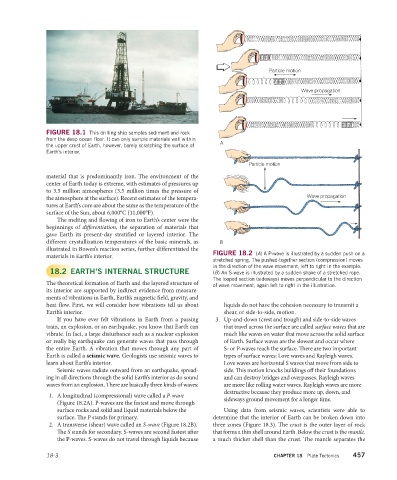
                       materials in Earth’s interior.                          FIGURE 18.2  (A) A P-wave is illustrated by a sudden push on a
                                                                               stretched spring. The pushed-together section (compression) moves
                                                                               in the direction of the wave movement, left to right in the example.
                         18.2  EARTH’S INTERNAL STRUCTURE                      (B) An S-wave is illustrated by a sudden shake of a stretched rope.
                                                                               The looped section (sideways) moves perpendicular to the direction
                       The theoretical formation of Earth and the layered structure of   of wave movement, again left to right in the illustration.
                       its interior are supported by indirect evidence from measure-
                       ments of vibrations in Earth, Earth’s magnetic field, gravity, and
                       heat flow. First, we will consider how vibrations tell us about   liquids do not have the cohesion necessary to transmit a
                       Earth’s interior.                                          shear, or side-to-side, motion.
                           If you have ever felt vibrations in Earth from a passing     3.  Up-and-down (crest and trough) and side-to-side waves
                       train, an explosion, or an earthquake, you know that Earth can   that travel across the surface are called surface waves that are
                       vibrate. In fact, a large disturbance such as a nuclear explosion   much like waves on water that move across the solid surface
                       or really big earthquake can generate waves that pass through   of Earth. Surface waves are the slowest and occur where

                       the entire Earth. A vibration that moves through any part of   S- or P-waves reach the surface. There are two important
                       Earth is called a seismic wave. Geologists use seismic waves to   types of surface waves: Love waves and Rayleigh waves.
                       learn about Earth’s interior.                              Love waves are horizontal S waves that move from side to
                           Seismic waves radiate outward from an earthquake, spread-  side. This motion knocks buildings off their foundations


                       ing in all directions through the solid Earth’s interior as do sound   and can destroy bridges and overpasses. Rayleigh waves
                       waves from an explosion. There are basically three kinds of waves:   are more like rolling water waves. Rayleigh waves are more
                                                                                  destructive because they  produce more up, down, and
                         1.  A longitudinal (compressional) wave called a P-wave
                                                                                  sideways ground movement for a longer time.
                           (Figure 18.2A). P-waves are the fastest and move through
                           surface rocks and solid and liquid materials below the   Using data from seismic waves, scientists were able to
                           surface. Th e P stands for primary.                 determine that the interior of Earth can be broken down into
                         2.  A transverse (shear) wave called an S-wave (Figure 18.2B).   three zones (Figure 18.3). The crust is the outer layer of rock
                           Th e S stands for secondary. S-waves are second fastest aft er   that forms a thin shell around Earth. Below the crust is the mantle,
                           the P-waves. S-waves do not travel through liquids because   a much thicker shell than the crust. The mantle separates the

                       18-3                                                                        CHAPTER 18  Plate Tectonics   457

