


Page 485 - 9780077418427.pdf
P. 485
/Users/user-f465/Desktop
          tiL12214_ch18_455-476.indd Page 462  9/3/10  6:21 PM user-f465
          tiL12214_ch18_455-476.indd Page 462  9/3/10  6:21 PM user-f465                                                /Users/user-f465/Desktop


                    150   120   90   60    30    0    30   60    90
                                                                                                           Direction of Earth's
                                                                                                           magnetic field
                    60

                                                                                                              Magnetite
                                                                            Cooling                           crystals
                                                                            lava                              preserve
                    30                                                                                        orientation
                                                                                                              of Earth's field


                                                                                                     Present orientation of Earth's
                    0                                                                                magnetic field


                    30


                                                                                                                    Lava flows
                                                                                                                    showing
                                                                                                                    reverse
                   A                                                                                                magnetism


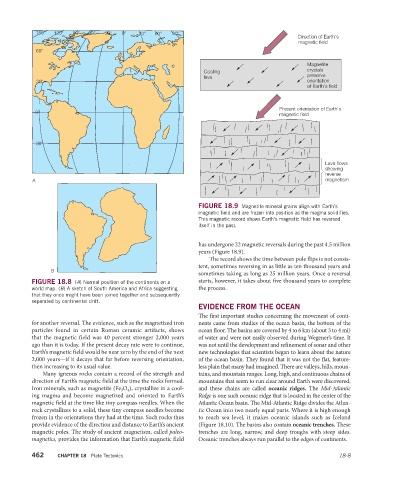
                                                                          FIGURE 18.9  Magnetite mineral grains align with Earth’s
                                                                          magnetic field and are frozen into position as the magma solidifies.
                                                                          This magnetic record shows Earth’s magnetic field has reversed
                                                                          itself in the past.

                                                                          has undergone 22 magnetic reversals during the past 4.5 million
                                                                          years (Figure 18.9).
                                                                             The record shows the time between pole flips is not consis-
                                                                          tent, sometimes reversing in as little as ten thousand years and
                         B
                                                                          sometimes taking as long as 25 million years. Once a reversal
                   FIGURE 18.8  (A) Normal position of the continents on a   starts, however, it takes about five thousand years to complete
                   world map. (B) A sketch of South America and Africa suggesting   the process.
                   that they once might have been joined together and subsequently
                   separated by continental drift.
                                                                          EVIDENCE FROM THE OCEAN
                                                                          The first important studies concerning the movement of conti-
                   for another reversal. The  evidence, such as the magnetized iron   nents came from studies of the ocean basin, the bottom of the
                   particles found in  certain  Roman  ceramic artifacts, shows   ocean floor. The basins are covered by 4 to 6 km (about 3 to 4 mi)
                   that the magnetic field was 40 percent stronger 2,000 years   of water and were not easily observed during Wegener’s time. It
                   ago than it is today. If the present decay rate were to continue,   was not until the development and refinement of sonar and other
                   Earth’s magnetic field would be near zero by the end of the next   new technologies that scientists began to learn about the nature
                    2,000 years—if it decays that far before reversing orientation,   of the ocean basin. They found that it was not the flat, feature-
                   then increasing to its usual value.                    less plain that many had imagined. There are valleys, hills, moun-
                      Many igneous rocks contain a record of the strength and   tains, and mountain ranges. Long, high, and continuous chains of
                   direction of Earth’s magnetic field at the time the rocks formed.   mountains that seem to run clear around Earth were discovered,
                   Iron minerals, such as magnetite (Fe 3 O 4 ), crystallize in a cool-  and these chains are called  oceanic ridges. The  Mid-Atlantic
                   ing magma and become magnetized and oriented to Earth’s   Ridge is one such oceanic ridge that is located in the center of the
                   magnetic field at the time like tiny compass needles. When the   Atlantic Ocean basin. The Mid- Atlantic Ridge divides the Atlan-
                   rock crystallizes to a solid, these tiny compass needles become   tic Ocean into two nearly equal parts. Where it is high enough
                   frozen in the orientations they had at the time. Such rocks thus   to reach sea level, it makes oceanic islands such as Iceland
                   provide evidence of the direction and distance to Earth’s ancient   ( Figure 18.10). The basins also contain oceanic trenches. These
                   magnetic poles. The study of ancient mag netism, called paleo-  trenches are long, narrow, and deep troughs with steep sides.
                   magnetics, provides the information that Earth’s magnetic field   Oceanic trenches always run parallel to the edges of continents.

                   462     CHAPTER 18 Plate Tectonics                                                                   18-8

