


Page 478 - 9780077418427.pdf
P. 478
/Users/user-f465/Desktop
          tiL12214_ch18_455-476.indd Page 455  9/3/10  6:21 PM user-f465
          tiL12214_ch18_455-476.indd Page 455  9/3/10  6:21 PM user-f465                                                /Users/user-f465/Desktop


                                                                             18                   Plate
                                                                             18

                                                                                                  Tectonics


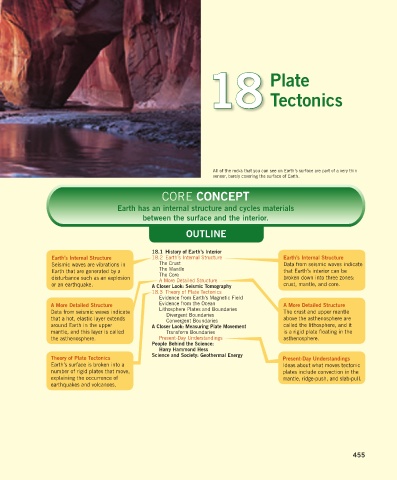
                                                                               All of the rocks that you can see on Earth’s surface are part of a very thin
                                                                               veneer, barely covering the surface of Earth.


                                                              CORE CONCEPT

                                               Earth has an internal structure and cycles materials
                                                       between the surface and the interior.

                                                                      OUTLINE


                                                          18.1  History of Earth’s Interior
                         Earth’s Internal Structure       18.2  Earth’s Internal Structure            Earth’s Internal Structure
                         Seismic waves are vibrations in     The Crust                                Data from seismic waves indicate
                                                             The Mantle
                         Earth that are generated by a                                                that Earth’s interior can be
                                                             The Core
                         disturbance such as an explosion                                             broken down into three zones:
                                                             A More Detailed Structure
                         or an earthquake.                A Closer Look: Seismic Tomography           crust, mantle, and core.
                                                          18.3  Theory of Plate Tectonics
                                                             Evidence from Earth’s Magnetic Field
                         A More Detailed Structure           Evidence from the Ocean                  A More Detailed Structure
                         Data from seismic waves indicate    Lithosphere Plates and Boundaries        The crust and upper mantle
                                                               Divergent Boundaries
                         that a hot, elastic layer extends     Convergent Boundaries                  above the asthenosphere are
                         around Earth in the upper        A Closer Look: Measuring Plate Movement     called the lithosphere, and it
                         mantle, and this layer is called      Transform Boundaries                   is a rigid plate floating in the
                         the asthenosphere.                  Present-Day Understandings               asthenosphere.
                                                          People Behind the Science:
                                                             Harry Hammond Hess
                                                          Science and Society: Geothermal Energy
                         Theory of Plate Tectonics                                                      Present-Day Understandings
                         Earth’s surface is broken into a                                             Ideas about what moves tectonic
                         number of rigid plates that move,                                            plates include convection in the
                         explaining the occurrence of                                                 mantle, ridge-push, and slab-pull.
                         earthquakes and volcanoes.


                                                                                                                             455

