Page 481 - 9780077418427.pdf
P. 481

/Users/user-f465/Desktop
          tiL12214_ch18_455-476.indd Page 458  9/3/10  6:21 PM user-f465
          tiL12214_ch18_455-476.indd Page 458  9/3/10  6:21 PM user-f465                                                /Users/user-f465/Desktop


                                                            Inner core    Mohorovi cic discontinuity, or the “Moho” for short. The bound-
                                                                          ary is a zone where seismic P-waves increase in velocity because
                                                             Outer core   of changes in the composition of the materials. The increase
                                                                          occurs because the composition on both sides of the boundary
                                                                          is different. The mantle is richer in ferromagnesian minerals
                                                                          and poorer in silicon than the crust.
                                                                             Studies of the Moho show that the crust varies in thickness
                                                                          around Earth’s surface. It is thicker under the continents and
                                                                          thinner under the oceans.
                                                                             The age of rock samples from Earth’s continents has been
                                                                          compared with the age samples of rocks taken from the seafloor
                                                                          by oceanographic ships. This sampling has found the continen-
                                                                          tal crust to be much older, with parts up to 3.8 billion years old.
                                                                          By comparison, the oldest oceanic crust is less than 200 million
                                                                          years old.
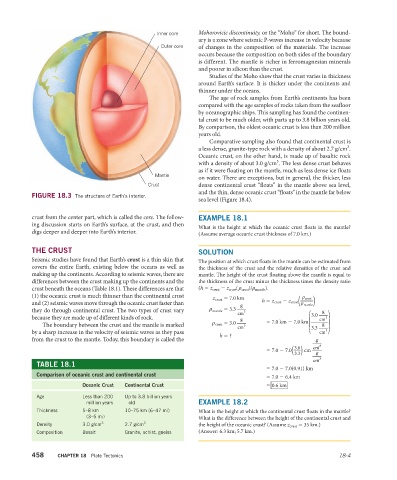
                                                                             Comparative sampling also found that continental crust is
                                                                                                                           3
                                                                          a less dense, granite-type rock with a density of about 2.7 g/cm .
                                                                          Oceanic crust, on the other hand, is made up of basaltic rock
                                                                                                    3
                                                                          with a density of about 3.0 g/cm . The less dense crust behaves
                                                                          as if it were floating on the mantle, much as less dense ice floats
                                                            Mantle
                                                                          on  water. There are exceptions, but in general, the thicker, less
                                                         Crust            dense continental crust “floats” in the mantle above sea level,
                                                                          and the thin, dense oceanic crust “floats” in the mantle far below
                   FIGURE 18.3  The structure of Earth’s interior.
                                                                          sea level (Figure 18.4).

                   crust from the center part, which is called the core. The follow-    EXAMPLE 18.1
                   ing discussion starts on Earth’s surface, at the crust, and then
                                                                          What is the height at which the oceanic crust floats in the mantle?
                   digs deeper and deeper into Earth’s interior.          (Assume average oceanic crust thickness of 7.0 km.)


                   THE CRUST                                              SOLUTION
                   Seismic studies have found that Earth’s crust is a thin skin that   The position at which crust floats in the mantle can be estimated from
                   covers the entire Earth, existing below the oceans as well as   the thickness of the crust and the relative densities of the crust and
                   making up the continents. According to seismic waves, there are   mantle. The height of the crust floating above the mantle is equal to
                   differences between the crust making up the continents and the   the thickness of the crust minus the thickness times the density ratio
                   crust beneath the oceans (Table 18.1). These differences are that   (h = z crust  − z crust ( ρ crust )/ρ mantle ).
                   (1) the oceanic crust is much thinner than the continental crust     z    crust   = 7.0 km  _
                                                                                                              ρ
                                                                                                             crust

                                                                                                           (  ρ
                   and (2) seismic waves move through the oceanic crust faster than    _       h =  z    crust   −  z    crust        mantle  )
                                                                                        g


                   they do through continental crust. The two types of crust vary     ρ    mantle   = 3.3          g
                                                                                                                  _
                                                                                         3
                                                                                       c m                     3.0
                   because they are made up of different kinds of rock.                _                      ( 3.3         )
                                                                                                                    3
                                                                                                               _
                                                                                                                   cm
                                                                                        g
                                                                                                                   g
                      The boundary between the crust and the mantle is marked     ρ    crust   = 3.0           = 7.0 km − 7.0 km      _
                                                                                         3
                                                                                        cm
                                                                                                                    3
                   by a sharp increase in the velocity of seismic waves as they pass                              c m
                                                                                 h = ?
                   from the crust to the mantle. Today, this boundary is called the                             _
                                                                                                                 g

                                                                                                                c m
                                                                                                          3.0 _  _ 3
                                                                                                = 7.0 − 7.0  (    )   cm

                                                                                                                 g
                                                                                                          3.3   _

                                                                                                                c m    3
                    TABLE 18.1
                                                                                                = 7.0 − 7.0(0.91) km
                    Comparison of oceanic crust and continental crust
                                                                                                = 7.0 − 6.4 km
                                    Oceanic Crust   Continental Crust                           = 0.6 km
                    Age            Less than 200    Up to 3.8 billion years
                                      million years      old              EXAMPLE 18.2
                    Thickness       5–8 km        10–75 km (6–47 mi)      What is the height at which the continental crust floats in the mantle?
                                      (3–5 mi)                            What is the difference between the height of the continental crust and
                    Density        3.0 g/cm 3     2.7 g/cm 3              the height of the oceanic crust? (Assume z crust  = 35 km.)
                    Composition     Basalt        Granite, schist, gneiss  (Answer: 6.3 km; 5.7 km.)
                   458     CHAPTER 18 Plate Tectonics                                                                   18-4
   476   477   478   479   480   481   482   483   484   485   486