


Page 482 - 9780077418427.pdf
P. 482
/Users/user-f465/Desktop
          tiL12214_ch18_455-476.indd Page 459  9/3/10  6:21 PM user-f465
          tiL12214_ch18_455-476.indd Page 459  9/3/10  6:21 PM user-f465                                                /Users/user-f465/Desktop


                                                                                                       ★             103 °


                                                                                       P-wave ray paths      Core


                                                                               103 °     P-wave                   P-wave
                                                                                                                     No direct P-waves 103 °
                                                                                         shadow                   shadow
                                                                                   No
                                                                                         zone                     zone

                                                                                    direct P-waves
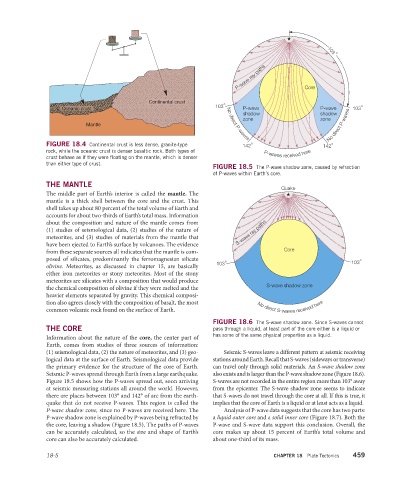
                       FIGURE 18.4  Continental crust is less dense, granite-type        142 °                     142 °
                       rock, while the oceanic crust is denser basaltic rock. Both types of     P-waves received here
                       crust behave as if they were floating on the mantle, which is denser
                       than either type of crust.
                                                                               FIGURE 18.5  The P-wave shadow zone, caused by refraction
                                                                               of P-waves within Earth’s core.
                       THE MANTLE
                                                                                                     Quake
                       The middle part of Earth’s interior is called the mantle. The                   ★
                       mantle is a thick shell between the core and the crust. This
                       shell takes up about 80 percent of the total volume of Earth and
                       accounts for about two-thirds of Earth’s total mass.  Information
                       about the composition and nature of the mantle comes from
                       (1) studies of seismological data, (2) studies of the nature of   S-wave ray paths
                         meteorites, and (3) studies of materials from the mantle that
                       have been ejected to Earth’s surface by volcanoes. The evidence
                       from these separate sources all indicates that the mantle is com-              Core
                       posed of silicates, predominantly the ferromagnesian silicate   103 °                                 103 °
                       olivine. Meteorites, as discussed in chapter 15, are basically
                       either iron meteorites or stony meteorites. Most of the stony
                       meteorites are silicates with a composition that would produce
                       the chemical composition of olivine if they were melted and the          S-wave shadow zone
                       heavier elements separated by gravity. This chemical composi-
                       tion also agrees closely with the composition of basalt, the most     No direct S-waves received here
                       common volcanic rock found on the surface of Earth.

                                                                               FIGURE 18.6  The S-wave shadow zone. Since S-waves cannot
                       THE CORE                                                pass through a liquid, at least part of the core either is a liquid or
                       Information about the nature of the core, the center part of   has some of the same physical properties as a liquid.
                       Earth, comes from studies of three sources of information:
                       (1) seismological data, (2) the nature of meteorites, and (3) geo-  Seismic S-waves leave a different pattern at seismic re ceiving
                       logical data at the surface of Earth. Seismological data provide   stations around Earth. Recall that S-waves (sideways or transverse)
                       the primary evidence for the structure of the core of Earth.   can travel only through solid materials. An S-wave shadow zone
                       Seismic P-waves spread through Earth from a large earthquake.   also exists and is larger than the P-wave shadow zone (Figure 18.6).
                       Figure 18.5 shows how the P-waves spread out, soon arriving   S-waves are not recorded in the entire region more than 103° away
                       at seismic measuring stations all around the world. However,   from the epicenter. The S-wave shadow zone seems to indicate
                       there are places between 103° and 142° of arc from the earth-  that S-waves do not travel through the core at all. If this is true, it
                       quake that do not receive P-waves. This region is called the   implies that the core of Earth is a liquid or at least acts as a liquid.
                       P-wave shadow zone, since no P-waves are received here. The   Analysis of P-wave data suggests that the core has two parts:
                       P-wave shadow zone is explained by P-waves being refracted by   a liquid outer core and a solid inner core (Figure 18.7). Both the
                       the core, leaving a shadow (Figure 18.5). The paths of P-waves   P-wave and S-wave data support this conclusion. Overall, the
                       can be accurately calculated, so the size and shape of Earth’s   core makes up about 15 percent of Earth’s total volume and
                       core can also be accurately calculated.                 about one-third of its mass.

                       18-5                                                                        CHAPTER 18  Plate Tectonics   459

